Topics
Roman Numerals
Number Work
Addition and Subtraction
Multiplication and Division
Fractions
- Types of Fractions
- Concept of Equivalent Fractions
- Like and Unlike Fraction
- Concept of Mixed Fractions
- Concept of Proper and Improper Fractions
- Conversion between Improper and Mixed fraction
- Conversion between Unlike and Like Fractions
- Comparing Fractions
- Addition of Fraction
- Subtraction of Fraction
- Multiplication of Fraction
- Using Operator 'Of' with Multiplication and Division
Angles
Circles
Multiples and Factors
Decimal Fractions
Measuring Time
Problems on Measurement
Perimeter and Area
Three Dimensional Objects and Nets
Pictographs
Patterns
Preparation for Algebra
Maharashtra State Board: Class 5
Inequality
In mathematics, when two expressions do not have the same value, they are not equal. This is represented using the "≠" (not equal to) symbol.
For example:
(7 + 5) ≠ (7 × 5) since 12 ≠ 35
Such representations are called inequalities.
If two expressions are not equal, one must be greater or smaller than the other. To indicate this, we use the symbols “<” (less than) and “>” (greater than).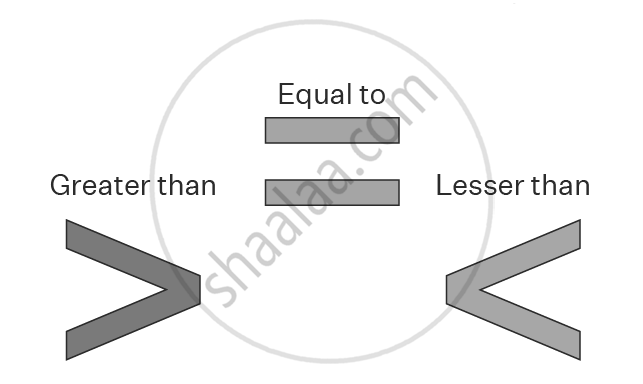
For example:
(9 − 5) = 4, (15 ÷ 3) = 5
Since 4 is less than 5, we write:
(9 − 5) < (15 ÷ 3) or (15 ÷ 3) > (9 − 5)
