Topics
Heredity and Evolution
- Heredity
- Transcription
- Translation
- Translocation
- Mutations
- Evolution
- Evidences of Evolution > Morphological Evidences
- Evidences of Evolution > Anatomical Evidences
- Evidences of Evolution > Vestigial Organs
- Evidences of Evolution > Palaeontological Evidences
- Evidences of Evolution > Connecting Links
- Evidences of Evolution > Embryological Evidences
- Darwin’s Theory of Natural Selection (Darwinism)
- Lamarck’s Theory of Evolution (Lamarckism)
- Speciation
- Human Evolution
- Human Ancestors
- Homo Sapiens Sapiens (Modern Man)
Life Processes in Living Organisms Part -1
- Life Processes in Living Organisms
- Living Organisms and Energy Production
- Glycolysis
- Tricarboxylic Acid Cycle (Citric Acid Cycle or Kreb’s Cycle)
- Phases of Respiration: Electron Transport Chain (Electron Transfer System)
- Production of ATP
- Cellular Respiration
- Energy From Different Food Components
- Cell Division: an Essential Life Process
- Mitosis > Karyokinesis (Division of Nucleus)
- Mitosis > Cytokinesis (Division of Cytoplasm)
- Significance of Mitosis
- Meiosis: Reduction Division
- Stages of Meiosis: Meiosis I
- Stages of Meiosis: Meiosis II
- Significance of Meiosis
- Mitosis Vs Meiosis
Life Processes in Living Organisms Part - 2
- Reproduction
- Asexual Reproduction
- Asexual Reproduction in Unicellular Organisms > Binary Fission
- Binary Fission > Simple Binary Fission
- Binary Fission > Transverse Binary Fission
- Binary Fission > Longitudinal Binary Fission
- Asexual Reproduction in Unicellular Organisms > Multiple Fission
- Asexual Reproduction in Unicellular Organisms > Budding
- Asexual Reproduction in Multicellular Organisms > Fragmentation
- Asexual Reproduction in Multicellular Organisms > Regeneration
- Asexual Reproduction in Multicellular Organisms > Budding
- Vegetative Reproduction or Vegetative Propagation
- Asexual Reproduction in Multicellular Organisms > Spore Formation
- Sexual Reproduction
- Sexual Reproduction in Plants
- Double Fertilization and Triple Fusion
- Pollination
- Seed Germination
- Human Reproduction
- The Male Reproductive System
- The Female Reproductive System
- Gametogenesis
- Fertilization in Humans
- Implantation in Human
- Pregnancy and Embryonic Development
- Parturition (Birth) in Human
- Lactation in Human
- Sex Determination in Humans
- Menstrual Cycle (Ovarian Cycle)
- Major Events of Menstrual Cycle
- In Vitro Fertilization (IVF)
- Surrogacy
- Sperm Bank/ Semen Bank
- The Twins
- Concept of Reproductive Health
- Population Explosion in India
Environmental Management
Towards Green Energy
- Energy and Use of Energy
- Generation of Electrical Energy
- Power Plant Based on Thermal Energy
- Power Plants Based on Nuclear Energy
- Power Plants Based on Natural Gas
- Electric Energy Generation and Environment
- Electricity Generation using Hydroelectric Energy
- Electricity Generation using Wind Energy
- Electricity Generation using Solar Energy
- Solar Photovoltaic Cell
- Solar Thermal Power Plant
Animal Classification
- Classification of Living Organisms
- History of Animal Classification
- Traditional Method of Animal Classification
- Conventional System of Animal Classification
- Criteria for New System of Classification > Grades of Organization
- Criteria for New System of Classification > Body Symmetry
- Criteria for New System of Classification > Germ Layers
- Criteria for New System of Classification > Body Cavity (Coelom)
- Criteria for New System of Classification > Body Segmentation
- Phylum: Porifera
- Phylum: Cnidaria/Coelenterata
- Phylum: Platyhelminthes
- Phylum: Aschelminthes
- Phylum: Annelida
- Phylum: Arthropoda
- Phylum: Mollusca
- Phylum: Echinodermata
- Phylum: Hemichordata
- Phylum: Chordata
- Subphylum: Urochordata
- Subphylum: Cephalochordata
- Subphylum: Vertebrata/Craniata
- Subphylum: Vertebrata/Craniata > Class: Cyclostomata
- Subphylum: Vertebrata/Craniata > Class: Pisces
- Subphylum: Vertebrata/Craniata > Class: Amphibia
- Subphylum: Vertebrata/Craniata > Class: Reptilia
- Subphylum: Vertebrata/Craniata > Class: Aves
- Subphylum: Vertebrata/Craniata > Class: Mammalia
Introduction to Microbiology
- Applied and Industrial Microbiology
- Microbial Role in Dairy Products
- Probiotics
- Yeast and Microbes in Bread Making
- Vinegar Production
- Microbial Enzymes
- Antibiotics
- Microbes and Fuels
- Bio-fuel
- Microbial Pollution Control
- Sewage Management
- Clean Technology
- Microbes and Farming
Cell Biology and Biotechnology
- Cell Biology (Cytology)
- Stem Cells
- Stem Cell Research
- Organ Transplantation
- Organ and Body Donation
- Concept of Biotechnology
- Crop Biotechnology > Hybrid Seeds
- Crop Biotechnology > Genetically Modified Organisms (GMOs)
- Crop Biotechnology > Biofertilizers
- Animal Husbandry (Livestock)
- Human Health
- Vaccination and Immunization
- Edible Vaccines
- Treatment
- Interferons
- Gene Therapy
- Cloning
- Industrial Products/White Biotechnology
- Environment and Biotechnology
- Food Biotechnology
- DNA Fingerprinting
- Green Revolution
- White Revolution
- Blue Revolution
- Fertilizers
- Insecticides
- Types of Farming in India > Organic Farming
- Animal Husbandry (Livestock) > Apiculture (Bee Farming)
- Cultivation of Medicinal Plants
- Processing and Preservation of Fruits
Social Health
Disaster Management
Life's Internal Secrets
- Autotrophic Plants
- Heterotrophic Plants
- Human Digestive System
- Nutrition in Plants
- Transport
The Regulators of Life
The Life Cycle
Mapping Our Genes
Understanding Metals and Non-Metals
Striving for Better Environment 2
- Use of Efficient and Eco-friendly Technology
- Sustainable Use of Resources
- Enforcement of Acts, Laws and Policies
Amazing World of Carbon Compounds
- Introduction
- Role of Endocrine Glands and Hormones
Introduction:
Our body uses chemical substances called hormones to regulate and coordinate various activities. Hormones are produced by special organs called endocrine glands, which are also known as ductless glands because they lack storage or transport systems for their secretions. As soon as hormones are produced, they are directly released into the bloodstream, allowing them to travel to all parts of the body.
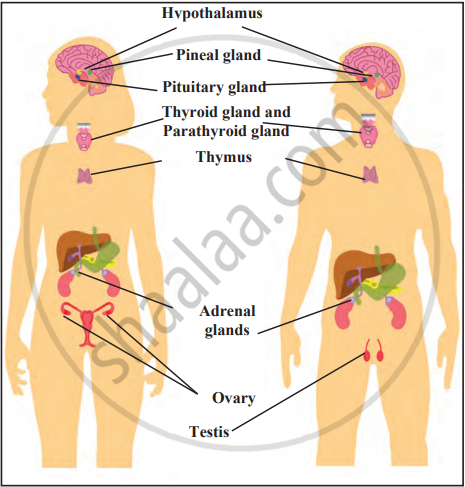
Endocrine glands
Role of Endocrine Glands and Hormones:
The endocrine glands work along with the nervous system to manage the body’s control and coordination. While the nervous system transmits fast and short-lived signals through electrical impulses, hormones act much more slowly but produce long-lasting effects. This makes the endocrine system essential for processes that require sustained regulation, such as growth, metabolism, and reproduction.
Examples of Hormonal Action,
To ensure that hormones are effective, they are secreted only when needed and in the right amounts. There is a built-in mechanism in the body that regulates hormone production. For example:
- When blood sugar levels rise after eating, certain cells in the pancreas are stimulated.
- In response, these cells release a hormone called insulin into the blood.
- Insulin helps lower blood sugar levels by facilitating the absorption of glucose into cells.
This mechanism ensures that the body maintains balance and functions efficiently. Comparison Between Nervous System and Endocrine System:
- Speed: Nerve impulses act quickly, while hormones work more slowly.
- Duration: Effects of nerve impulses are short-lived, but hormonal effects last longer.
- Mode of Action: The nervous system uses electrical signals, whereas hormones are chemical messengers carried by the blood.
