Advertisements
Chapters
▶ 2: Physical Quantities and Measurement
3: Force and Pressure
4: Energy
5: Light Energy
6: Heat Transfer
7: Sound
8: Electricity
![Selina solutions for Concise Physics [English] Class 8 ICSE chapter 2 - Physical Quantities and Measurement - Shaalaa.com](/images/concise-physics-english-class-8-icse_6:53235d1491ff438fb024a108557878b3.jpg "Selina solutions for Concise Physics [English] Class 8 ICSE chapter 2 - Physical Quantities and Measurement")
Advertisements
Solutions for Chapter 2: Physical Quantities and Measurement
Below listed, you can find solutions for Chapter 2 of CISCE Selina for Concise Physics [English] Class 8 ICSE.
Selina solutions for Concise Physics [English] Class 8 ICSE 2 Physical Quantities and Measurement Objective Questions [Pages 33 - 34]
Equal volumes of the two different substances have equal masses.
True
False
The density of a piece of brass will change by changing its size or shape.
True
False
The density of a liquid decreases with increase in its temperature.
True
False
Relative density of water is 1.0.
True
False
Relative density of a substance is expressed in g cm-3.
True
False
When a body is immersed in a liquid, the buoyant force experienced by the body is equal to the volume of the liquid displaced by it.
Ture
False
A body experiences the same buoyant force while floating in water or alcohol.
Ture
False
A body experiences the same buoyant force when it floats or sinks in water.
Ture
False
A body floats in a liquid when its weight becomes equal to the weight of the liquid displaced by its submerged part.
Ture
False
A body while floating sinks deeper in a liquid of low density than in a liquid of high density.
Ture
False
1 kg is the mass of ............ml of water at 4°C.
Mass = density x .........
The S.I. unit of density is ..........
Density of water is .......Kg m-3.
1 g cm-3 = ......... Kg m-3.
The density of a body which sinks in water is ......... than 1000 Kg m-3.
A body sinks in a liquid A but floats in a liquid B. The density of liquid A is ....... than the density of liquid B.
A body X sinks in water, but a body Y floats on water. The density of the body X is ......... than the density of body Y.
The buoyant force experienced by a body when floating in saltwater is ....... to or same that of when floating in pure water.
The weight of a body floating in a liquid is ........
Match the following :
| Column A | Column B | ||
| (a) | kg `m^-3` | (i) | relative density |
| (b) | no unit | (ii) | sinks in alcohol |
| (c) | relative density | (iii) | floats on water |
| (d) | iron | (iv) | density |
| (e) | wood | (v) | density bottle |
The correct relation is
Density = Mass x Volume
Mass = Density x Volume
Volume = Density x Mass
Density = Mass + Volume
The relative density of alcohol is 0.8. Its density is
0.8
800 kg nr3
800 g cm-3
0.8 kg m-3
A block of wood of density 0.8 g cm-3 has a volume of 60 cm3. The mass of block is
60.8 g
75 g
48 g
0.013 g
The density of aluminium is 2.7 g cm-3 and that of brass 8.4 g cm’3. The correct statement is
Equal masses of aluminium and brass have equal volumes
The mass of a certain volume of brass is more than the mass of equal volume of aluminium.
The volume of a certain mass of brass is more than the volume of equal mass of aluminium.
Equal volumes of aluminium and brass have equal masses.
A density bottle has a marking 25 ml on it. It means that:
the mass of density bottle is 25 g
the density bottle will store 25 ml of any liquid in it
the density bottle will store 25 ml of water, but more volume of liquid denser than water.
the density bottle will store 25 ml of water, but more volume of a liquid lighter than water.
The correct statement is
The buoyant force on a body is equal to the volume of the liquid displaced by it ‘
The buoyant force on a body is equal to the volume of the body
The buoyant force on a body is equal to the weight of the liquid displaced by it
The buoyant force on a body is always equal to the weight of the body.
A piece of wood floats on water. The buoyant force on wood will be
zero
more than the weight of the wood piece
equal to the weight of the wood piece
less than the weight of the wood piece.
The weight of a body is more than the buoyant force experienced by it, due to a liquid. The body will
sink
float with its some part outside the liquid
float just below the surface of liquid
float with whole of its volume above the surface of liquid.
Selina solutions for Concise Physics [English] Class 8 ICSE 2 Physical Quantities and Measurement Short/Long Answer Questions [Pages 34 - 35]
Define the term Density of a substance.
Name the S.I. unit of density. How is it related to g Cm-3?
The density of brass is 8.4 g cm-3. What do you mean by this statement?
Arrange the following substances in order of their increasing density:
Iron, Cork, Brass, Water, Mercury.
How does the density of a liquid (or gas) vary with temperature?
A given quantity of a liquid is heated. Which of the following quantity will vary and how?
(a) mass, (b) volume and (c) density
Describe an experiment to determine the density of the material of a coin.
Describe an experiment to determine the density of a liquid.
What is a density bottle? How is it used to find the density of a liquid?
Define the term relative density of a substance.
What is the unit of relative density?
Distinguish between density and relative density.
Explain the meaning of the statement
‘Relative density of aluminium is 2.7’.
How does the density of a body and that of a liquid determine whether the body will float or sink into that liquid?
A cork piece floats on water surface while an iron nail sinks in it. Explain the reason.
Which of the following will sink or float on water? (Density of water = 1 g Cm-3)
(a) body A having density of 500 kg m-3
Which of the following will sink or float on water? (Density of water = 1 g Cm-3) body B having density 2520 kg m-3
Which of the following will sink or float on water? (Density of water = 1 g Cm-3)
body C having density 1100 kg m-3
Which of the following will sink or float on water? (Density of water = 1 g Cm-3)
body D having density 0.85 g m-3
What is the law of floatation?
The density of water is 1.0 g Cm-3. The density of iron is 7.8 × 10″3 g Cm-3. The density of mercury is 13.6 g Cm-3.
Ans the following:
Will a piece of iron float or sink in water?
The density of water is 1.0 g Cm-3. The density of iron is 7.8 × 10″3 g Cm-3. The density of mercury is 13.6 g Cm-3.
Answer the following:
Will a piece of iron float or sink in mercury?
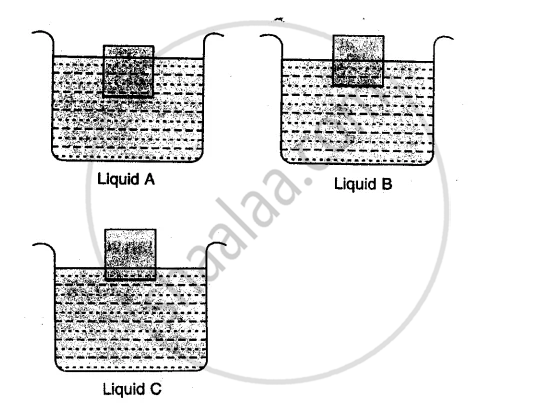
The diagram given below show a body floating in three different liquids. A, B and C at different levels.
(a) In which liquid does the body experience the greatest buoyant force?
(b) Which liquid has the least density?
(c) Which liquid has the highest density?
For a floating body, how is its weight related to the buoyant force?
Why does a piece of ice float on water?
Explain why an iron needle sinks in water, but a ship made of iron floats on water.
It is easier to swim in sea water than in river water. Explain the reason.
Icebergs floating on sea water are dangerous for ships. Explain the reason.
Explain why it is easier to lift a stone under water than in air.
What is a submarine? How can it be made to dive in water and come to the surface of water?
A balloon filled with hydrogen rises in air. Explain the reason.
Selina solutions for Concise Physics [English] Class 8 ICSE 2 Physical Quantities and Measurement Numericals [Pages 35 - 36]
The density of air is 1.28 g/Iitre. Express it in g cm-3
The density of air is 1.28 g/Iitre. Express it in kg m-3
The dimensions of a hall are 10 m × 7 m × 5 m. If the density of air is 1.11 kg m-3, find the mass of air in the hall.
The density of aluminium is 2.7 g cm3. Express it in kg m−3.
The density of alcohol is 600 kg m-3. Express it in g Cm-3.
A piece of zinc of mass 438.6 g has a volume of 86 cm3. Calculate the density of zinc.
A piece of wood of mass 150 g has a volume of 200 Cm3. Find the density of wood in C.GS. unit and S.I. unit.
Calculate the volume of wood of mass 6000 kg if the density of wood is 0.8 g Cm-3
Calculate the density of solid from the following data :
(a) Mass of solid = 72 g
(b) Initial volume of water in measuring cylinder = 24 ml
(c) Final volume of water when solid is completely immersed in water = 42 ml
The mass of an empty density bottle is 21.8 g when filled completely with water is 41.8 g and when filled completely with liquid it is 40.6 g. Find
- the volume of density bottle.
- the relative density of liquid.
From the following observations, calculate the density and relative density of a brine solution.
Mass of empty density bottle = 22 g
Mass of bottle + water = 50 g
Mass of bottle + brine solution = 54 g
The mass of an empty density bottle is 30 g, it is 75 g when filled completely with water and 65 g when filled completely with a liquid. Find volume of density bottle.
The mass of an empty density bottle is 30 g, it is 75 g when filled completely with water and 65 g when filled completely with a liquid. Find density of liquid.
The mass of an empty density bottle is 30 g, it is 75 g when filled completely with water and 65 g when filled completely with a liquid. Find relative density of liquid.
Solutions for 2: Physical Quantities and Measurement
Selina solutions for Concise Physics [English] Class 8 ICSE chapter 2 - Physical Quantities and Measurement
Shaalaa.com has the CISCE Mathematics Concise Physics [English] Class 8 ICSE CISCE solutions in a manner that help students grasp basic concepts better and faster. The detailed, step-by-step solutions will help you understand the concepts better and clarify any confusion. Selina solutions for Mathematics Concise Physics [English] Class 8 ICSE CISCE 2 (Physical Quantities and Measurement) include all questions with answers and detailed explanations. This will clear students' doubts about questions and improve their application skills while preparing for board exams.
Further, we at Shaalaa.com provide such solutions so students can prepare for written exams. Selina textbook solutions can be a core help for self-study and provide excellent self-help guidance for students.
Concepts covered in Concise Physics [English] Class 8 ICSE chapter 2 Physical Quantities and Measurement are Density of a Substance in Its Different States, Measurement of Relative Density, Buoyancy Force (Upthrust Force), Principle of Floatation (Laws of Flotation), Law of Floatation, Applications of Floatation, Density and It’s Unit, Determination of Density of a Regular Solid, Vessels for Measuring the Volume, Determination of Density of an Irregular Solid, Measurement of Density, Determination of Density of a Liquid, Determination of Density of a Liquid Using the Density Bottle, Relative Density and Its Unit, Measurement of Relative Density of a Liquid.
Using Selina Concise Physics [English] Class 8 ICSE solutions Physical Quantities and Measurement exercise by students is an easy way to prepare for the exams, as they involve solutions arranged chapter-wise and also page-wise. The questions involved in Selina Solutions are essential questions that can be asked in the final exam. Maximum CISCE Concise Physics [English] Class 8 ICSE students prefer Selina Textbook Solutions to score more in exams.
Get the free view of Chapter 2, Physical Quantities and Measurement Concise Physics [English] Class 8 ICSE additional questions for Mathematics Concise Physics [English] Class 8 ICSE CISCE, and you can use Shaalaa.com to keep it handy for your exam preparation.
