Advertisements
Advertisements
प्रश्न
Define the term relative density of a substance.
Advertisements
उत्तर
RELATIVE DENSITY: “is the ratio of the density of a substance to the density of water at 4° C.”
Or
RELATIVE DENSITY “is the ratio of the mass of the substance to the mass of an equal volume of water at 4° C.”
APPEARS IN
संबंधित प्रश्न
A body floats in a liquid when its weight becomes equal to the weight of the liquid displaced by its submerged part.
Which of the following will sink or float on water? (Density of water = 1 g Cm-3)
body C having density 1100 kg m-3
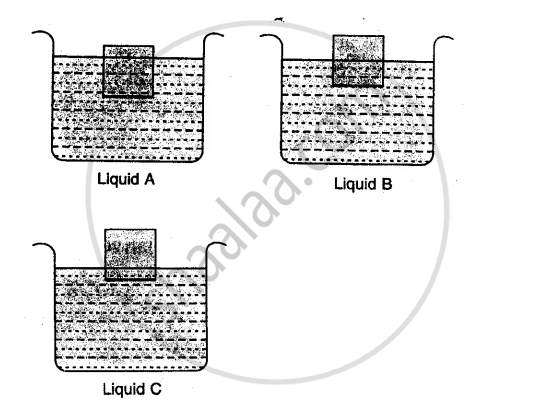
The diagram given below show a body floating in three different liquids. A, B and C at different levels.
(a) In which liquid does the body experience the greatest buoyant force?
(b) Which liquid has the least density?
(c) Which liquid has the highest density?
Explain the following statement:
It is easier to cut with a sharp knife than with a blunt one.
How does the liquid pressure on a diver change if :
The diver moves horizontally?
What is the cause of upthrust? At which point can it be considered to act?
A block of wood is floating on water with its dimensions 50 cm x 50 cm x 50 cm inside water. Calculate the buoyant force acting on the block. Take g = 9.8 N kg-1.
What is the centre of buoyancy? State its position for a floating body with respect to the centre of gravity of the body.
A beaker contains a liquid of density ‘ρ’ up to height ‘h’ such that ‘PA’ is atmospheric pressure and ‘g’ is the acceleration due to gravity. Answer the following questions:
- What is the pressure on the free surface of the liquid?
- What is the pressure on the base of the beaker?
- What is the lateral pressure at the base on the inner walls of the beaker?
The magnitude of buoyant force acting on an object immersed in a liquid depends on ______ of the liquid.
