Please select a subject first
Advertisements
Advertisements
The stopping potential in a photoelectric experiment is linearly related to the inverse of the wavelength (1/λ) of the light falling on the cathode. The potential difference applied across an X-ray tube is linearly related to the inverse of the cutoff wavelength (1/λ) of the X-ray emitted. Show that the slopes of the lines in the two cases are equal and find its value.
(Use Planck constant h = 6.63 × 10⁻³⁴ Js= 4.14 × 10⁻¹⁵ eVs, speed of light c = 3 × 10⁸ m/s.)
Concept: undefined >> undefined
Suppose a monochromatic X-ray beam of wavelength 100 pm is sent through a Young's double slit and the interference pattern is observed on a photographic plate placed 40 cm away from the slit. What should be the separation between the slits so that the successive maxima on the screen are separated by a distance of 0.1 mm?
Concept: undefined >> undefined
Advertisements
Continuous X-rays are made to strike a tissue paper soaked with polluted water. The incoming X-rays excite the atoms of the sample by knocking out the electrons from the inner shells. Characteristic X-rays are analysed and the intensity is plotted against the wavelength. Assuming that only Kα intensities are detected, list the elements present in the sample from the plot. Use Moseley's equation v − (25 × 1014Hz)(Z − 1)2.
(Use Planck constant h = 6.63 × 10⁻³⁴ Js= 4.14 × 10⁻¹⁵ eVs, speed of light c = 3 × 10⁸ m/s.)
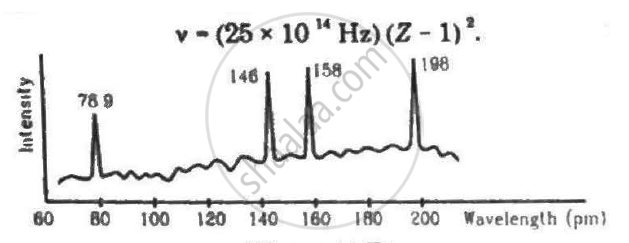
Concept: undefined >> undefined
A molecule of hydrogen contains two protons and two electrons. The nuclear force between these two protons is always neglected while discussing the behaviour of a hydrogen molecule. Why?
Concept: undefined >> undefined
How will the thermionic current vary if the filament current is increased?
Concept: undefined >> undefined
Would you prefer a material with a high melting point or a low melting point to be used as a cathode in a diode?
Concept: undefined >> undefined
Would you prefer a material with a high work-function or a low work-function to be used as a cathode in a diode?
Concept: undefined >> undefined
An isolated metal sphere is heated to a high temperature. Will it become positively charged due to thermionic emission?
Concept: undefined >> undefined
A diode value is connected to a battery and a load resistance. The filament is heated, so that a constant current is obtained in the circuit. As the cathode continuously emits electrons, does it become more and more positively charged?
Concept: undefined >> undefined
Why does thermionic emission not take place in non-conductors?
Concept: undefined >> undefined
The cathode of a diode valve is replaced by another cathode of double the surface area. Keeping the voltage and temperature conditions the same, will the place current decrease, increase or remain the same?
Concept: undefined >> undefined
Let i0 be the thermionic current from a metal surface when the absolute temperature of the surface is T0. The temperature is slowly increased and the thermionic current is measured as a function of temperature. Which of the following plots may represent the variation in (i/i0) against (T/T0)?
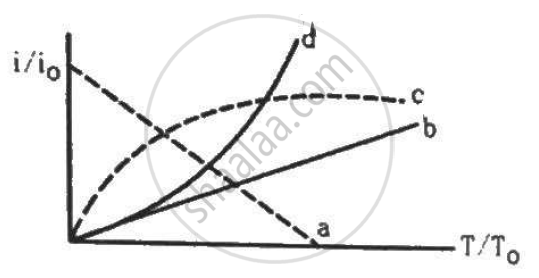
Concept: undefined >> undefined
The anode of a thermionic diode is connected to the negative terminal of a battery and the cathode to its positive terminal.
Concept: undefined >> undefined
The constant A in the Richardson−Dushman equation for tungsten is 60 × 104 A m−2K−2. The work function of tungsten is 4.5 eV. A tungsten cathode with a surface area 2.0 × 10⁻⁵ m2 is heated by a 24 W electric heater. In steady state, the heat radiated by the heater and the cathode equals the energy input by the heater and the temperature becomes constant. Assuming that the cathode radiates like a blackbody, calculate the saturation current due to thermions. Take Stefan's Constant = 6 × 10⁻⁸ W m−2 K−1. Assume that the thermions take only a small fraction of the heat supplied.
Concept: undefined >> undefined
Explain the terms : Transmitter in communication system
Concept: undefined >> undefined
Why are coils of electric toasters and electric irons made of an alloy rather than a pure metal?
Concept: undefined >> undefined
Asha's mother read an article in the newspaper about a disaster that took place at Chernobyl. She could not understand much from the articles and asked a few questions from Asha regarding the article. Asha tried to answer her mother's questions based on what she learnt in Class XII Physics.
(a) What was the installation at Chernobyl where the disaster took place? What according to you, was the cause of this disaster?
(b) Explain the process of release of energy in the installation at Chernobyl.
(c) What according to you, were the values displayed by Asha and her mother?
Concept: undefined >> undefined
The wavefronts of a light wave travelling in vacuum are given by x + y + z = c. The angle made by the direction of propagation of light with the X-axis is _________ .
Concept: undefined >> undefined
The wavefronts of light coming from a distant source of unknown shape are nearly _________ .
Concept: undefined >> undefined
Calculate the electric field in a copper wire of cross-sectional area 2.0 mm2 carrying a current of 1 A.
The resistivity of copper = 1.7 × 10⁻⁸ Ω m
Concept: undefined >> undefined
