Please select a subject first
Advertisements
Advertisements
Find the sum of all odd natural numbers less than 50.
Concept: undefined >> undefined
Find the sum of first 12 natural numbers each of which is a multiple of 7.
Concept: undefined >> undefined
Advertisements
Find the sum of first 51 terms of an A.P. whose 2nd and 3rd terms are 14 and 18 respectively.
Concept: undefined >> undefined
The first term of an A.P. is 5, the last term is 45 and the sum of its terms is 1000. Find the number of terms and the common difference of the A.P.
Concept: undefined >> undefined
Find the sum of all natural numbers between 250 and 1000 which are divisible by 9.
Concept: undefined >> undefined
The first and the last terms of an A.P. are 34 and 700 respectively. If the common difference is 18, how many terms are there and what is their sum?
Concept: undefined >> undefined
In an A.P. the first term is 25, nth term is –17 and the sum of n terms is 132. Find n and the common difference.
Concept: undefined >> undefined
If the 8th term of an A.P. is 37 and the 15th term is 15 more than the 12th term, find the A.P. Also, find the sum of first 20 terms of A.P.
Concept: undefined >> undefined
Find the sum of all multiples of 7 lying between 300 and 700.
Concept: undefined >> undefined
The sum of n natural numbers is 5n2 + 4n. Find its 8th term.
Concept: undefined >> undefined
The fourth term of an A.P. is 11 and the eighth term exceeds twice the fourth term by 5. Find the A.P. and the sum of first 50 terms.
Concept: undefined >> undefined
Construct a triangle ABC, in which AB = 4.2 cm, BC = 6.3 cm and AC = 5 cm. Draw perpendicular bisector of BC which meets AC at point D. Prove that D is equidistant from B and C.
Concept: undefined >> undefined
In each of the given figures; PA = PB and QA = QB.
| i. |  |
| ii. | 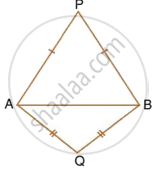 |
Prove, in each case, that PQ (produce, if required) is perpendicular bisector of AB. Hence, state the locus of the points equidistant from two given fixed points.
Concept: undefined >> undefined
Construct a right angled triangle PQR, in which ∠Q = 90°, hypotenuse PR = 8 cm and QR = 4.5 cm. Draw bisector of angle PQR and let it meets PR at point T. Prove that T is equidistant from PQ and QR.
Concept: undefined >> undefined
In parallelogram ABCD, side AB is greater than side BC and P is a point in AC such that PB bisects angle B. Prove that P is equidistant from AB and BC.
Concept: undefined >> undefined
In triangle LMN, bisectors of interior angles at L and N intersect each other at point A. Prove that:
- Point A is equidistant from all the three sides of the triangle.
- AM bisects angle LMN.
Concept: undefined >> undefined
Use ruler and compasses only for this question.
- Construct ΔABC, where AB = 3.5 cm, BC = 6 cm and ∠ABC = 60°.
- Construct the locus of points inside the triangle which are equidistant from BA and BC.
- Construct the locus of points inside the triangle which are equidistant from B and C.
- Mark the point P which is equidistant from AB, BC and also equidistant from B and C. Measure and record the length of PB.
Concept: undefined >> undefined
The given figure shows a triangle ABC in which AD bisects angle BAC. EG is perpendicular bisector of side AB which intersects AD at point F.
Prove that:

F is equidistant from A and B.
Concept: undefined >> undefined
The given figure shows a triangle ABC in which AD bisects angle BAC. EG is perpendicular bisector of side AB which intersects AD at point F.
Prove that:

F is equidistant from AB and AC.
Concept: undefined >> undefined
The bisectors of ∠B and ∠C of a quadrilateral ABCD intersect each other at point P. Show that P is equidistant from the opposite sides AB and CD.
Concept: undefined >> undefined
