Advertisements
Advertisements
प्रश्न
The bisectors of ∠B and ∠C of a quadrilateral ABCD intersect each other at point P. Show that P is equidistant from the opposite sides AB and CD.
Advertisements
उत्तर

Since P lies on the bisector of angle B,
Therefore, P is equidistant from AB and BC ...(1)
Similarly, P lies on the bisector of angle C,
Therefore, P is equidistant from BC and CD ...(2)
From (1) and (2),
Hence, P is equidistant from AB and CD.
संबंधित प्रश्न
Draw a line AB = 6 cm. Draw the locus of all the points which are equidistant from A and B.
Draw an angle ABC = 75°. Draw the locus of all the points equidistant from AB and BC.
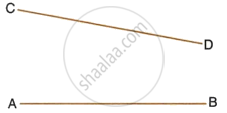
In the figure given below, find a point P on CD equidistant from points A and B.
Describe the locus of a runner, running around a circular track and always keeping a distance of 1.5 m from the inner edge.
Describe the locus of the door handle, as the door opens.
Describe the locus of the centres of all circles passing through two fixed points.
Describe the locus of points at distances less than or equal to 2.5 cm from a given point.
In a quadrilateral PQRS, if the bisectors of ∠ SPQ and ∠ PQR meet at O, prove that O is equidistant from PS and QR.
In Fig. AB = AC, BD and CE are the bisectors of ∠ABC and ∠ACB respectively such that BD and CE intersect each other at O. AO produced meets BC at F. Prove that AF is the right bisector of BC.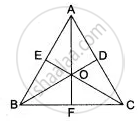
Given: ∠BAC, a line intersects the arms of ∠BAC in P and Q. How will you locate a point on line segment PQ, which is equidistant from AB and AC? Does such a point always exist?
