Advertisements
Advertisements
प्रश्न
Construct a triangle ABC, with AB = 7 cm, BC = 8 cm and ∠ABC = 60°. Locate by construction the point P such that:
- P is equidistant from B and C.
- P is equidistant from AB and BC.
- Measure and record the length of PB.
Advertisements
उत्तर

Steps of construction:
-
- Draw a line segment AB = 7 cm.
- Draw angle ∠ABC = 60° with the help of a compass.
- Cut off BC = 8 cm.
- Join A and C.
- The triangle ABC so formed is the required triangle.
- Draw the perpendicular bisector of BC. The point situated on this line will be equidistant from B and C.
- Draw the angle bisector of ∠ABC. Any point situated on this angular bisector is equidistant from lines AB and BC.
The point that fulfills the condition required in i. and ii. is the intersection point of the bisector of line BC and the angular bisector of ∠ABC.
P is the required point, which is equidistant from AB and AC as well as from B and C.
On measuring the length of line segment PB, it is equal to 4.5 cm.
APPEARS IN
संबंधित प्रश्न
Draw an angle ABC = 75°. Draw the locus of all the points equidistant from AB and BC.
In the figure given below, find a point P on CD equidistant from points A and B.
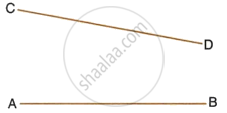
Describe the locus for questions 1 to 13 given below:
1. The locus of a point at a distant 3 cm from a fixed point.
Describe the locus of the moving end of the minute hand of a clock.
Describe the locus of the door handle, as the door opens.
Describe the locus of the centres of all circles passing through two fixed points.
Describe the locus of a point in rhombus ABCD, so that it is equidistant from
- AB and BC;
- B and D.
By actual drawing obtain the points equidistant from lines m and n; and 6 cm from a point P, where P is 2 cm above m, m is parallel to n and m is 6 cm above n.
In a quadrilateral PQRS, if the bisectors of ∠ SPQ and ∠ PQR meet at O, prove that O is equidistant from PS and QR.
The bisectors of ∠B and ∠C of a quadrilateral ABCD intersect in P. Show that P is equidistant from the opposite sides AB and CD.
