Advertisements
Advertisements
Look at the figure given below. It is a section of human kidney as seen from the front.
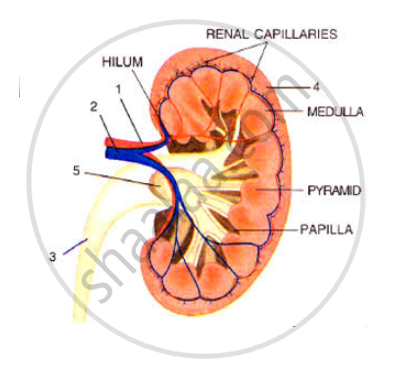
Which area/part (give its name and number given on the diagram) which contains the following:
(i) Malpighian capsule
(ii) The pyramids
(iii) Freshly collected urine
Concept: undefined >> undefined
The following diagram represents a mammalian kidney tubule (nephron) and its blood supply.
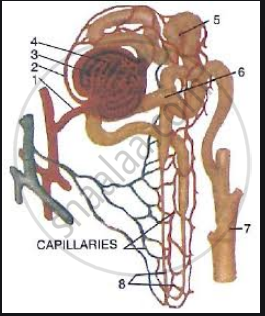
Parts indicated by the guidelines 1to 8 are as follows:
1. Afferent arteriole from renal artery
2. Efferent arteriole
3. Bowman's capsule
4. Glomerulus
5. Proximal convoluted tubule with blood capillaries
6. Distal convoluted tubule with blood capillaries
7. Collecting tubule
8. U-shaped loop of Henle
Study the diagram and answer the question that follow:
Which structure contains the lowest concentration of urea?
Concept: undefined >> undefined
Advertisements
The following diagram represents a mammalian kidney tubule (nephron) and its blood supply.
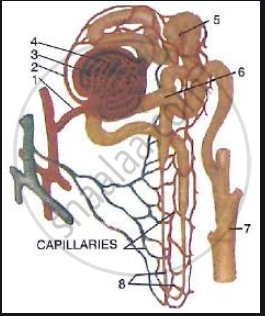
Parts indicated by the guidelines 1to 8 are as follows:
1. Afferent arteriole from renal artery
2. Efferent arteriole
3. Bowman's capsule
4. Glomerulus
5. Proximal convoluted tubule with blood capillaries
6. Distal convoluted tubule with blood capillaries
7. Collecting tubule
8. U-shaped loop of Henle
Study the diagram and answer the question that follow:
Which structure contains the highest concentration of urea?
Concept: undefined >> undefined
The following diagram represents a mammalian kidney tubule (nephron) and its blood supply.
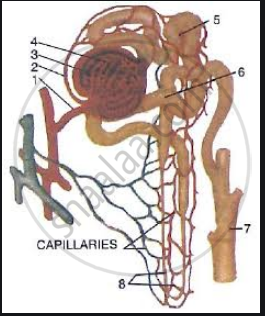
Parts indicated by the guidelines 1to 8 are as follows:
1. Afferent arteriole from renal artery
2. Efferent arteriole
3. Bowman's capsule
4. Glomerulus
5. Proximal convoluted tubule with blood capillaries
6. Distal convoluted tubule with blood capillaries
7. Collecting tubule
8. U-shaped loop of Henle
Study the diagram and answer the question that follow:
Which structure (normally) contains the lowest concentration of glucose?
Concept: undefined >> undefined
The following diagram represents a mammalian kidney tubule (nephron) and its blood supply.
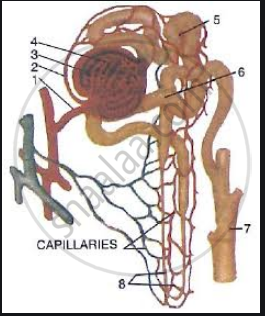
Parts indicated by the guidelines 1to 8 are as follows:
1. Afferent arteriole from renal artery
2. Efferent arteriole
3. Bowman's capsule
4. Glomerulus
5. Proximal convoluted tubule with blood capillaries
6. Distal convoluted tubule with blood capillaries
7. Collecting tubule
8. U-shaped loop of Henle
Study the diagram and answer the question that follow:
Where is most water reabsorbed ?
Concept: undefined >> undefined
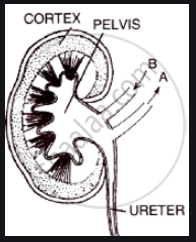
Given below is a highly simplified diagram of the human kidney cut open longitudinally. Answer the question that follow:
Name the functional units of the kidneys.
Concept: undefined >> undefined
Given below is a highly simplified diagram of the human kidney cut open longitudinally. Answer the question that follow:
Why does the cortex of the kidney show a dotted appearance?

Concept: undefined >> undefined
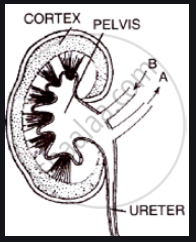
Given below is a highly simplified diagram of the human kidney cut open longitudinally. Answer the question that follow:
Mention two functions of the kidney.
Concept: undefined >> undefined
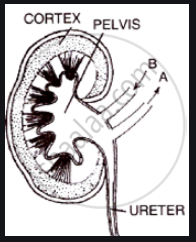
Given below is a highly simplified diagram of the human kidney cut open longitudinally. Answer the question that follow:
Write two differences in composition of the blood flowing through the blood vessels, 'A' and 'B'.
Concept: undefined >> undefined
Study the diagram given alongside and then answer the question that follow:
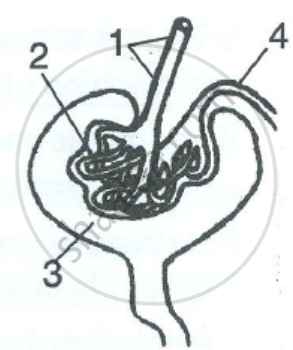
Name the parts labelled 1, 2, 3, and 4.
Concept: undefined >> undefined
Study the diagram given alongside and then answer the question that follow:
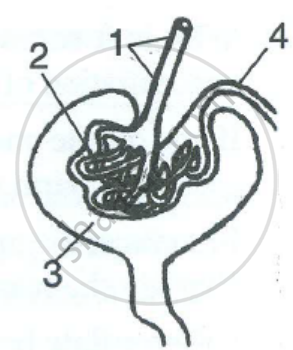
Name the stages involved in the formation of urine.
Concept: undefined >> undefined
Study the diagram given alongside and then answer the question that follow:
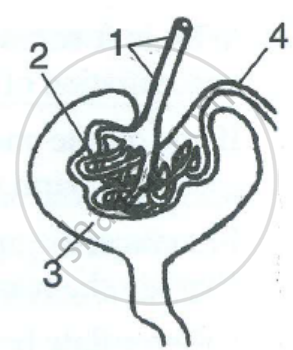
What is the technical term given to the process occurring in 2 and 3? Briefly describe the process.
Concept: undefined >> undefined
A complete ring of bark was removed from a tree in spring. The tree continued to live through summer but a swelling appeared on the bark above the ring while the bark below shriveled up. Answer the questions given below :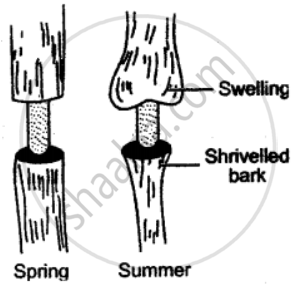
(i) Account for the swelling in the bark above the ring.
(ii) Account for the shrinking of the bark below the ring.
(iii) Name the tissue that distributes food in plants.
(iv) Name the tissue that distributes water in plants.
(v) What is the role of a bark in a plant?
Concept: undefined >> undefined
Explain the functioning of kidney.
Concept: undefined >> undefined
Differentiate between:
The Renal artery and the Renal vein.
Concept: undefined >> undefined
Differentiate between:
Renal cortex and Renal medulla.
Concept: undefined >> undefined
Differentiate between:
Ureter and Urethra.
Concept: undefined >> undefined
Study the diagram given below and then answer the questions that follow:
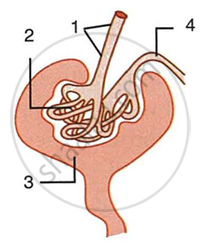 |
- Name the region in the kidney where the above structure is present?
- Name the parts labelled 1, 2, 3 and 4.
- Name the stages involved in the formation of urine.
- What is the technical term given to the process occurring in 2 and 3? Briefly describe the process.
Concept: undefined >> undefined
The diagram below represents a mammalian kidney tubule (nephron) and its blood supply. Parts indicated by the guidelines 1 to 8 are as follows:
1. U-shaped loop of Henle
2. Proximal convoluted tubule with blood capillaries
3. Bowman’s capsule
4. Afferent arteriole from the renal artery
5. Glomerulus
6. Venule to the renal vein
7. Collecting tubule
8. Distal convoluted tubule with blood capillaries Study the diagram and answer the following questions in each case:
(i) Where does ultrafiltration take place?
(ii) Which structure contains the lowest concentration of urea?
(iii) Which structure contains the highest concentration of urea?
(iv) Which structure contains the lowest concentration of glucose?
(v) Where is the most water reabsorbed?
Concept: undefined >> undefined
Given below is a simple diagram of the human kidney cut open longitudinally. Answer the following questions: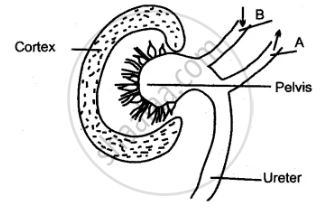
c
(v) Write two differences in the composition of the blood flowing through blood vessels A and B.
Concept: undefined >> undefined
