Advertisements
Advertisements
What is meant by 'reflection of light'?
Concept: undefined >> undefined
Define the following terms used in the study of reflection of light by drawing a labelled ray-diagram:
- Incident ray
- Point of incidence
- Normal
- Reflected ray
- Angle of incidence
- Angle of reflection
Concept: undefined >> undefined
Advertisements
State and explain the laws of reflection of light at a plane surface (like a plane mirror), With the help of a labelled ray-diagram. Mark the angles of 'incidence' and 'reflection' clearly on the diagram. If the angle of reflection is 47.5°, what will be the angle of incidence?
Concept: undefined >> undefined
With the help of a labelled ray-diagram, describe how a plane mirror forms an image of a point source of light placed in front of it. State the characteristics of the image formed in a plane mirror.
Concept: undefined >> undefined
Explain why, though both a plane mirror and a sheet of paper reflect light but we can see the image of our face in a plane mirror but not in a sheet of paper.
Concept: undefined >> undefined
The image in a plane mirror is virtual and laterally inverted. What does this statement mean?
Concept: undefined >> undefined
Write all the capital letters of the alphabet which look the same in a plane mirror.
Concept: undefined >> undefined
The angle of reflection is equal to the angle of incidence:
(a) always
(b) sometimes
(c) under special conditions
(d) never
Concept: undefined >> undefined
The image of an object formed by a plane mirror is:
(a) virtual
(b) real
(c) diminished
(d) upside-down
Concept: undefined >> undefined
The image formed by a plane mirror is :
(a) virtual, behind the mirror and enlarged.
(b) virtual, behind the mirror and of the same size as the object.
(c) real, at the surface of the mirror and enlarged.
(d) real, behind the mirror and of the same size as the object.
Concept: undefined >> undefined
The figure given alongside shows the image of a clock as seen in a plane mirror. The correct time is:
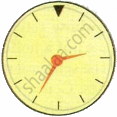
Concept: undefined >> undefined
A man stands 10 m in front of a large plane mirror. How far must the walk before he is 5 m away from his image?
Concept: undefined >> undefined
An object is placed 20 cm in front of a plane mirror. The mirror is moved 2 cm towards the object. The distance between the positions of the positions of the original and final images seen in the mirror is ______.
Concept: undefined >> undefined
A man sits in an optician's chair looking into plane mirror which is 2 m away from him and views the image of a chart which faces the mirror and is 50 cm behind his head. How far away from his eyes does the chart appear to be?
Concept: undefined >> undefined
A ray of light strikes a plane mirror PQ at an angle of incidence of 30°, is reflected from the plane mirror and then strikes a second plane mirror QR placed at right angles to the first mirror. The angle of reflection at the second mirror is ______.
Concept: undefined >> undefined
Explain how to read the following message which was found on some blotting paper:

Concept: undefined >> undefined
If a ray of light goes from a rarer medium to a denser medium, will it bend towards the normal or away from it?
Concept: undefined >> undefined
If a ray of light goes form a denser medium to a rarer medium, will it bend towards the normal or away from the normal?
Concept: undefined >> undefined
A ray of light travelling in glass emerges into air. State whether it will bend towards the normal or away from the normal.
Concept: undefined >> undefined
A ray of light goes from water into air. Will it bend towards the normal or away from the normal?
Concept: undefined >> undefined
