Please select a subject first
Advertisements
Advertisements
Explain ‘Electric generator’ with the help of the following points:
- Diagram of an AC Generator with labelling
- Principle of an electric generator
- The function of slip rings
- Any two uses of a generator.
Concept: Alternating current (AC) and Direct Current (DC)
Answer the following question:
what is the heating effect of the electric current? state any four applications of it?
Concept: Heating Effect of Electric Current
Answer the following question:
State the effect on the magnetic needle in Oersted’s experiment when:
(a) the current is passed through the wire.
(b) the current through the wire is increased
(c) the current through the wire is reversed.
Concept: Introduction to Magnetic Effect of Current
Choose the correct option:
A conductor rod of length (l) is moving with velocity (v) in a direction normal to a uniform magnetic field (B). What will be the magnitude of induced emf produced between the ends of the moving conductor?
Concept: Introduction to Electromagnetic Induction
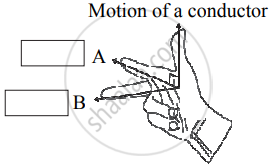
Observe the given figure of Fleming’s Right Hand Rule and write the labels of A and B correctly.
Concept: Introduction to Electromagnetic Induction
Read the given passage and answer the following questions:
The home electrical connection consists of ‘live’, ‘neutral’ and ‘earth’ wires. The ‘live’ and the ‘neutral’ wires have potential difference of 220 V. The ‘earth’ is connected to ground. Due to a fault in the equipment or if the plastic coating on the ‘live’ and the ‘neutral’ wires gives a way the two wires come in contact with each other and a large current flows through it producing heat. If any inflammable material (such as wood, cloth, plastic, etc.) exists around that place it can catch fire. Therefore a fuse wire is used as a precautionary measure.
- Name the two wires having potential difference of 220 V.
- What is a short circuit?
- Write the function of a fuse.
Concept: Introduction to Magnetic Effect of Current
The unit of electrical power is _______.
Concept: Electric Circuit
The right-hand thumb rule is also called _______ rule.
Concept: Introduction to Electromagnetic Induction
Which of the following scientist invented the rule of electromagnetic induction?
Concept: Introduction to Electromagnetic Induction
Alternating current : oscillatory :: Direct current : _______
Concept: Alternating current (AC) and Direct Current (DC)
Write two devices based on the heating effect of electric current.
Concept: Heating Effect of Electric Current
Match the columns.
| Column A | Column B |
| 1) Direct current | a) Oscillatory |
| 2) Alternating current | b) Non oscillatory |
Concept: Alternating current (AC) and Direct Current (DC)
Distinguish between Direct current and alternating current.
Concept: Alternating current (AC) and Direct Current (DC)
Explain the importance/uses of fuse wire.
Concept: Heating Effect of Electric Current
Explain the application of heating effect of electric current in an electric bulb with a diagram.
Concept: Heating Effect of Electric Current
Observe the given figure of Fleming's Left Hand Rule and write the labels of 'A' and 'B':

Concept: Force on a Current-Carrying Conductor Placed in a Uniform Magnetic Field
If 220 V potential difference is applied across an electric bulb, a current of 0.45 A flows in the bulb. What must be the power of the bulb?
Concept: Heating Effect of Electric Current
Answer the following questions based on the given graph.

- Identify which curve shows AC and DC.
- What is the frequency of AC and DC?
Concept: Alternating current (AC) and Direct Current (DC)
Tara, after completing her exams, went to her grandmother's house along with her younger brother Rahul. One day, Rahul came home after playing and switched on the fan and air conditioner. At the same time, his grandmother was preparing a milkshake for him using a mixer. Suddenly, they heard a big sound and the electricity of the house got shut down. Tara is called an electrician. He said the main reason for supply to shut down was overloading.
- What is overloading?
- Is overloading and short the same? When does short-circuiting take place?
- How can the effects of overloading be avoided?
Concept: Heating Effect of Electric Current
Observe the following diagram and answer the questions.

- Construction of which equipment does the above diagram show?
- On which principle does this equipment work?
- According to which law the coil ABCD rotates?
- Write the law in your own words.
- Where is this equipment used?
Concept: Electric Motor
