Please select a subject first
Advertisements
Advertisements
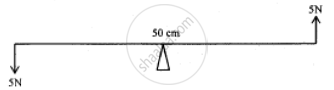
Two forces each of 5N act vertically upwards and downwards respectively on the two ends of a uniform metre rule which is placed at its mid-point as shown in the diagram. Determine the magnitude of the resultant moment of these forces about the midpoint.
Concept: Concept of Machines
Draw a diagram to show how a single pulley can be used so as to have its ideal M.A= 2.
Concept: Concept of Machines
The diagram below shows a lever in use:
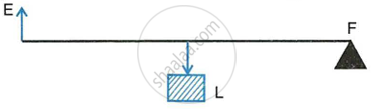
- To which class of levers does it belong?
- Without changing the dimensions of the lever, if the load is shifted towards the fulcrum what happens to the mechanical advantage of the lever?
Concept: Levers
Draw a diagram of a block and tackle system of pulleys having a velocity ratio of 5. In your diagram indicate clearly the points of application and the directions of the load L and effort E. Also mark the tension T in each strand.
Concept: Combination of Pulleys
The pulley system has drawn lifts a load of 150 N when an effort of 60 N is applied. Find its mechanical advantage.
Concept: Pulley
Is the above pulley system an ideal machine or not?
Concept: Pulley
The diagram below shows a claw hammer used to remove a nail :
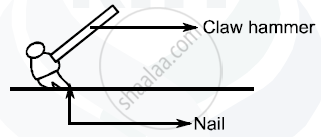
(i) To which class of lever does it belong ?
(ii) Give one more example of the same class of lever mentioned by you in (i) for which the mechanical advantage is greater than one.
Concept: Concept of Machines
The diagram below shows a pulley arrangement :
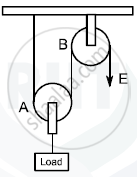
(i) Copy the diagram and mark the direction of tension on each strand of the string.
(ii) What is the velocity ratio of the arrangement ?
(iii) If the tension acting on the string is T, then what is the relationship between T and effort E ?
(iv) If the free end of the string moves through distance x, find the distance by which the load is raised.
Concept: Pulley
The following belong to which class of lever?
A pair of scissors
Concept: Levers
A block and tackle system of pulleys has a velocity ratio of 4.
- Draw a labelled diagram of the system indicating clearly the points of application and directions of load and effort.
- What is the value of the mechanical advantage of the given pulley system if it is an ideal pulley system?
Concept: Pulley
Name a single pulley in which displacement of load and effort is not the same.
Concept: A Single Movable Pulley
A metre scale of weight 50 gf can be balanced at 40 cm mark without any weight suspended on it.
- If this ruler is cut at its centre then state which part [0 to 50 cm or 50 to 100 cm] of the ruler will weigh more than 25 gf.

- What minimum weight placed on this metre ruler can balance this ruler when it is pivoted at its centre?
Concept: Combination of Pulleys
Name the class of the lever shown in the picture below:
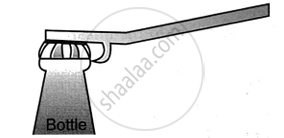
Concept: Levers >> Types of Levers
| Meera chose to use a block and tackle system of '9' pulleys instead of a single movable pulley to lift a heavy load. |
What is the advantage of using a block and tackle system over a single movable pulley?
Concept: A Single Movable Pulley
| Meera chose to use a block and tackle system of '9' pulleys instead of a single movable pulley to lift a heavy load. |
Why should she connect more number of pulleys in the upper fixed block?
Concept: Pulley

Two identical marbles A and B are rolled down along Path 1 and Path 2 respectively.
Path 1 is frictionless and Path 2 is rough.
- Which marble will surely reach the next peak?
- Along which path/s the mechanical energy will be conserved?
- Along which path/s is the law of conservation of energy obeyed?
Concept: Principle of a Machine
Copy and complete the labelled diagram connecting the two pulleys with a tackle to obtain Velocity Ratio= 2.

Concept: Combination of Pulleys
If Load = 48 kgf and efficiency is 80% then calculate:
- Mechanical Advantage.
- Effort needed to lift the load.

Concept: Combination of Pulleys
The adjacent diagram shows the movable block of a block and tackle system with effort in a convenient direction. From the diagram we can conclude that the number of pulleys used in the fixed block are ______.
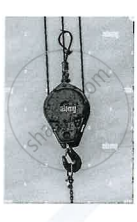
Concept: Combination of Pulleys
