Advertisements
Advertisements
प्रश्न
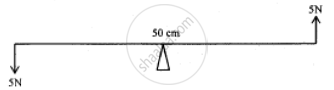
Two forces each of 5N act vertically upwards and downwards respectively on the two ends of a uniform metre rule which is placed at its mid-point as shown in the diagram. Determine the magnitude of the resultant moment of these forces about the midpoint.
Advertisements
उत्तर १
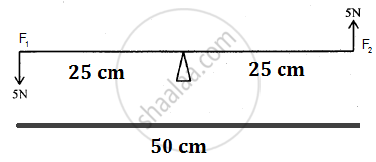
Moment of force F1 = 5 ⨯ 25 = 125
Moment of force F2 = 5 ⨯ 25 = 125
Since both the forces are acting in anticlockwise direction, the resultant moment of force is the sum of the two moments.
∴ Resultant moment of force = 125 + 125 = 250
उत्तर २
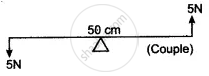
M = `"F" × vec("d")` (or) F × S
M = `5xx50/100 "m"`
= 5 × 0.5
= 2.5 Nm.
APPEARS IN
संबंधित प्रश्न
With reference to the terms mechanical advantage, velocity ratio and efficiency of a machine, name and define the term that will not change for the machine of a given design.
State four ways in which machines are useful to us.
Mechanical advantage (M.A.), load (L) and effort (E) are related as ______.
Name a machine which is used to multiply speed ?
The diagram below shows a claw hammer used to remove a nail :
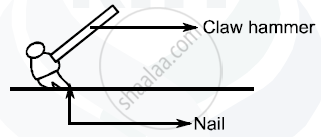
(i) To which class of lever does it belong ?
(ii) Give one more example of the same class of lever mentioned by you in (i) for which the mechanical advantage is greater than one.
Give an example for each of the following uses of a machine:
to obtain gain in force,
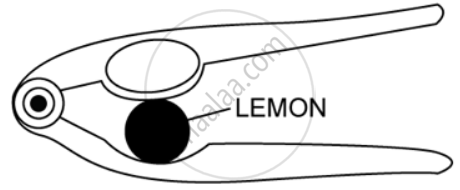
Shows a lemon crusher.
- In the diagram, mark the position of the fulcrum F and the line of action of load L and effort E.
- Name the class of lever
Under what condition will a set of gears produce a gain in speed
Name a machine which can be used to multiply force and change the direction of force applied.
Mention the advantages of using a machine.
