Advertisements
Advertisements
Question
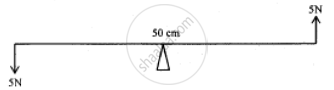
Two forces each of 5N act vertically upwards and downwards respectively on the two ends of a uniform metre rule which is placed at its mid-point as shown in the diagram. Determine the magnitude of the resultant moment of these forces about the midpoint.
Advertisements
Solution 1
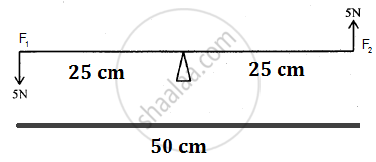
Moment of force F1 = 5 ⨯ 25 = 125
Moment of force F2 = 5 ⨯ 25 = 125
Since both the forces are acting in anticlockwise direction, the resultant moment of force is the sum of the two moments.
∴ Resultant moment of force = 125 + 125 = 250
Solution 2
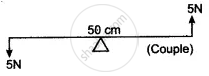
M = `"F" × vec("d")` (or) F × S
M = `5xx50/100 "m"`
= 5 × 0.5
= 2.5 Nm.
APPEARS IN
RELATED QUESTIONS
Draw a diagram to show how a single pulley can be used so as to have its ideal M.A= 2.
Name a machine to multiply force ?
Name a machine to change the point of application of force ?
Mechanical advantage (M.A.), load (L) and effort (E) are related as ______.
State the incorrect statement:
A force of 5 kgf is required to cut a metal sheet. A pair of shears used for cutting the metal sheet has its blades 5 cm long, while its handles is 10 cm long. What effort is needed to cut the sheet?
Stat the principle of an ideal machine.
Under what condition will a set of gears produce a gain in speed
What is a machine?
Mention the advantages of using a machine.
