Advertisements
Advertisements
Question
What is the principle of an ideal machine?
Advertisements
Solution
An ideal machine takes energy in one form and converts into another form without any energy losses. The work output is equal to the work input.
APPEARS IN
RELATED QUESTIONS
With reference to the terms Mechanical Advantage, Velocity Ratio and efficiency of a machine, name and define the term that will not change for the machine of a given design.
A scissor is a _________ multiplier
Mechanical advantage (M.A.), load (L) and effort (E) are related as ______.
‘The force needed to push a load up an inclined plane is less than the force needed to lift it directly’ Give a reason.
Work is the application of a ....... through a distance.
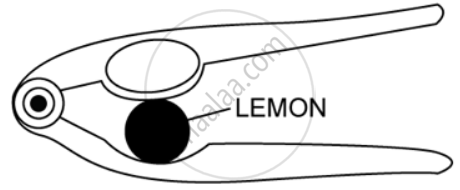
Shows a lemon crusher.
- In the diagram, mark the position of the fulcrum F and the line of action of load L and effort E.
- Name the class of lever
Complete the following sentence :
A scissors is a ___________ multiplier.
Under what condition will a set of gears produce a gain in speed
What is a machine?
Mention the advantages of using a machine.
