Please select a subject first
Advertisements
Advertisements
The sum of the first three terms of an Arithmetic Progression (A.P.) is 42 and the product of the first and third term is 52. Find the first term and the common difference.
Concept: Sum of First ‘n’ Terms of an Arithmetic Progressions
The sum of first 15 terms of an A.P. is 750 and its first term is 15. Find its 20th term.
Concept: Sum of First ‘n’ Terms of an Arithmetic Progressions
The 5th term and the 9th term of an Arithmetic Progression are 4 and – 12 respectively.
Find:
- the first term
- common difference
- sum of 16 terms of the AP.
Concept: Sum of First ‘n’ Terms of an Arithmetic Progressions
Which term of the Arithmetic Progression (A.P.) 15, 30, 45, 60...... is 300?
Hence find the sum of all the terms of the Arithmetic Progression (A.P.)
Concept: Sum of First ‘n’ Terms of an Arithmetic Progressions
The nth term of an Arithmetic Progression (A.P.) is given by the relation Tn = 6(7 – n)..
Find:
- its first term and common difference
- sum of its first 25 terms
Concept: Sum of First ‘n’ Terms of an Arithmetic Progressions
The point (3, 0) is invariant under reflection in:
Concept: Advanced Concept of Reflection in Mathematics
Use graph sheet to Solution this question. Take 2 cm = 1 unit alogn both the axes.
- Plot A, B, C where A(0, 4), B(1, 1) and C(4, 0)
- Reflect A and B on the x-axis and name them as E and D respectively.
- Reflect B through the origion and name it F. Write down the coordinates of F.
- Reflect B and C on the y-axis and name them as H and G respectively.
- Join points A, B, C, D, E, F, G, H and A in order and name the closed figure formed.
Concept: Advanced Concept of Reflection in Mathematics
Use graph sheet for this question. Take 2 cm = 1 unit along the axes.
- Plot A(0, 3), B(2, 1) and C(4, –1).
- Reflect point B and C in y-axis and name their images as B' and C' respectively. Plot and write coordinates of the points B' and C'.
- Reflect point A in the line BB' and name its images as A'.
- Plot and write coordinates of point A'.
- Join the points ABA'B' and give the geometrical name of the closed figure so formed.
Concept: Advanced Concept of Reflection in Mathematics
Study the graph and answer each of the following:
- Write the coordinates of points A, B, C and D.
- Given that, point C is the image of point A. Name and write the equation of the line of reflection.
- Write the coordinates of the image of the point D under reflection in y-axis.
- Whats the name given to a point whose image is the point itself?
- On joining the points A, B, C, D and A in order, a figure is formed. Name the closed figure.

Concept: Advanced Concept of Reflection in Mathematics
In the given figure ∠BAP = ∠DCP = 70°, PC = 6 cm and CA = 4 cm, then PD : DB is ______.

Concept: Criteria for Similarity of Triangles
In the given figure, AC || DE || BF. If AC = 24 cm, EG = 8 cm, GB = 16 cm, BF = 30 cm.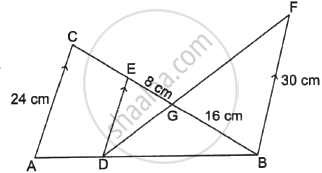
- Prove ΔGED ∼ ΔGBF
- Find DE
- DB : AB
Concept: Basic Proportionality Theorem
In the given diagram, ΔABC ∼ ΔPQR. If AD and PS are the bisectors of ∠BAC and ∠QPR, respectively, then ______.

Concept: Criteria for Similarity of Triangles
In the given diagram, ΔADB and ΔACB are two right-angled triangles with ∠ADB = ∠BCA = 90°. If AB = 10 cm, AD = 6 cm, BC = 2.4 cm and DP = 4.5 cm.

- Prove that ΔAPD ∼ ΔBPC
- Find the length of BD and PB
- Hence, find the length of PA
- Find area ΔAPD : area ΔBPC.
Concept: Criteria for Similarity of Triangles
Use ruler and compasses only for the following questions. All constructions lines and arcs must be clearly shown.
Construct the locus of points at a distance of 3.5 cm from A.
Concept: Points Equidistant from Two Given Points
Use ruler and compasses only for the following questions. All constructions lines and arcs must be clearly shown
Construct the locus of points equidistant from AC and BC.
Concept: Points Equidistant from Two Given Points
Use ruler and compasses only for the following questions. All constructions lines and arcs must be clearly shown
Mark 2 points X and Y which are a distance of 3.5 cm from A and also equidistant from AC and BC. Measure XY.
Concept: Points Equidistant from Two Given Points
Construct a triangle ABC with AB = 5.5 cm, AC = 6 cm and ∠BAC = 105°
Hence:
1) Construct the locus of points equidistant from BA and BC
2) Construct the locus of points equidistant from B and C.
3) Mark the point which satisfies the above two loci as P. Measure and write the length of PC.
Concept: Points Equidistant from Two Intersecting Lines
Use ruler and compasses only for this question:
I. Construct ABC, where AB = 3.5 cm, BC = 6 cm and ABC = 60o.
II. Construct the locus of points inside the triangle which are equidistant from BA and BC.
III. Construct the locus of points inside the triangle which are equidistant from B and C.
IV. Mark the point P which is equidistant from AB, BC and also equidistant from B and C. Measure and records the length of PB.
Concept: Points Equidistant from Two Intersecting Lines
Use ruler and compass to answer this question. Construct ∠ABC = 90°, where AB = 6 cm, BC = 8 cm.
- Construct the locus of points equidistant from B and C.
- Construct the locus of points equidistant from A and B.
- Mark the point which satisfies both the conditions (a) and (b) as 0. Construct the locus of points keeping a fixed distance OA from the fixed point 0.
- Construct the locus of points which are equidistant from BA and BC.
Concept: Points Equidistant from Two Intersecting Lines
Use ruler and compasses for the following question taking a scale of 10 m = 1 cm. A park in a city is bounded by straight fences AB, BC, CD and DA. Given that AB = 50 m, BC = 63 m, ∠ABC = 75°. D is a point equidistant from the fences AB and BC. If ∠BAD = 90°, construct the outline of the park ABCD. Also locate a point P on the line BD for the flag post which is equidistant from the corners of the park A and B.
Concept: Summary of Important Results on Locus
