Please select a subject first
Advertisements
Advertisements
What is meant by coherent sources of light?
Concept: No Interference by Two Independent Light-Sources : Coherent Sources
In Young's double slit experiment using monochromatic light of wavelength 600 nm, 5th bright fringe is at a distance of 0·48 mm from the centre of the pattern. If the screen is at a distance of 80 cm from the plane of the two slits, calculate:
(i) Distance between the two slits.
(ii) Fringe width, i.e. fringe separation.
Concept: Interference of Light Waves and Young’s Experiment
In Young’s double-slit experiment, using monochromatic light, fringes are obtained on a screen placed at some distance from the slits. If the screen is moved by 5 x 10⁻² m towards the slits, the change in the fringe width is 3 x 10⁻⁵ m. If the distance between the two slits is 10-3 m, calculate the wavelength of the light used.
Concept: Interference of Light Waves and Young’s Experiment
In Young’s double-slit experiment, show that:
`beta = (lambda "D")/"d"` where the terms have their usual meaning.
Concept: Interference of Light Waves and Young’s Experiment
In Young’s double slit experiment, what is the effect on fringe pattern if the slits are brought closer to each other?
Concept: Interference of Light Waves and Young’s Experiment
In Young’s double slit experiment, what should be the phase difference between the two overlapping waves to obtain 5th dark band/fringe on the screen?
Concept: Interference of Light Waves and Young’s Experiment
Answer the following question briefly and to the point:
What is the phase difference between any two points lying on the same wavefront?
Concept: Huygens Principle
What type of wavefronts are associated with a source infinity?
Concept: Huygens Principle
In Young's double slit experiment, the distance of the 4th bright fringe from the centre of the interference pattern is 1.5 mm. The distance between the slits and the screen is 1.5 m, and the wavelength of light used is 500 nm. Calculate the distance between the two slits.
Concept: Interference of Light Waves and Young’s Experiment
What type of wavefronts are associated with a point source of light?
Concept: Huygens Principle
In Young's double slit experiment, show that:
`β = (λ"D")/"d"`
Where the terms have their usual meaning.
Concept: Interference of Light Waves and Young’s Experiment
In Young’s double slit experiment, how is interference pattern affected when the following changes are made:
- Slits are brought closer to each other.
- Screen is moved away from the slits.
- Red coloured light is replaced with blue coloured light.
Concept: Interference of Light Waves and Young’s Experiment
Represent diagrammatically how the incident planar wavefronts of wavelength λ pass through an aperture of size d, when d is approximately equal to λ.
Concept: Huygens Principle
In an experiment of the photoelectric effect, the graph of maximum kinetic energy EK of the emitted photoelectrons versus the frequency v of the incident light is a straight line AB shown in Figure 6 below:
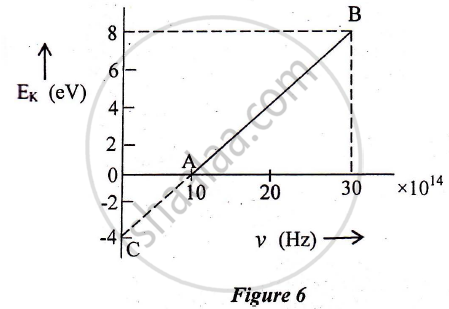
Find:
1) Threshold frequency of the metal
2) The work function of the metal.
3) Stopping potential for the photoelectrons emitted by the light of frequency `v = 30 xx 10^14 Hz`
Concept: Photoelectric Effect - Hertz’s Observations
Calculate the momentum of a photon of energy 6 x I 0-19 J.
Concept: Photoelectric Effect - Hertz’s Observations
With reference to the photoelectric effect, what is meant by threshold wavelength?
Concept: Photoelectric Effect - Hertz’s Observations
Two metals A and B have work functions 4 eV and 6 eV respectively. Which metal has a lower threshold wavelength for photoelectric effect?
Concept: Photoelectric Effect - Hertz’s Observations
Plot a labelled graph of IVsl where Vs is stopping potential versus frequency f of the incident radiation.
Concept: Photoelectric Effect - Hertz’s Observations
State how will you use this graph to detennine the value of Planck's constant.
Concept: Photoelectric Effect - Hertz’s Observations
If the frequency of the incident radiation is increased from 4 × 10¹⁵ Hz to 8 × 10¹⁵ Hz, by how much will the stopping potential for a given photosensitive surface go up?
Concept: Photoelectric Effect - Hertz’s Observations
