Advertisements
Advertisements
प्रश्न
Two metals A and B have work functions 4 eV and 6 eV respectively. Which metal has a lower threshold wavelength for photoelectric effect?
Advertisements
उत्तर
`lambda = "hc"/"w"`
∴ 6eV. Thus, metal B has lower threshold wavelength.
APPEARS IN
संबंधित प्रश्न
The photoelectric work function for a metal surface is 2.3 eV. If the light of wavelength 6800A is incident on the surface of metal, find threshold frequency and incident frequency. Will there be an emission of photoelectrons or not?
[Velocity of light c = 3 x 10⁸ m/s,
Planck’s constant, h = 6.63 * 10-34 Js ]
The photoelectric current in a photoelectric cell can be reduced to zero by a stopping potential of 1.8 volt. Monochromatic light of wavelength 2200Å is incident on the cathode. Find the maximum kinetic energy of the photoelectrons in joules. [Charge on electron = 1.6 x 10⁻¹⁹ C]
Light of intensity ‘I’ and frequency ‘v’ is incident on a photosensitive surface and causes photoelectric emission. What will be the effect on anode current when (i) the intensity of light is gradually increased. In each case, all other factors remain the same. Explain, giving justification in each case.
Draw a plot showing the variation of photoelectric current versus the intensity of incident radiation on a given photosensitive surface.
In an experiment of the photoelectric effect, the graph of maximum kinetic energy EK of the emitted photoelectrons versus the frequency v of the incident light is a straight line AB shown in Figure 6 below:
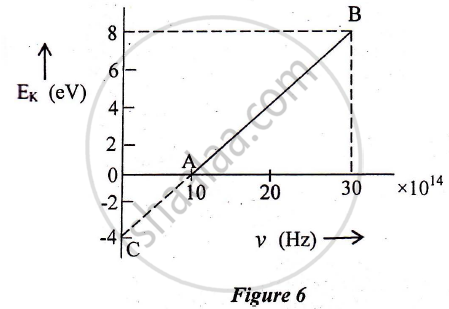
Find:
1) Threshold frequency of the metal
2) The work function of the metal.
3) Stopping potential for the photoelectrons emitted by the light of frequency `v = 30 xx 10^14 Hz`
A beam of monochromatic radiation is incident on a photosensitive surface. Answer the following question giving reason :
Do the emitted photoelectrons have the same kinetic energy?
In photoelectric effect, why should the photoelectric current increase as the intensity of monochromatic radiation incident on a photosensitive surface is increased? Explain.
What is photoelectri effect ? Defin (i) Stopping potential (ii) Photoelectric work function.
The phenomenon of photoelectric emission was observed by ______.
What facilitated the escape of free, charged particles from the metal surface?
