Advertisements
Advertisements
प्रश्न
In an experiment of the photoelectric effect, the graph of maximum kinetic energy EK of the emitted photoelectrons versus the frequency v of the incident light is a straight line AB shown in Figure 6 below:
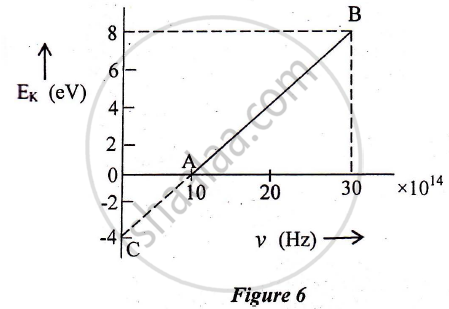
Find:
1) Threshold frequency of the metal
2) The work function of the metal.
3) Stopping potential for the photoelectrons emitted by the light of frequency `v = 30 xx 10^14 Hz`
Advertisements
उत्तर
1) From the graph,
Threshold frequency = `10 xx 10^14 Hz`
`v_0 = 10^15 Hz`
2) The work function of the metal
`w = hv_0`
`= 6.63 xx 10^(-34) xx 15^15`
`= (6.63 xx 10^(-19))/(1.6 xx 10^(-19))`
= 4.14 eV
3) `E_k = 8 eV`
Stopping potential = `K.E._"max" - phi`
`=> 8 - 4.14 = 3.86 eV`
`V = 3.86/e xx ev = 3.86 V`
APPEARS IN
संबंधित प्रश्न
Draw a neat labelled circuit diagram of experimental arrangement for study of photoelectric effect.
The photoelectric work function for a metal is 4.2 eV. If the stopping potential is 3V, find the threshold wavelength and maximum kinetic energy of emitted electrons.
(Velocity of light in air = 3 x 10⁸m/s,
Planck's constant = 6·63 x10-34 J -s,
Charg.e ori electron = 1·6 x 10 -19 C)
A photosensitive surface emits photoelectrons when red light falls on it. Will the surface emit photoelectrons when blue light is incident on it? Give reason.
Draw a plot showing the variation of photoelectric current with collector potential for different frequencies but same intensity of incident radiation ?
What change will you observe if intensity of incident radiation is changed but the frequency remains the same?
With reference to the photoelectric effect, what is meant by threshold wavelength?
Photoelectric effect is possible ______.
What happens when light falling on a material (usually a metal) causes photoelectric emission?
What happened to high-voltage sparks across the detector loop when the emitter plate was illuminated with ultraviolet light from an arc lamp?
What are the free, charged particles that escape from the metal surface?
