Advertisements
Advertisements
प्रश्न
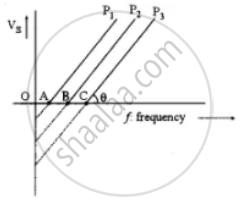
Plot a labelled graph of IVsl where Vs is stopping potential versus frequency f of the incident radiation.
Advertisements
उत्तर
APPEARS IN
संबंधित प्रश्न
The photoelectric current in a photoelectric cell can be reduced to zero by a stopping potential of 1.8 volt. Monochromatic light of wavelength 2200Å is incident on the cathode. Find the maximum kinetic energy of the photoelectrons in joules. [Charge on electron = 1.6 x 10⁻¹⁹ C]
The photoelectric work function for a metal is 4.2 eV. If the stopping potential is 3V, find the threshold wavelength and maximum kinetic energy of emitted electrons.
(Velocity of light in air = 3 x 10⁸m/s,
Planck's constant = 6·63 x10-34 J -s,
Charg.e ori electron = 1·6 x 10 -19 C)
Light of intensity ‘I’ and frequency ‘v’ is incident on a photosensitive surface and causes photoelectric emission. What will be the effect on anode current when (i) the intensity of light is gradually increased. In each case, all other factors remain the same. Explain, giving justification in each case.
Light of intensity ‘I’ and frequency ‘v’ is incident on a photosensitive surface and causes photoelectric emission. What will be the effect on anode current when the anode potential is increased? In each case, all other factors remain the same. Explain, giving justification in each case.
A beam of monochromatic radiation is incident on a photosensitive surface. Answer the following question giving reason :
Do the emitted photoelectrons have the same kinetic energy?
What is photoelectri effect ? Defin (i) Stopping potential (ii) Photoelectric work function.
With reference to the photoelectric effect, what is meant by threshold wavelength?
State how will you use this graph to detennine the value of Planck's constant.
If the frequency of the incident radiation is increased from 4 × 10¹⁵ Hz to 8 × 10¹⁵ Hz, by how much will the stopping potential for a given photosensitive surface go up?
What are the electrons emitted when light falls on a material generally called?
