Please select a subject first
Advertisements
Advertisements
The deviation produced for violet, yellow and red lights for crown glass are 3.75°, 3.25° and 2.86° respectively. Calculate the dispersive power of the crown glass.
Concept: Dispersion of White Light by a Prism : Angular Dispersion
A ray of light is incident on a prism whose refractive index is 1.52 at an angle of 40°. If the angle of emergence is 60°, calculate the angle of the prism.
Concept: Dispersion of White Light by a Prism : Angular Dispersion
In a regular prism, what is the relation between angle of incidence and angle of emergence when it is in the minimum deviation position?
Concept: Dispersion of White Light by a Prism : Angular Dispersion
Calculate dispersive power of a transparent material given : nv = 1.56, nr = 1.54, ny = 1.55.
Concept: Dispersion of White Light by a Prism : Angular Dispersion
A narrow beam of monochromatic light, PQ, is incident normally on one face of an equiangular glass prism of refractive index 1.45. When the prism is immersed in a certain liquid, the ray makes a grazing emergence along the other face (See figure). Find the refractive index of this liquid. 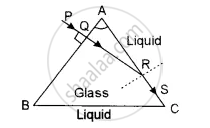
Concept: Dispersion of White Light by a Prism : Angular Dispersion
What is meant by the dispersive power of transparent material?
Concept: Dispersion of White Light by a Prism : Angular Dispersion
Define angular dispersion.
Concept: Dispersion of White Light by a Prism : Angular Dispersion
Name any two phenomena which take place in the formation of a rainbow.
Concept: Total Internal Reflection
For any prism, obtain a relation between the angle of the prism (A), the angle of minimum deviation (δm) and the refractive index of its material (μ or n).
Concept: Dispersion of White Light by a Prism : Angular Dispersion
When a ray of white light is incident obliquely on the first surface of a prism, then ______.
Concept: Dispersion of White Light by a Prism : Angular Dispersion
The focal length of a double convex lens is equal to the radius of curvature of either surface. What is the refractive index of its material?
Concept: Power of a Lens
What is meant by a thin prism?
Concept: Dispersion of White Light by a Prism : Angular Dispersion
- A virologist studies details of a virus with the help of an instrument. Name the instrument used by him.
- Draw a labelled ray diagram of an image formed by this instrument, assuming
- a small upright object.
- image lies at least distance of distinct vision.
Concept: Introduction to Optical Instruments >> Compound Microscope
Define coherent sources of light
Concept: No Interference by Two Independent Light-Sources : Coherent Sources
In Young’s double slit experiment, show graphically how the intensity of light varies with distance
Concept: Interference of Light Waves and Young’s Experiment
What should be the path difference between two waves reaching a point for obtaining constructive interference in Young’s Double Slit experiment ?
Concept: Interference of Light Waves and Young’s Experiment
Derive the law of reflection using Huygen’s Wave Theory.
Concept: Huygens Principle
Draw a neat labelled diagram of Young’s Double Slit experiment. Show that `beta = (lambdaD)/d` , where the terms have their usual meanings (either for bright or dark fringe).
Concept: Interference of Light Waves and Young’s Experiment
With what type of source of light are cylindrical wave fronts associated?
Concept: Huygens Principle
How is the fringe width of an interference pattern in Young's double-slit experiment affected if the two slits are brought closer to each other?
Concept: Interference of Light Waves and Young’s Experiment
