Advertisements
Advertisements
प्रश्न
A narrow beam of monochromatic light, PQ, is incident normally on one face of an equiangular glass prism of refractive index 1.45. When the prism is immersed in a certain liquid, the ray makes a grazing emergence along the other face (See figure). Find the refractive index of this liquid. 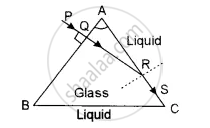
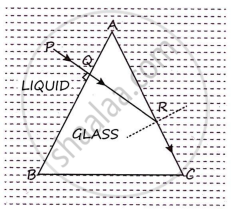
A narrow beam of monochromatic light PQ is incident normally on one face of an equiangular glass prism of refractive index 1.45. When the prism is immersed in a certain ‘liquid’ the ray makes a grazing emergence along the other face as shown in the figure. Find the refractive index of this liquid.
Advertisements
उत्तर
When the prism is immersed in the liquid and the incident ray emerges along AC, it is clear that it must be incident at the critical angle C on the face AC.
∠A + ∠ARQ = ∠C + ∠ARQ
From the figure,
∴ ∠C = ∠A = 60°
The critical angle when the prism is immersed in the liquid is 60°.
If μg is the refractive index of the material of the prism w.r.t. liquid
Then `""^l µ_g = 1/sinC`
= `1/sin60°`
= `1/(sqrt3/2)`
= `2/sqrt3`
Also, we know that `""^l µ_g =( ""^aµ_g)/( ""^aµ_l)`
`""^aµ_l =( ""^aµ_g)/( ""^l µ_g )`
= `1.45/2 xx sqrt3`
= 1.45 × 0.866
= 1.256
APPEARS IN
संबंधित प्रश्न
Plot a graph to show the variation of the angle of deviation as a function of the angle of incidence for light passing through a prism. Derive an expression for the refractive index of the prism in terms of angle of minimum deviation and angle of the prism.
A ray of light passes through an equilateral glass prism such that the angle of incidence is equal to the angle of emergence and each of these angles is equal to 3/4 of angle of prism. Find the angle of deviation.
What is the cause of dispersion of light
Give the formula that can be used to determine refractive index of materials of a prism in minimum deviation condition ?
If three identical prisms are combined, is it possible to pass a beam that emerges undeviated? Undispersed?
By properly combining two prisms made of different materials, it is possible to
(a) have dispersion without average deviation
(b) have deviation without dispersion
(c) have both dispersion and average deviation
(d) have neither dispersion nor average deviation
A thin prism of crown glass (μr = 1.515, μv = 1.525) and a thin prism of flint glass (μr = 1.612, μv = 1.632) are placed in contact with each other. Their refracting angles are 5.0° each and are similarly directed. Calculate the angular dispersion produced by the combination.
A ray of light is incident on a prism whose refractive index is 1.52 at an angle of 40°. If the angle of emergence is 60°, calculate the angle of the prism.
When a ray of white light is incident obliquely on the first surface of a prism, then ______.
What is meant by a thin prism?
