Advertisements
Advertisements
Write IUPAC name of the complex [Pt(en)2Cl2]. Draw structures of geometrical isomers for this complex.
Concept: Isomerism in Coordination Compounds >> Structural Isomerism
Write structures of compounds A and B of the following reaction :

Concept: Important Terms Pertaining to Coordination Compounds
Write structures of compounds A and B of the following reaction :

Concept: Important Terms Pertaining to Coordination Compounds
A colloidal sol is prepared by the given method in the figure. What is the charge on hydrated ferric oxide colloidal particles formed in the test tube? How is the solution represented?

Concept: Properties of Colloidal Solutions
How does chemisorption vary with temperature?
Concept: Types of Adsorption
Answer the following question.
Write IUPAC name of the complex [Pt(en)2CI2]. Draw structures of geometrical isomers for this complex.
Concept: Isomerism in Coordination Compounds >> Stereoisomerism
Write the hybridization and magnetic character of the following complexes:
[Fe(H2O)6]2+
(Atomic no. of Fe = 26)
Concept: Bonding in Coordination Compounds >> Magnetic Properties of Coordination Compounds
Write the hybridization and magnetic character of the following complexes:
[Fe(CO)5]
(Atomic no. of Fe = 26)
Concept: Bonding in Coordination Compounds >> Magnetic Properties of Coordination Compounds
A colloidal sol is prepared by the given method in the figure. What is the charge on hydrated ferric oxide colloidal particles formed in the test tube? How is the sol represented?
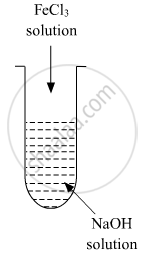
Concept: Properties of Colloidal Solutions
How does chemisorption vary with temperature?
Concept: Types of Adsorption
Why dextro and laevo rotatory isomers of Butan-2-ol are difficult to separate by fractional distillation?
Concept: Isomerism in Coordination Compounds
Why are low spin tetrahedral complexes not formed?
Concept: Bonding in Coordination Compounds >> Crystal Field Theory (CFT)
[Ni(H2O)6]2+ (aq) is green in colour whereas [Ni(H2O)4 (en)]2+ (aq)is blue in colour, give reason in support of your answer.
Concept: Bonding in Coordination Compounds >> Crystal Field Theory (CFT)
Write the formula and hybridization of the following compound:
tris(ethane-1, 2–diamine) cobalt(III) sulphate
Concept: Werner’s Theory of Coordination Compounds
In a coordination entity, the electronic configuration of the central metal ion is t2g3 eg1
Is the coordination compound a high spin or low spin complex?
Concept: Bonding in Coordination Compounds >> Valence Bond Theory (VBT)
In a coordination entity, the electronic configuration of the central metal ion is t2g3 eg1
Draw the crystal field splitting diagram for the above complex.
Concept: Bonding in Coordination Compounds >> Crystal Field Theory (CFT)
Account for the following:
Ti(IV) is more stable than the Ti (II) or Ti(III).
Concept: Importance and Applications of Coordination Compounds
The CFSE of [CoCl6]3– is 18000 cm–1 the CFSE for [CoCl4]– will be ______.
Concept: Bonding in Coordination Compounds >> Crystal Field Theory (CFT)
The number of ions formed on dissolving one molecule of FeSO4.(NH4)2SO4.6H2O in water is ______.
Concept: Concept of Coordination Compounds
Using Valence bond theory, explain the following in relation to the paramagnetic complex [Mn(CN)6]3−
- type of hybridization
- magnetic moment value
- type of complex – inner, outer orbital complex
Concept: Bonding in Coordination Compounds >> Valence Bond Theory (VBT)
