Advertisements
Advertisements
प्रश्न
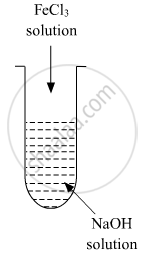
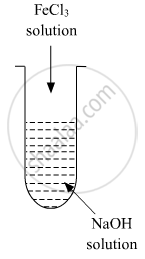
A colloidal sol is prepared by the given method in the figure. What is the charge on hydrated ferric oxide colloidal particles formed in the test tube? How is the sol represented?
Advertisements
उत्तर
Colloidal particles usually adsorb those ions which are in excess and are common to its own lattice. This preferential adsorption of a particular type of ions imparts a particular type of charge to colloidal particles.
When FeCl3 is added in NaOH, the constituent of the sol is Fe(OH)3 but the dispersion medium is having an excess of OH- ions. Hence, it gets preferentially adsorbed to the sol giving the overall negative charge. The sol is represented as Fe2O3.xH2O / OH-
APPEARS IN
संबंधित प्रश्न
Define the following term:
Zeta potential
Explain the terms Coagulation
What happens when persistent dialysis of a colloidal solution is carried out?
What happens when an emulsion is centrifuged?
Which of the following will show Tyndall effect?
How does it become possible to cause artificial rain by spraying silver iodide on the clouds?
Why does leather get hardened after tanning?
Assertion: Coagulation power of Al3+ is more than Na+.
Reason: Greater the valency of the flocculating ion added, greater is its power to cause precipitation (Hardy Schulze rule).
What is electrophoresis?
Why a negatively charged sol is obtained when AgNO3 solution is added to KI solution?
