Advertisements
Advertisements
प्रश्न
Explain what is observed when an electrolyte NaCl is added to hydrated ferric oxide sol.
What happens when a solution of NaCl is added to a ferric hydroxide sol? Explain.
Advertisements
उत्तर
When NaCl is added to ferric oxide sol, it dissociates to give Na+ and Cl− ions. Particles of ferric oxide sol are positively charged. Thus, they get coagulated in the presence of negatively charged Cl− ions.
संबंधित प्रश्न
Out of MgCl2 and AlCl3, which one is more effective in causing coagulation of negatively charged sol and why?
Explain what is observed when an electric current is passed through a colloidal sol?
Explain the term Electrophoresis
What happens when an emulsion is centrifuged?
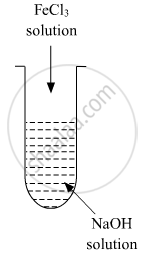
A colloidal sol is prepared by the given method in the figure. What is the charge on hydrated ferric oxide colloidal particles formed in the test tube? How is the solution represented?

A colloidal sol is prepared by the given method in the figure. What is the charge on hydrated ferric oxide colloidal particles formed in the test tube? How is the sol represented?
What happens when a lyophilic sol is added to a lyophobic sol?
(i) Lyophobic sol is protected.
(ii) Lyophilic sol is protected.
(iii) Film of lyophilic sol is formed over lyophobic sol.
(iv) Film of lyophobic sol is formed over lyophilic sol.
Which phenomenon occurs when an electric field is applied to a colloidal solution and electrophoresis is prevented?
(i) Reverse osmosis takes place.
(ii) Electroosmosis takes place.
(iii) Dispersion medium begins to move.
(iv) Dispersion medium becomes stationary.
Why does leather get hardened after tanning?
Assertion: Colloidal solutions show colligative properties.
Reason: Colloidal particles are large in size.
Assertion: Coagulation power of Al3+ is more than Na+.
Reason: Greater the valency of the flocculating ion added, greater is its power to cause precipitation (Hardy Schulze rule).
Which of the following is used for removing change on colloidal solution?
The right option for the statement “Tyndall effect is exhibited by”, is:
State the Hardy-Schulze rule.
What is electrophoresis?
The conditions given below are in the context of observing Tyndall effect in colloidal solutions:
- The diameter of the colloidal particles is comparable to the wavelength of light used.
- The diameter of the colloidal particles is much smaller than the wavelength of light used.
- The diameter of the colloidal particles is much larger than the wavelength of light used.
- The refractive indices of the dispersed phase and the dispersion medium are comparable.
- The dispersed phase has a very different refractive index from the dispersion medium.
Choose the most appropriate conditions from the options given below:
