Advertisements
Advertisements
Questions
Explain what is observed when an electrolyte NaCl is added to hydrated ferric oxide sol.
What happens when a solution of NaCl is added to a ferric hydroxide sol? Explain.
Advertisements
Solution
When NaCl is added to ferric oxide sol, it dissociates to give Na+ and Cl− ions. Particles of ferric oxide sol are positively charged. Thus, they get coagulated in the presence of negatively charged Cl− ions.
RELATED QUESTIONS
Define the following term:
Zeta potential
Give reasons for the following observations:
Brownian movement provides stability to the colloidal solution.
What modification can you suggest in the Hardy-Schulze law?
Explain the terms Coagulation
Explain the term Tyndall effect.
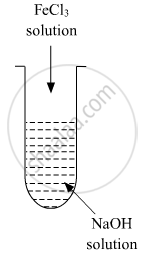
A colloidal sol is prepared by the given method in the figure. What is the charge on hydrated ferric oxide colloidal particles formed in the test tube? How is the solution represented?

A colloidal sol is prepared by the given method in the figure. What is the charge on hydrated ferric oxide colloidal particles formed in the test tube? How is the sol represented?
Which of the following statements are correct?
(i) Mixing two oppositely charged sols neutralises their charges and stabilises the colloid.
(ii) Presence of equal and similar charges on colloidal particles provides stability to the colloids.
(iii) Any amount of dispersed liquid can be added to emulsion without destabilising it.
(iv) Brownian movement stabilises sols.
What causes brownian motion in colloidal dispersion?
Match the statement given in Column I with the phenomenon given in Column II.
| Column I | Column II |
| (i) Dispersion medium moves in an electric field | (a) Osmosis |
| (ii) Solvent molecules pass through semi permeable membrane towards solvent side |
(b) Electrophoresis |
| (iii) Movement of charged colloidal particles under the influence of applied electric potential towards oppositely charged electrodes |
(c) Electroosmosis |
| (iv) Solvent molecules pass through semi permeable membranes towards solution side |
(d) Reverse osmosis |
Assertion: Colloidal solutions show colligative properties.
Reason: Colloidal particles are large in size.
Give reason for the following:
Lyophilic colloidal solutions are more stable than lyophobic colloidal solutions.
What is common in aqua sols and solid aerosols? How do they differ?
What is Gold number?
State the Hardy-Schulze rule.
Define the following term:
Coagulation
Why a negatively charged sol is obtained when AgNO3 solution is added to KI solution?
Which of the following is a correct statement?
