Advertisements
Advertisements
Question
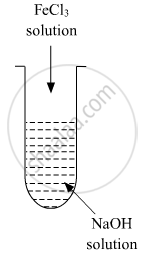
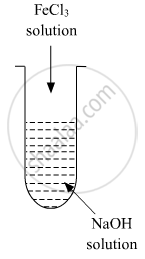
A colloidal sol is prepared by the given method in the figure. What is the charge on hydrated ferric oxide colloidal particles formed in the test tube? How is the sol represented?
Advertisements
Solution
Colloidal particles usually adsorb those ions which are in excess and are common to its own lattice. This preferential adsorption of a particular type of ions imparts a particular type of charge to colloidal particles.
When FeCl3 is added in NaOH, the constituent of the sol is Fe(OH)3 but the dispersion medium is having an excess of OH- ions. Hence, it gets preferentially adsorbed to the sol giving the overall negative charge. The sol is represented as Fe2O3.xH2O / OH-
APPEARS IN
RELATED QUESTIONS
Give reasons for the following observations:
Brownian movement provides stability to the colloidal solution.
Explain what is observed when a beam of light is passed through a colloidal sol.
What happens when persistent dialysis of a colloidal solution is carried out?
What happens when an emulsion is centrifuged?
The values of colligative properties of colloidal solution are of small order in comparison to those shown by true solutions of same concentration because of colloidal particles ______.
Which of the following statements are correct?
(i) Mixing two oppositely charged sols neutralises their charges and stabilises the colloid.
(ii) Presence of equal and similar charges on colloidal particles provides stability to the colloids.
(iii) Any amount of dispersed liquid can be added to emulsion without destabilising it.
(iv) Brownian movement stabilises sols.
Give reason for the following:
Lyophilic colloidal solutions are more stable than lyophobic colloidal solutions.
What is Gold number?
Tyndall effect is observed in
State the Hardy-Schulze rule.
