- Gauss’s law is useful for finding the electric field in highly symmetric charge distributions (line, plane, sphere).
- For an infinitely long charged wire, the electric field is radial and depends only on the distance r from the wire.
- Electric field due to an infinite line charge decreases with distance:
E = \[\frac{\lambda}{2\pi\varepsilon_0r}\] - For an infinite plane sheet, the electric field is uniform and does not change with distance.
- Electric field due to an infinite plane sheet is:
E = \[\frac{\sigma}{2\varepsilon_0}\] - For a uniformly charged spherical shell, the field outside behaves like a point charge at the centre:
E = \[\frac{1}{4\pi\varepsilon_0}\frac{q}{r^2}\] - Inside a uniformly charged spherical shell, the electric field is zero.
Definitions [36]
Definition: Test Charge
A unit positive charge used to test the strength of electric fields is called a test charge.
Definition: Electric Charge
The basic property of matter due to which it experiences electric force and shows attraction or repulsion, is called electric charge.
OR
The fundamental property of subatomic particles that gives rise to the phenomenon of experiencing force in the presence of electric and magnetic fields is called electric charge.
- Positive charge: Deficiency of electrons
- Negative charge: Excess of electrons
- SI unit: Coulomb (C)
- Dimension: [M0L0T1A1]
Definition: Point Charge
An electric charge which can be considered to exist at a single point is called a point charge.
Definition: Conductors
Conductors are those through which electric charge can easily flow. Metals, human body, earth, mercury and electrolytes are conductors of electricity.
OR
The material through which electric charge can flow easily is called a conductor.
Definition: Insulators
Those substances in which electric charge cannot flow are called ‘insulators' (or dielectrics). Glass, hard-rubber, plastics and dry wood are insulators. Insulators have practically no free electrons.
OR
The material in which electrons are tightly bound to the nucleus and thus not available for conductance is called an insulator.
OR
Substances which offer high resistance to the passage of electricity and do not allow electricity to pass through them easily, are called insulators.
Definition: Semiconductors
Substances whose resistance to the movement of charges is intermediate between conductors and insulators, are called semiconductors.
Definition: Charging by Conduction
Charging by conduction is the process in which an uncharged conductor becomes charged by direct contact with a charged conductor due to the transfer of electrons.
Definition: Charging by Electrostatic Induction”
A process in which a charged object induces charge in an uncharged 'conductor' placed near it, without touching the conductor. This is called "charging by electrostatic induction”.
Definition: Induced Charge
The charge induced on an uncharged conductor due to a nearby charged body is called an induced charge.
Definition: Inducing Charge
The charge on the charged object which causes induction is called the inducing charge.
Definition: Elementary Charge
The smallest unit of electric charge, denoted by e, is called the elementary charge.
Definition: Point Charge
A charged body whose size is negligibly small compared to the distance between the charges under consideration, is called a point charge.
Define a unit charge.
One coulomb is the amount of charge which, when placed at a distance of one metre from another charge of the same magnitude in vacuum, experiences a force of 9.0 × 10⁹ N.
Definition: Electric Field Intensity (E)
The electric field intensity at any point is the strength of the electric field at that point.
- It is defined as the force experienced by a unit positive charge placed at that point.
\[\vec{E}=\frac{\vec{F}}{q_0}=\frac{kq}{r^2}\hat{r}=\frac{kq}{r^3}\vec{r}\]
- The SI unit of E is NC−1 (newtons per coulomb).
Definition: Electric Field
The space surrounding an electric charge q in which another charge q0 experiences a (electrostatic) force of attraction or repulsion, is called the electric field of the charge q.
OR
Electric field due to a charge Q at a point in space may be defined as the force that a unit positive charge would experience if placed at that point.
OR
The region surrounding an electric charge or a group of charges in which another charge experiences a force is called an electric field.
Definition: Non-Uniform Electric Field
A field whose magnitude and direction are not the same at all points is called a non-uniform electric field.
Definition: Uniform Electric Field
A field whose magnitude and direction is the same at all points is called a uniform electric field.
Definition: Test Charge
The charge q that tests the effect of the source charge is called the test charge.
Definition: Source Charge
The charge Q that produces the electric field is called the source charge.
Define electric field.
The region in which the charge experiences an electric force is the electric field around the charge.
Definition: Electric Lines of Force
“An electric line of force is an imaginary smooth curve drawn in an electric field along which a free, isolated positive charge moves. The tangent drawn at any point on the electric line of force gives the direction of the force acting on a positive charge placed at that point.”
OR
An imaginary curve drawn in such a way that the tangent at any given point on this curve gives the direction of the electric field is called an electric line of force.
Define electric dipole moment.
The electric dipole moment is defined as the product of the magnitude of one of the charges and the distance between the two equal and opposite charges.
Definition: Direction of Dipole Axis
“The line joining the two charges, pointing from the negative charge to the positive charge. This is known as the ‘direction of dipole axis’.”
OR
The line passing through both charges +q and −q is called the dipole axis (also called the axial line or axis of the dipole).
Definition: Electric Dipole
An electric dipole is a pair of equal and opposite point charges placed at a short distance apart.
OR
A system formed by two equal and opposite point charges placed at a small distance apart is called an electric dipole.
OR
A system of two equal and opposite point charges +q and −q separated by a small fixed distance 2a is called an electric dipole.
- The total charge of an electric dipole is zero
- Zero net charge does not mean zero electric field - the field exists because the charges are spatially separated
- The midpoint of the line joining −q and +q is called the centre of the dipole
Definition: Centre of Dipole
The midpoint of the line joining the two charges is called the centre of the dipole.
Definition: Equatorial Line
The line passing through the centre of the dipole and perpendicular to the dipole axis is called the equatorial line.
OR
The plane passing through the centre of the dipole and perpendicular to the dipole axis is called the equatorial plane; the line along which the equatorial field is evaluated is the equatorial line (perpendicular bisector).
Definition: Electric Dipole Moment
Electric dipole moment \[\vec p\] is a vector quantity defined as the product of the magnitude of either charge and the separation between them.
Mathematical definition: \[\vec p\] = q × 2a
| Symbol | \[\vec p\] |
| Magnitude | p = q × 2a |
| Direction | From −q to +q (along the dipole axis) |
| SI Unit | Coulomb-metre (C·m) |
| Dimensional Formula | [M0L1T1A1] |
Definition: Restoring Couple
The torque (couple) acting on an electric dipole placed in a uniform electric field, which tends to align the dipole along the field, is called the restoring couple.
Definition: Electric Flux
A measure of electric field through a surface, given by the number of electric lines of force per unit area enclosing the electric lines of force, is called electric flux.
OR
Electric flux through a surface is defined as the dot product of the electric field vector and the area vector of the surface.
For any general surface,
Φ = \[\int_S\vec{E}\cdot d\vec{A}\]
Define Electric Flux.
The number of electric field lines crossing a given area, kept normal to the electric field lines, is called electric flux.
Definition: Steradian
“1 steradian is the solid angle subtended by a part of the surface of a sphere at the centre of the sphere, when the area of the part is equal to the square of the radius of the sphere.”
Definition: Electric Flux
The electric flux is a measure of the number of lines of force passing through some surface held in the electric field. It is denoted by ФE.
OR
The electric flux through a surface is the dot product of the electric field and the area vector of the surface, is called electric flux.
Definition: Electric Flux Through a Surface
The electric flux linked with a surface in an electric field may be defined as the surface integral of the normal component of the electric field over that surface.
Definition: Electric Flux Density
In an electric field, the ratio of electric flux through a surface to the area A of the surface is called the 'electric flux density' at the location of the surface.
Mathematical Definition:
Electric flux density = \[\frac {Φ_E}{A}\]
For a plane surface normal to the electric field:
Electric flux density = \[\frac {E A}{A}\] = E
Definition: Plane Angle
The arc of a circle subtends an angle at the centre of the circle. This angle is called a 'plane angle'.
Definition: Radian
“1 radian is the angle which an arc of length equal to the radius of a circle subtends at the centre of the circle.”
Formulae [10]
Formula: Electric Field Due to a Point Charge
\[\vec{E}=\frac{1}{4\pi\varepsilon_0}\frac{Q}{r^2}\hat{r}\]
The dimensional formula of the electric field E is:
E = \[\frac {F}{q_0}\] = \[\frac{[LMT^{-2}]}{[IT]}=[MLT^{-3}I^{-1}]\]
Formula: Electric Field at a Point
E = \[\frac{1}{4\pi\varepsilon_{0}}\frac{q}{r^{2}}\] newton / coulomb
where \[\frac{1}{4\pi\varepsilon_{0}}\] = 9.0 × 10⁹ newton meter2 / coulomb2.
Formula: Electric Field Due to a Continuous Line Charge
\[\overset{\rightarrow}{\operatorname*{\mathbf{E}}}=\frac{\overset{\rightarrow}{\operatorname*{\mathbf{F}}}}{q_{0}}=\frac{1}{4\pi\varepsilon_{0}}\int_{L}\frac{\lambda dl}{r_{21}^{2}}\overset{\wedge}{\operatorname*{\mathbf{r}_{21}}}\]
Formula: Electric Field Due to a Continuous Volume Charge
\[\overset{\rightarrow}{\operatorname*{\operatorname*{E}}}=\frac{\overset{\rightarrow}{\operatorname*{\operatorname*{F}}}}{q_{0}}=\frac{1}{4\pi\varepsilon_{0}}\int_{V}\frac{\rho dV}{r_{21}^{2}}\overset{\wedge}{\operatorname*{\operatorname*{r}_{21}}}\]
Formula: Electric Field Due to a Continuous Surface Charge
\[\overset{\rightarrow}{\operatorname*{\mathbf{E}}}=\frac{\overset{\rightarrow}{\operatorname*{\mathbf{F}}}}{q_{0}}=\frac{1}{4\pi\varepsilon_{0}}\int_{S}\frac{\sigma dS}{r_{21}^{2}}\overset{\wedge}{\operatorname*{\mathbf{r}_{21}}}\]
Formula: Electric Field Due to an Electric Dipole
E = \[\frac{1}{4\pi\varepsilon_{0}}\frac{p}{r^{3}}\]
In vector notation:
\[\overrightarrow{\mathbf{E}}=-\frac{1}{4\pi\varepsilon_{0}}\frac{\overrightarrow{\mathbf{p}}}{r^{3}}\]
Formula: Restoring torque on an electric dipole
τ = p E sin θ
in vector form:
\[\vec τ\] = \[\vec p\] × \[\vec E\]
Formula: Electric Flux
E = \[\frac {\text {Number of electric lines of force}}{\text {Area enclosing the electric lines of force}}\]
OR
Φ = EA cos θ
where:
- Φ = electric flux
- E = magnitude of the electric field
- A = area of the surface
- θ = angle between \[\vec{E}\] and the area vector \[\vec{E}\]
SI Unit
- SI unit of electric flux = N m² C⁻¹
- Equivalent SI unit = V m
Dimensional Formula: [ML3T-3A-1]
Formula: Electric Flux Through a Flat Surface in a Uniform Field
ФЕ = E A cos θ
- If the plane surface is normal to the electric field (θ = 0):
ФЕ = ЕА cos 0 = ЕА - If the plane surface is parallel to the electric field (θ = 90°):
Or = E A cos 90° = 0 - For field lines entering the plane surface normally (θ = 180°):
ФЕ = ЕА cos 180° = -EA
Formula: Electric Flux
\[\Phi_{E}=\int_{A}\vec{\mathbf{E}}\cdot d\vec{\mathbf{A}}\]
where,
∫A = is the (surface) integral over the entire surface
ΦE = is positive when lines leave the surface, negative when they enter.
OR
Electric flux through a small area element:
dΦ = E ⋅ dS = E dS cos θ
Total electric flux through a surface:
Φ = \[\int_S\vec{E}\cdot d\vec{S}\]
Theorems and Laws [5]
Law: Coulomb’s Law
Statement
Coulomb’s law states that the electrostatic force between two stationary point charges is directly proportional to the product of the magnitudes of the charges and inversely proportional to the square of the distance between them. The force acts along the line joining the two charges and is repulsive for like charges and attractive for unlike charges.
Explanation/Mathematical Form
Let two point charges q1 and q2 be placed at a distance r apart in vacuum (or air).
According to Coulomb’s law:
F ∝ q1q2
Combining the above relations:
F = k\[\frac {q_1q_1}{r^2}\]
where
F = electrostatic force between the charges,
r = distance between the charges,
k = proportionality constant.
In vacuum (or air),
k = 9.0 × 10⁹ N m2C−2
Hence,
F = \[\frac{1}{4\pi\varepsilon_0}\frac{q_1q_2}{r^2}\]
where ε0 is the permittivity of free space, given by
ε0 = 8.85 × 10⁻¹² C2N−1m−2
If the charges are placed in a dielectric medium of permittivity ε,
F = \[\frac{1}{4\pi\varepsilon}\frac{q_1q_2}{r^2}\]
and since ε = Kε0,
F = \[\frac{1}{4\pi K\varepsilon_0}\frac{q_1q_2}{r^2}\]
where K is the dielectric constant of the medium.
Conclusion
Coulomb’s law quantitatively describes the force of attraction or repulsion between two point charges.
The force:
- depends on the magnitudes of charges,
- varies inversely as the square of the distance,
- acts along the line joining the charges, and
- decreases in a dielectric medium by a factor equal to its dielectric constant.
Law: Coulomb’s Law (Vector Form)
Statement
The electrostatic force acting between two stationary point charges is given by a vector quantity whose magnitude obeys Coulomb’s law and whose direction is along the line joining the two charges. The force on each charge is equal in magnitude and opposite in direction.
Explanation / Mathematical Form
Let two point charges q1 and q2 be located at position vectors \[\vec {r_1}\] and \[\vec {r_2}\] respectively.
The force on charge q1 due to charge q2 is:
\[\vec F_{12}\] = \[\frac{1}{4\pi\varepsilon_0}\frac{q_1q_2}{r_{12}^2}\hat{r}_{12}\]
Similarly, the force on q2 due to q1 is:
\[\vec F_{21}\] = \[\frac{1}{4\pi\varepsilon_0}\frac{q_1q_2}{r_{12}^2}\hat{r}_{21}\]
where
\[\hat r _{12}\] and \[\hat r_{21}\] are unit vectors along the line joining the charges and
Hence,
\[\vec F_{21}\] = −\[\vec F_{12}\]
This relation is valid for both like and unlike charges, representing repulsion or attraction respectively.
Conclusion
The vector form of Coulomb’s law shows that:
- Electrostatic force is a central force acting along the line joining the charges.
- Forces between two charges are equal and opposite, satisfying Newton’s third law.
- The direction of force is clearly specified, unlike the scalar form.
Law: Principle of Superposition of Electric Forces
Statement
The principle of superposition states that the net electric force acting on a given charge due to a number of other charges is equal to the vector sum of the individual forces exerted on it by each charge taken separately, assuming the other charges are absent.
Explanation / Mathematical Form
Consider a system of nnn point charges q1,q2,q3,…,qn.
The force acting on charge q1 due to the other charges is:
where
\[\vec F_{12}\] is the force on q1 due to q2,
\[\vec F_{13}\] is the force due to q3, and so on.
According to Coulomb’s law, the force on q1 due to q2 is:
\[\vec F_{12}\] = \[\frac{1}{4\pi\varepsilon_0}\frac{q_1q_2}{r_{12}^2}\hat{r}_{12}\]
Similarly, forces due to other charges can be written, and their vector sum gives the resultant force on q1.
Thus, the force between any two charges is independent of the presence of other charges.
Conclusion
The principle of superposition shows that:
- Electric forces obey vector addition.
- Each pair of charges interacts independently.
- The net force on a charge in a multi-charge system is found by adding all individual Coulomb forces vectorially.
State Gauss’ Law.
The electric flux (ΦE) through any closed surface is equal to `1/in_0` times the ‘net’ change q enclosed by the surface.
ΦE = `oint vec E d vec A`
= `q/in_0`
∈0 = Permittivity of free space.
Gauss’ theorem states that the net electric flux over a closed surface is `1/epsilon_0` times the net electric charge enclosed by the surface.
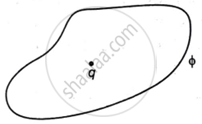
Φ = `oint vec E * d vec A`
= `q/epsilon_0`
Theorem: Gauss' Theorem
Statement
Gauss’s theorem in electrostatics states that the total electric flux through any closed surface (called a Gaussian surface) is equal to \[\frac {1}{ε_0}\] times the net charge enclosed by the surface, irrespective of the shape and size of the surface.
Mathematical Form
ΦE = \[\oint\vec{E}\cdot d\vec{A}=\frac{q_{\mathrm{enc}}}{\varepsilon_0}\]
where
- \[\vec E\] = electric field intensity
- d\[\vec{A}\] = outward normal area element
- qenc = net charge enclosed
- ε0 = permittivity of free space
Proof (Outline)
Consider a point charge +q placed inside a closed surface.
The electric field at a point on the surface is
E = \[\frac{1}{4\pi\varepsilon_0}\frac{q}{r^2}\]
The flux through a small area element dA is
dΦE = \[\vec{E}\cdot d\vec{A}=EdA\cos\theta\]
Since dAcosθ = r2dΩ,
dΦE = \[\frac{q}{4\pi\varepsilon_0}d\Omega\]
Integrating over the entire closed surface,
ΦE = \[\frac{q}{4\pi\varepsilon_0}\int d\Omega\]
But the total solid angle subtended by a closed surface is 4π,
ΦE = \[\frac {q}{ε_0}\]
Hence proved.
Key Note
Gauss’s law is most useful for symmetric charge distributions (spherical, cylindrical, planar) and is valid for all inverse-square law fields.
Key Points
Additivity of Charge
- Electric charge is additive — the total charge of a system is the algebraic sum of all charges in it.
- Example: A system with +5 C and −2 C has a net charge of +3 C.
- Electrostatic forces between two point charges obey Newton's Third Law — action and reaction are equal and opposite.
Key Points: Positive and Negative Charges
- Rubbing a glass rod with silk and an ebonite rod with cat-skin makes them electrically charged.
- A glass rod repels another glass rod, and an ebonite rod repels another ebonite rod when brought close.
- A rubbed glass rod attracts a rubbed ebonite rod, showing a different type of interaction.
- These experiments prove that electric charges are of two types.
- The charge on a glass rod is called positive, and the charge on an ebonite rod is called negative (named by Benjamin Franklin, 1750). Like charges repel, and unlike charges attract.
Key Points: Electron Theory of Electrification
- Matter is made of atoms consisting of a positively charged nucleus (protons and neutrons) with negatively charged electrons revolving around it.
- In a neutral atom, the number of electrons equals the number of protons, so the atom as a whole is electrically neutral.
- Electrons are responsible for electrification; protons do not move because they are tightly bound in the nucleus.
- Loss of electrons makes a body positively charged, while gain of electrons makes a body negatively charged.
- When two different materials rub together, electrons are transferred from one to the other, producing frictional electrification.
Key Points: Important Properties of Electric Charge
- Quantisation of charge: Electric charge exists in discrete packets, and the charge on any body is given by
q = ±ne
where n is an integer and e = 1.6 × 10⁻¹⁹ C is the elementary charge. - No fractional charge: Charge cannot exist as a fraction of eee (like 0.5e or 2.3e); hence, electric charge is atomic in nature.
- Conservation of charge: The total electric charge of an isolated system remains constant; charge can neither be created nor destroyed, only transferred.
- Experimental support: Processes such as rubbing, pair production and annihilation, and radioactive decay always conserve the net charge of the system.
- Invariance of charge: The value of electric charge does not change with velocity, unlike mass, which varies with speed.
Key Points: Electric Field
- A charge creates an electric field around it, and the field exists even if the charge is removed because the space has already been modified.
- The electric field exists at every point in three-dimensional space and does not depend on the test charge used to measure it (if the test charge is very small).
- For a positive source charge, the electric field is directed radially outward, while for a negative source charge, it is directed radially inward.
- The strength of the electric field decreases as the distance from the charge increases, and at equal distances from a point charge, the field has the same magnitude.
- The force on a charge in an electric field is given by \[\vec F\](r) = q\[\vec E\](r), and the SI unit of electric field is N/C.
Key Points: Properties of the Electric Lines of Force
- Electric field lines originate from positive charges and terminate on negative charges (or at infinity).
- The tangent to a field line at any point gives the direction of the electric field; in a uniform field, the lines are parallel and straight.
- No two electric field lines intersect, as this would imply more than one direction of the electric field at a point.
- Electric field lines do not pass through a conductor, showing that the electric field inside a conductor is zero.
- The density of field lines indicates field strength—closer lines represent a stronger field, while wider spacing represents a weaker field; the lines are continuous and imaginary, though the field is real.
Key Points: Applications of Gauss' Theorem
Key Points: Electric Flux
- SI unit of Electric flux = N·m²·C⁻¹ or V·m (since E = N / C = V/m).
- Dimensions of electric flux: [ΦE] = [E] [A] = [ML3T−3A−1]
Key Points: Gauss' Theorem
- Gauss’ theorem establishes a connection between the electric flux through a closed surface and the charge enclosed, and is especially useful for highly symmetric charge distributions.
- An area can be treated as a vector quantity, with both magnitude (area) and direction (the outward normal to the surface).
- A solid angle is the three-dimensional analogue of a plane angle and describes how a surface appears from a point.
- The total solid angle subtended at a point by a closed surface, irrespective of its shape, is always the same.
- The solid angle subtended by an area element depends on its orientation and position relative to the point, being maximum when the area faces the point directly.
Key Points: Gaussian Surface and its Properties
- A Gaussian surface is an imaginary closed surface used to calculate the electric flux of a vector field.
- It must be a closed surface (e.g., a sphere, cylinder, or cube); open surfaces such as discs or squares are not valid.
- The shape of the Gaussian surface should match the symmetry of the charge distribution so that the electric field is uniform or normal to the surface.
- The surface must not pass through any discrete charge, though it may pass through a continuous charge distribution.
- Electric flux through a Gaussian surface depends only on the charges enclosed, even though the electric field on the surface is due to both internal and external charges.
Key Points: Applications of Gauss’ Theorem
- Point Charge:
Using a spherical Gaussian surface, the electric field due to a point charge is
E = \[\frac{1}{4\pi\varepsilon_0}\frac{q}{r^2}\]which directly leads to Coulomb’s law. - Infinite Line of Charge:
For a uniformly charged infinite wire with linear charge density λ,
E = \[\frac{\lambda}{2\pi\varepsilon_0r}\]The field is radial and varies inversely with distance r. - Infinite Plane Sheet of Charge:
For a sheet with surface charge density σ,
E = \[\frac{\sigma}{2\varepsilon_0}\]The field is independent of distance from the sheet. - Two Parallel Charged Sheets:
The electric field is uniform between the sheets and zero outside when the sheets carry equal and opposite charges. - Charged Conductor:
The electric field inside a conductor is zero, and just outside the surface,
E = \[\frac{\sigma}{\varepsilon_0}\]where σ is surface charge density. - Uniformly Charged Spherical Shell / Conducting Sphere:
Outside the shell: behaves like a point charge at the centre
Inside the shell: the electric field is zero - Uniformly Charged Non-conducting Sphere:
Outside: E ∝ \[\frac {1}{r^2}\]Inside: E ∝ r, increasing linearly from centre to surface
Important Questions [16]
- What is meant by the statement: "Relative permittivity of water is 81"?
- A Charged Oil Drop Weighing 1.6 X 10⁻¹⁵ N is Found to Remain Suspended in a Uniform Electric Field of Intensity 2 X 10³ Nc-1. Find the Charge on the Drop.
- In case of an infinite line charge, how does intensity of electric field at a point change, if at all, when. charge on it is doubled? distance of the point is halved?
- The Intensity of the Electric Field at a Point at a Perpendicular Distance ‘R’ from an Infinite Line Charge, Having Linear Charge Density ‘λ’ is Given By:
- The Intensity of the Electric Field at a Perpendicular Distance of 0·5 M from an Infinitely Long Line Charge Having Linear Charge Density (λ) is 3-6 × 10³ Vm-1. Find the Value of λ.
- In an Electric Dipole, at Which Point is the Electric Potential Zero ?
- Derive an Expression for the Intensity of Electric Field at a Point in Broadside Position Or on [4) an Equatorial Line of an Electric Dipole.
- Two Point Charges Q1 = 400 μC and Q2 = 100 μC Are Kept Fixed, 60 Cm Apart in Vacuum. Find Intensity of the Electric Field at Midpoint of the Line Joining Q1 and Q2.
- A Short Electric Dipole (Which Consists of Two Point Charges, +Q and -q) is Placed at the Centre 0 and Inside a Large Cube (Abcdefgh) of Length L, as Shown in Figure 1. the Electric Flux, Emanating Through the Cube Is:
- Show that intensity of electric field at a point in broadside position of an electric dipole is given by: E = (1/4𝜋𝜀0)p/(r2+𝑙2)3/2 Where the terms have their usual meaning.
- In an electric dipole, what is the locus of a point having zero potential?
- A hollow sphere of radius R has a point charge q at its centre. Electric flux emanating from the sphere is X. How will the electric flux change, if at all, when radius of the sphere is doubled?
- A hollow sphere of radius R has a point charge q at its centre. Electric flux emanating from the sphere is X. How will the electric flux change, if at all,
- A hollow sphere of radius R has a point charge Q at its centre. Electric flux emanating from it is ϕ. If both the charge and the radius of the sphere are doubled
- A Closed Surface in Vacuum Encloses Charges –Q and +3q. the Total Electric Flux Emerging Out of the Surface
- State Gauss’ Law.
Concepts [32]
- Electric Charge
- Positive and Negative Charges
- Electron Theory of Electrification
- Conductors and Insulators
- Electrostatic Induction
- Important Properties of Electric Charge
- Scalar Form of Coulomb’s Law
- Coulomb's Law in Vector Form
- Principle of Superposition
- Equilibrium of Charge and System of Charges
- Electric Field
- Intensity of Electric Field
- Electric Field Intensity Due to a Point-Charge
- Intensity of Electric Field due to a Continuous Charge Distribution
- Electric Lines of Force
- Electric Dipole
- Electric Field due to an Electric Dipole
- Torque on a Dipole in a Uniform Electric Field
- Motion of a Charged Particle in Uniform Electric Field
- Area Vector
- Solid Angle
- Electric Flux
- Gauss' Theorem
- Gaussian Surface and its Properties
- Applications of Gauss' Theorem > Electric Field due to a Point Charge
- Applications of Gauss' Theorem > Electric Field due to an Infinite Line of Charge
- Applications of Gauss' Theorem > Electric Field due to an Infinite Plane Sheet of Charge
- Applications of Gauss' Theorem > Electric Field due to Two Infinite Parallel Sheets of Charge
- Applications of Gauss' Theorem > Electric Field Intensity Just Outside a Charged Conductor
- Applications of Gauss' Theorem > Electric Field due to a Uniformly Charged Thin Spherical Shell
- Applications of Gauss' Theorem > Electric Field due to a Uniformly Charged Sphere
- Overview: Gauss' Theorem
