- Gauss’s law is useful for finding the electric field in highly symmetric charge distributions (line, plane, sphere).
- For an infinitely long charged wire, the electric field is radial and depends only on the distance r from the wire.
- Electric field due to an infinite line charge decreases with distance:
E = \[\frac{\lambda}{2\pi\varepsilon_0r}\] - For an infinite plane sheet, the electric field is uniform and does not change with distance.
- Electric field due to an infinite plane sheet is:
E = \[\frac{\sigma}{2\varepsilon_0}\] - For a uniformly charged spherical shell, the field outside behaves like a point charge at the centre:
E = \[\frac{1}{4\pi\varepsilon_0}\frac{q}{r^2}\] - Inside a uniformly charged spherical shell, the electric field is zero.
Definitions [8]
Define Electric Flux.
The number of electric field lines crossing a given area, kept normal to the electric field lines, is called electric flux.
Definition: Electric Flux
A measure of electric field through a surface, given by the number of electric lines of force per unit area enclosing the electric lines of force, is called electric flux.
OR
Electric flux through a surface is defined as the dot product of the electric field vector and the area vector of the surface.
For any general surface,
Φ = \[\int_S\vec{E}\cdot d\vec{A}\]
Definition: Radian
“1 radian is the angle which an arc of length equal to the radius of a circle subtends at the centre of the circle.”
Definition: Steradian
“1 steradian is the solid angle subtended by a part of the surface of a sphere at the centre of the sphere, when the area of the part is equal to the square of the radius of the sphere.”
Definition: Electric Flux
The electric flux is a measure of the number of lines of force passing through some surface held in the electric field. It is denoted by ФE.
OR
The electric flux through a surface is the dot product of the electric field and the area vector of the surface, is called electric flux.
Definition: Electric Flux Through a Surface
The electric flux linked with a surface in an electric field may be defined as the surface integral of the normal component of the electric field over that surface.
Definition: Electric Flux Density
In an electric field, the ratio of electric flux through a surface to the area A of the surface is called the 'electric flux density' at the location of the surface.
Mathematical Definition:
Electric flux density = \[\frac {Φ_E}{A}\]
For a plane surface normal to the electric field:
Electric flux density = \[\frac {E A}{A}\] = E
Definition: Plane Angle
The arc of a circle subtends an angle at the centre of the circle. This angle is called a 'plane angle'.
Formulae [3]
Formula: Electric Flux
E = \[\frac {\text {Number of electric lines of force}}{\text {Area enclosing the electric lines of force}}\]
OR
Φ = EA cos θ
where:
- Φ = electric flux
- E = magnitude of the electric field
- A = area of the surface
- θ = angle between \[\vec{E}\] and the area vector \[\vec{E}\]
SI Unit
- SI unit of electric flux = N m² C⁻¹
- Equivalent SI unit = V m
Dimensional Formula: [ML3T-3A-1]
Formula: Electric Flux Through a Flat Surface in a Uniform Field
ФЕ = E A cos θ
- If the plane surface is normal to the electric field (θ = 0):
ФЕ = ЕА cos 0 = ЕА - If the plane surface is parallel to the electric field (θ = 90°):
Or = E A cos 90° = 0 - For field lines entering the plane surface normally (θ = 180°):
ФЕ = ЕА cos 180° = -EA
Formula: Electric Flux
\[\Phi_{E}=\int_{A}\vec{\mathbf{E}}\cdot d\vec{\mathbf{A}}\]
where,
∫A = is the (surface) integral over the entire surface
ΦE = is positive when lines leave the surface, negative when they enter.
OR
Electric flux through a small area element:
dΦ = E ⋅ dS = E dS cos θ
Total electric flux through a surface:
Φ = \[\int_S\vec{E}\cdot d\vec{S}\]
Theorems and Laws [2]
State Gauss’ Law.
The electric flux (ΦE) through any closed surface is equal to `1/in_0` times the ‘net’ change q enclosed by the surface.
ΦE = `oint vec E d vec A`
= `q/in_0`
∈0 = Permittivity of free space.
Gauss’ theorem states that the net electric flux over a closed surface is `1/epsilon_0` times the net electric charge enclosed by the surface.
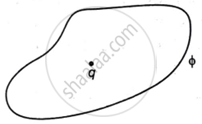
Φ = `oint vec E * d vec A`
= `q/epsilon_0`
Theorem: Gauss' Theorem
Statement
Gauss’s theorem in electrostatics states that the total electric flux through any closed surface (called a Gaussian surface) is equal to \[\frac {1}{ε_0}\] times the net charge enclosed by the surface, irrespective of the shape and size of the surface.
Mathematical Form
ΦE = \[\oint\vec{E}\cdot d\vec{A}=\frac{q_{\mathrm{enc}}}{\varepsilon_0}\]
where
- \[\vec E\] = electric field intensity
- d\[\vec{A}\] = outward normal area element
- qenc = net charge enclosed
- ε0 = permittivity of free space
Proof (Outline)
Consider a point charge +q placed inside a closed surface.
The electric field at a point on the surface is
E = \[\frac{1}{4\pi\varepsilon_0}\frac{q}{r^2}\]
The flux through a small area element dA is
dΦE = \[\vec{E}\cdot d\vec{A}=EdA\cos\theta\]
Since dAcosθ = r2dΩ,
dΦE = \[\frac{q}{4\pi\varepsilon_0}d\Omega\]
Integrating over the entire closed surface,
ΦE = \[\frac{q}{4\pi\varepsilon_0}\int d\Omega\]
But the total solid angle subtended by a closed surface is 4π,
ΦE = \[\frac {q}{ε_0}\]
Hence proved.
Key Note
Gauss’s law is most useful for symmetric charge distributions (spherical, cylindrical, planar) and is valid for all inverse-square law fields.
Key Points
Key Points: Applications of Gauss' Theorem
Key Points: Electric Flux
- SI unit of Electric flux = N·m²·C⁻¹ or V·m (since E = N / C = V/m).
- Dimensions of electric flux: [ΦE] = [E] [A] = [ML3T−3A−1]
Key Points: Gauss' Theorem
- Gauss’ theorem establishes a connection between the electric flux through a closed surface and the charge enclosed, and is especially useful for highly symmetric charge distributions.
- An area can be treated as a vector quantity, with both magnitude (area) and direction (the outward normal to the surface).
- A solid angle is the three-dimensional analogue of a plane angle and describes how a surface appears from a point.
- The total solid angle subtended at a point by a closed surface, irrespective of its shape, is always the same.
- The solid angle subtended by an area element depends on its orientation and position relative to the point, being maximum when the area faces the point directly.
Key Points: Gaussian Surface and its Properties
- A Gaussian surface is an imaginary closed surface used to calculate the electric flux of a vector field.
- It must be a closed surface (e.g., a sphere, cylinder, or cube); open surfaces such as discs or squares are not valid.
- The shape of the Gaussian surface should match the symmetry of the charge distribution so that the electric field is uniform or normal to the surface.
- The surface must not pass through any discrete charge, though it may pass through a continuous charge distribution.
- Electric flux through a Gaussian surface depends only on the charges enclosed, even though the electric field on the surface is due to both internal and external charges.
Key Points: Applications of Gauss’ Theorem
- Point Charge:
Using a spherical Gaussian surface, the electric field due to a point charge is
E = \[\frac{1}{4\pi\varepsilon_0}\frac{q}{r^2}\]which directly leads to Coulomb’s law. - Infinite Line of Charge:
For a uniformly charged infinite wire with linear charge density λ,
E = \[\frac{\lambda}{2\pi\varepsilon_0r}\]The field is radial and varies inversely with distance r. - Infinite Plane Sheet of Charge:
For a sheet with surface charge density σ,
E = \[\frac{\sigma}{2\varepsilon_0}\]The field is independent of distance from the sheet. - Two Parallel Charged Sheets:
The electric field is uniform between the sheets and zero outside when the sheets carry equal and opposite charges. - Charged Conductor:
The electric field inside a conductor is zero, and just outside the surface,
E = \[\frac{\sigma}{\varepsilon_0}\]where σ is surface charge density. - Uniformly Charged Spherical Shell / Conducting Sphere:
Outside the shell: behaves like a point charge at the centre
Inside the shell: the electric field is zero - Uniformly Charged Non-conducting Sphere:
Outside: E ∝ \[\frac {1}{r^2}\]Inside: E ∝ r, increasing linearly from centre to surface
Important Questions [5]
- A hollow sphere of radius R has a point charge Q at its centre. Electric flux emanating from it is ϕ. If both the charge and the radius of the sphere are doubled
- A hollow sphere of radius R has a point charge q at its centre. Electric flux emanating from the sphere is X. How will the electric flux change, if at all, when radius of the sphere is doubled?
- A hollow sphere of radius R has a point charge q at its centre. Electric flux emanating from the sphere is X. How will the electric flux change, if at all,
- A Closed Surface in Vacuum Encloses Charges –Q and +3q. the Total Electric Flux Emerging Out of the Surface
- State Gauss’ Law.
Concepts [13]
- Area Vector
- Solid Angle
- Electric Flux
- Gauss' Theorem
- Gaussian Surface and its Properties
- Applications of Gauss' Theorem > Electric Field due to a Point Charge
- Applications of Gauss' Theorem > Electric Field due to an Infinite Line of Charge
- Applications of Gauss' Theorem > Electric Field due to an Infinite Plane Sheet of Charge
- Applications of Gauss' Theorem > Electric Field due to Two Infinite Parallel Sheets of Charge
- Applications of Gauss' Theorem > Electric Field Intensity Just Outside a Charged Conductor
- Applications of Gauss' Theorem > Electric Field due to a Uniformly Charged Thin Spherical Shell
- Applications of Gauss' Theorem > Electric Field due to a Uniformly Charged Sphere
- Overview: Gauss' Theorem
