Advertisements
Advertisements
प्रश्न
Think of different types of people who have to face great difficulties. Write what you can do to help at least one of them.
Advertisements
उत्तर
- Many people encounter significant challenges, including those with physical disabilities, those living in poverty, the elderly, and others. To make things simpler for the poor, we can provide different supports to improve their standard of living, such as free education for children up to grade 12.
- Basic food commodities such as wheat and rice can be made more affordable for individuals.
- Their dwellings might have a concrete roof and walls installed for free or at a low cost. These things can help people survive and overcome their daily challenges.
APPEARS IN
संबंधित प्रश्न
Which literary device is used in the last two lines:
Tinkling, luminous, tender, and clear, Like her bridal laughter and bridal tear.
Write a short note on Abou bin Adhem.
What is the message of the poem?
Join the following sentence to make one complete sentence without using and, but or so.
My grandfather is very old. He is very active.
Why couldn't the narrator sleep?
In what ways do you think we could help prevent the extinction of languages and dialects?
Here are some commonly used medical terms. Find out their meanings.
| CT scan | MRI | tomography |
| Autopsy | dialysis | ECG |
| Post mortem | angiography | biopsy |
Discuss with your partners
Reading plays is more interesting than studying science.
What is the poet’s feeling towards childhood?
What is a space shuttle? Name the shuttle which took Kalpana in space.
What did the myna do finally?
A poem for you to read
All but Blind*
All but blind
In his chambered hole
Gropes for worms
The four-clawed Mole.
All but blind
In the evening sky
The hooded Bat
Twirls softly by.
All but blind
In the burning day
The Barn Owl blunders
On her way.
And blind as are
These three to me,
So, blind to Someone
I must be.
Write down the consequences of the following occurrences with the help of the play.
Dr. Thomas Stockmann wants an article exposing social evils to be printed in the newspaper.
Write in your own words, how the Robinson family made each of their homes.
Think and write in your own words.
Why do you think, birds greet the autumn season gladly?
‘..... and that’s how I realized that courage and hope can help me overcome any major mishap/problem in life.’ Write an episode/experience from your own life that leads to the above conclusion.
Look at the two trees. One is a green flourishing tree and the other, a brown withering tree.
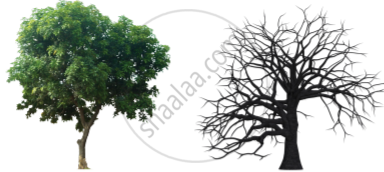
The class will now be divided into two groups. Group A will list down the agents that support a tree’s growth. Group B will list down those that prevent it. Once the groups are ready with their lists, a few representatives from each group will write down the lists on the black board.
Write a Diary entry each day for a month and compile them into a book. You may also name your diary as Anne Frank did.
You find it tough to learn a new language ______
Arrange the jumbled sentences and write a paragraph. Use appropriate conjunctions.
Jane Eyre is an orphan.
She lives with her aunt Mrs. Reed.
Mrs. Reed does not like Jane because Jane is not her daughter.
Jane’s uncle Mr. Reed likes Jane, but he dies.
He makes Mrs. Reed promise to take care of Jane, but instead she sends Jane away.
Jane is ten years old, she is sent to Lowood school.
Jane graduates and stays there to teach.
She leaves for Thornfield, where she is a governess.
She is very happy there.
Application form annual day participation.

Two stories got mixed up. Sort them out and write them in the appropriate boxes.
- We thought the lion had eaten someone.
- Suddenly the kite lifted him off the ground and took him over the treetops.
- He saw a shoe in the lion's cage.
- Finally, the kite brought him back to the park.
- Our class had gone to the zoo.
- Puran was flying the brand new kite in the park.
- Some children stood and screamed, and some ran to the Director of the zoo.
- Puran was frightened and excited.
- The lion had not eaten anyone, because the shoe was one of the lion's toys.
Correct the use of the describing word in the following sentence.
Which is the lightest of the two parcels?
Use the option to fill in the blank.
Ram ______ a good football player.
Some words have similar sound, but different meaning. Choose the correct word from the option and fill in the blank.
The squirrel has a long ______.
Some word have similar sound, but different meaning. Choose the correct word from the option and fill in the blank.
He is our school ______.
I can do the sum ________. [easy}
Rearrange the sentences given below and write a summary of the story in a paragraph. Begin with:
Philip Sletherby was travelling by train to Brill Manor.
- The young man introduced himself as Bertie, the son of Saltpen Jago.
- Bertie needed three pounds desperately and asked Sletherby to lend it to him.
- All the time Sletherby was gazing at the door panel of the car, on which were the two crests – a demi-lion and a greyhound courant.
- He was received by Claude People. K.C., who had kept on talking about various things.
- Bertie had left his purse behind, after sealing an envelope with the crest on the purse.
- Bertie stated that it was the Jago crest. He further added that his mother’s hair was dark brown similar to his.
- While describing the appearance of Honario Saltpen-Jago, K.C. referred to her altered hairstyle.
- Sletherby realized that Bertie had not lied to him, but that he had mistaken him for fraud.
- He explained that the Saltpen crest was that of a demi-lion.
- Sletherby sat dumbstruck on learning that Mrs. Honario Saltpen Jago had changed her dark brown hair to a blonde, just five weeks ago.
- Sletherby pointed out to him that his mother’s letter had a greyhound courant crest.
- His companion in the train was a young man who was searching for something frantically
- Suspecting foul play, Sletherby did not give him any money, as he knew Mrs. Saltpen-Jago was a blonde.
Observe the following picture and write a paragraph in about 150 word about each one of them.

Write a composition (in approximately 400-450 words) on the following subject:
Music
