Advertisements
Advertisements
प्रश्न
The speed-time graph for a car is shown in the following figure:
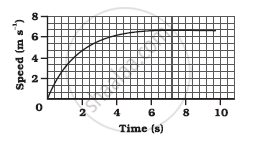
- Find how far the car travels in the first 4 seconds. Shade the area on the graph that represents the distance travelled by the car during the period.
- Which part of the graph represents uniform motion of the car?
Advertisements
उत्तर
The motion during the first 4 seconds is not uniformly accelerated. So, the distance travelled by car in the first 4 seconds is calculated using the graphical method.
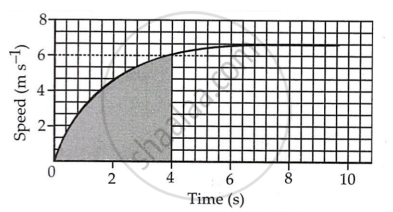
(a) Number of squares in the shaded part of the graph is 320.5
One small square m x-axis represents `t = 2/5 s`
One small square on the y-axis represents.
`v = 2/3 ms^-1`
∴ area of each square, `v xx t`
= `2/3 xx 2/5`
= `4/15 m`
Total area = `61.5 × 4/15`
= 16.4 m
(b) The limiting flat portion of the curve describes the constant speed of the car, i.e., a speed of 6.0 m s−1. At this stage, the acceleration of the car is zero.
Therefore, a portion of the graph between t = 6 s to 10 s, describes the uniform motion of the car.
APPEARS IN
संबंधित प्रश्न
What is the nature of the distance-time graphs for uniform and non-uniform motion of an object?
What can you say about the motion of an object if its speed-time graph is a straight line parallel to the time axis?
Figure shows the distance-time graph for the motion of two vehicles A and B. Which one of them is moving faster?
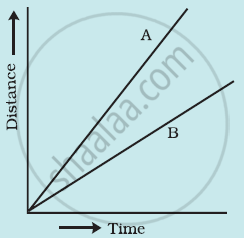
Figure: Distance-time graph for the motion of two cars
Which of the following distance-time graphs shows a truck moving with speed which is not constant?
What does the slope of a distance-time graph indicate ?
Four cars A, B, C and D are moving on a levelled, straight road. Their distance-time graphs are shown in the given figure. Which of the following is the correct statement regarding the motion of these cars?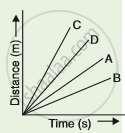
A student draws a distance-time graph for a moving scooter and finds that a section of the graph is horizontal line parallel to the time axis. Which of the following conclusion is correct about this section of the graph?
Write down the type of motion of a body in each of the following distance time-graph.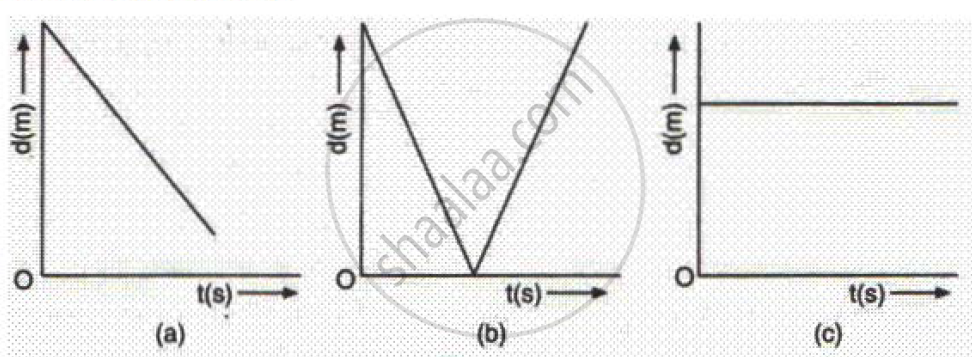
The slope of the distance-time graph indicates the speed.
Assertion: The position-time graph of a uniform motion in one dimension of a body can have a negative slope
Reason: When the speed of the body decreases with time then, the position-time graph of the moving body has a negative slope.
