Advertisements
Advertisements
प्रश्न
The size of an atom depends on the number of valence electrons.
विकल्प
Right
Wrong
Advertisements
उत्तर
The size of an atom depends on the number of valence electrons- Wrong
APPEARS IN
संबंधित प्रश्न
Arrange the following as per the instruction given in the brackets:
Na, K, Li (Increasing atomic size)
Answer the following in respect of element `31/15 P `
Is it a reducing agent or oxidizing agent?
Which is greater in size an atom or an anion?
Give scientific reasons for the following:
Atomic radius goes on decreasing while going from left to right in a period.
Fill in the blanks.
Size of the atoms ______ from left to right across a period and ______ on descending in a group of normal elements.
Arrange the following in increasing order of property indicated
I, I+, I- (atomic size)
Supply the missing word from those in the brackets:
If an element has seven electrons in its outermost shell then it is likely to have the ______ (largest/ smallest) atomic size among all the elements in the same period.
The changes in the properties of elements on moving from left to right across a period of the Periodic Table. For the property, choose the correct answer.
The atomic size:
Write scientific reason.
In same period, boron and oxygen elements have different atomic size.
Which of the following is the correct order of atomic size?
Which of the following gives the correct increasing order of the atomic radii of O, F, and N?
Which among the following elements has the largest atomic radii?
Which of the following are the characteristics of isotopes of an element?
- Isotopes of an element have same atomic masses
- Isotopes of an element have same atomic number
- Isotopes of an element show same physical properties
- Isotopes of an element show same chemical properties
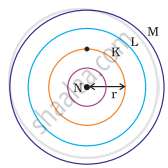
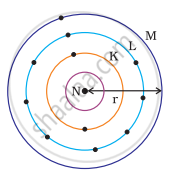
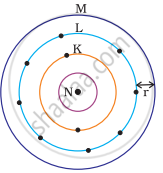
Which one of the following depict the correct representation of atomic radius(r) of an atom?
|
(i) |
(ii) |
|
(iii) |
(iv) |

An element X (atomic number 17) reacts with an element Y (atomic number 20) to form a divalent halide.
- Where in the periodic table are elements X and Y placed?
- Classify X and Y as metal (s), non-metal (s) or metalloid (s)
- What will be the nature of oxide of element Y? Identify the nature of bonding in the compound formed
- Draw the electron dot structure of the divalent halide
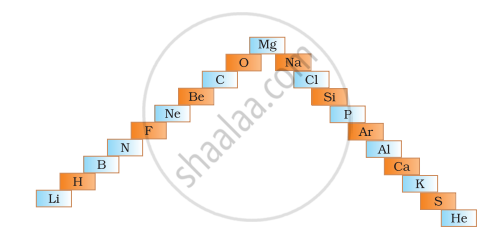
- In below ladder symbols of elements are jumbled up. Rearrange these symbols of elements in the increasing order of their atomic number in the Periodic Table.
- Arrange them in the order of their group also.
Arrange the following in order of increasing radii:
Cl−, Cl
Explain your choice.
Which one has the largest size?
Give reason for the following:
The size of a Cl− ion is greater than the size of a Cl atom.
