Advertisements
Advertisements
प्रश्न
The perimeter of a triangle is 14.4 cm and the ratio of lengths of its side is 2 : 3 : 4. Construct the triangle.
Advertisements
उत्तर १
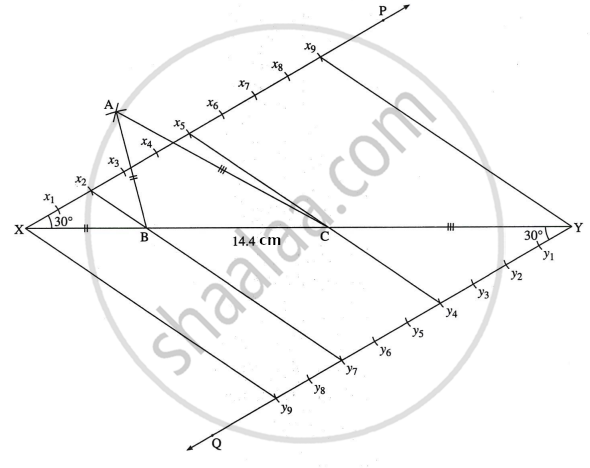
Explanation:
Let ΔABC be the required triangle.
Draw the line XY = 14.4 cm, which is the perimeter of ΔABC.
Divide line XY in the ratio 2:3:4.
Draw ray XP such that, ∠YXP = 30°.
Draw line YQ on the opposite side of ray XP such that, `angle`XYQ = 30°.
Make ray XP into 9 equal parts i.e. `"X"_(x_1)`,x1x2, ... x8x9.
Similarly, according to the figure, make 9 equal parts of ray YQ.
Join x2y7 and x5y4, intersecting line XY at B and C respectively.
Draw an arc considering B as center and BX as radius.
Taking C as center and CY as radius, draw an arc which intersects the first arc at point A.
Draw line AB and line AC.
∴ ΔABC is the required triangle.
उत्तर २
Rough figure:
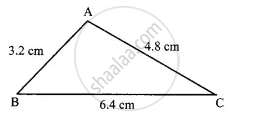
Explanation:
Let the common multiple be x
∴ In ∆ABC,
AB = 2x cm, AC = 3x cm, BC = 4x cm
Perimeter of triangle = 14.4 cm
∴ AB + BC + AC = 14.4
∴ 9x = 14.4
∴ `x = 14.4/9`
∴ x = 1.6
∴ AB = 2x = 2 × 1.6 = 3.2 cm
∴ AC = 3x = 3 × 1.6 = 4.8 cm
∴ BC = 4x = 4 × 1.6 = 6.4 cm
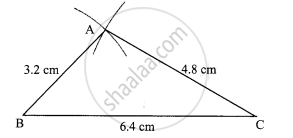
APPEARS IN
संबंधित प्रश्न
Draw an isosceles triangle with base 5 cm and the other sides 3.5 cm each.
Choose the lengths of the sides yourself and draw one equilateral, one isosceles and one scalene triangle.
Draw triangle with the measures given below.
In ∆PRS, l(RS) = 5.5 cm, l(RP) = 4.2 cm, m ∠R = 90°
Construct a triangle of the measures given below.
In ∆MNP, l(NP) = 5.2 cm, m∠N = 70°, m ∠P = 40°
Construct a triangle of the measures given below.
Construct a triangle of the measures given below.
Construct a triangle of the measures given below.
Students should take examples of their own and practise the construction of triangles.
Construct a triangle using the given data: XY = 5.2cm, XZ = 6.5cm and ∠X = 75°
Construct an isosceles triangle in which: AB = AC, BC = 6 cm and ∠B = 75°
Construct an isosceles triangle in which: XY = XZ, YZ = 5.5 cm and ∠X = 60°
Construct an isosceles triangle in which: PQ = QR, PR = 4.5 cm and ∠R = 60°
Construct a triangle using the given data: AB - AC = 1.2 cm, BC = 6.0 cm and ∠B = 60°
Construct a triangle using the given data: Perimeter of triangle is 10.6 cm, and the base angles are 60° and 45°
Which tool is essential for drawing arcs while constructing a triangle using given side measurements?
For constructing △XYZ where XY = 6 cm, YZ = 5 cm, and XZ = 4 cm, which construction method should be used?
In Construction of △ABC where AB = 3 cm, BC = 5 cm, and ∠ABC = 60°, which side must be drawn first as the base?
