Advertisements
Advertisements
प्रश्न
The adjacent sides of a parallelogram ABCD measure 34 cm and 20 cm, and the diagonal AC measures 42 cm. Find the area of the parallelogram.
Advertisements
उत्तर
Given that adjacent sides of a parallelogram ABCD measure 34 cm and 20 cm, and the diagonal AC measures 42 cm.
Area of parallelogram = Area of ΔADC + area of ΔABC
[∵ Diagonal of a parallelogram divides into two congruent triangles]
= 2 ×[𝐴𝑟𝑒𝑎 𝑜𝑓 Δ𝐴𝐵𝐶]
Now for Area of ΔABC
Let 2s = AB + BC + CA [∵ Perimeter of ΔABC]
`⇒S=1/2(AB+BC+CA)`
`=S=1/2(34+20+42)`
`=1/2=(96)=48cm`
∴Area of ΔABC =`sqrt(s(s-ab))`
`=sqrt(48(48-34)(48-20)(48-42))`
`=sqrt(48(14)(28)(6))=336 cm^2`
∴𝐴𝑟𝑒𝑎 𝑜𝑓 𝑝𝑎𝑟𝑎𝑙𝑙𝑒𝑙𝑜𝑔𝑟𝑎𝑚 𝐴𝐵𝐶𝐷=2[𝐴𝑟𝑒𝑎 𝑜𝑓 Δ𝐴𝐵𝐶]=2×336=`672 cm^2`
APPEARS IN
संबंधित प्रश्न
The perimeter of an isosceles triangle is 42 cm and its baše is (32) times each of the equal sides. Find the length of each side of the triangle, area of the triangle and the height of the triangle.
Find the area of a triangle whose base and altitude are 5 cm and 4 cm respectively.
Find the area of the triangle formed by the points
(–10, –4), (–8, –1) and (–3, –5)
Using Heron’s formula, find the area of a triangle whose sides are 1.8 m, 8 m, 8.2 m
If the side of a rhombus is 10 cm and one diagonal is 16 cm, the area of the rhombus is 96 cm2.
Find the area of a parallelogram given in figure. Also find the length of the altitude from vertex A on the side DC.
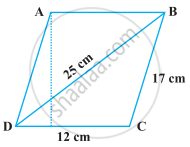
A field in the form of a parallelogram has sides 60 m and 40 m and one of its diagonals is 80 m long. Find the area of the parallelogram.
How much paper of each shade is needed to make a kite given in the following figure, in which ABCD is a square with diagonal 44 cm.
In the following figure, ∆ABC has sides AB = 7.5 cm, AC = 6.5 cm and BC = 7 cm. On base BC a parallelogram DBCE of same area as that of ∆ABC is constructed. Find the height DF of the parallelogram.

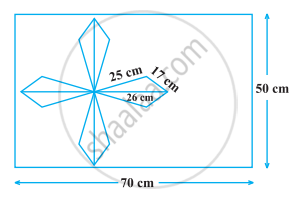
A design is made on a rectangular tile of dimensions 50 cm × 70 cm as shown in the following figure. The design shows 8 triangles, each of sides 26 cm, 17 cm and 25 cm. Find the total area of the design and the remaining area of the tile.