Advertisements
Advertisements
प्रश्न
If the side of a rhombus is 10 cm and one diagonal is 16 cm, the area of the rhombus is 96 cm2.
विकल्प
True
False
Advertisements
उत्तर
This statement is True.
Explanation:
To find the area of rhombus, we divide it into two triangles.
As all the sides of a rhombus are equal, we have for a triangle
a = 10, b = 10, c = 16
`s = (a + b + c)/2`
⇒ `s = (10 + 10 + 16)/2 = 36/2 = 18`.
Area (Δ) = `sqrt(s(s - a)(s - b)(s - c))`
⇒ Area (Δ) = `sqrt(18(18 - 10)(18 - 10)(18 - 16))`
⇒ Area (Δ) = `sqrt(18 xx 8 xx 8 xx 2)`
⇒ Area (Δ) = 48 cm2
As the sides of the other triangle are also same, so their areas will also be equal.
Area (Rhombus) = Area (Δ) + Area (Δ)
⇒ Area (Rhombus) = 48 + 48 = 96 cm2
APPEARS IN
संबंधित प्रश्न
Sides of a triangle are in the ratio of 12 : 17 : 25 and its perimeter is 540 cm. Find its area.
Some measures are given in the adjacent figure, find the area of ☐ABCD.
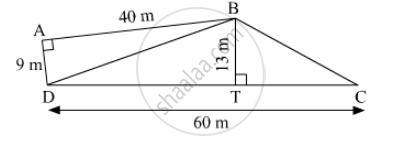
The area of triangle formed by the points (− 5, 0), (0, – 5) and (5, 0) is
A man walks near a wall, such that the distance between him and the wall is 10 units. Consider the wall to be the Y-axis. The path travelled by the man is
Using Heron’s formula, find the area of a triangle whose sides are 10 cm, 24 cm, 26 cm
The perimeter of a triangular plot is 600 m. If the sides are in the ratio 5 : 12 : 13, then find the area of the plot
Find the area of an equilateral triangle whose perimeter is 180 cm
A field in the form of a parallelogram has sides 60 m and 40 m and one of its diagonals is 80 m long. Find the area of the parallelogram.
The perimeter of a triangular field is 420 m and its sides are in the ratio 6 : 7 : 8. Find the area of the triangular field.
A rhombus shaped sheet with perimeter 40 cm and one diagonal 12 cm, is painted on both sides at the rate of Rs 5 per m2. Find the cost of painting.
