Advertisements
Advertisements
प्रश्न
If the side of a rhombus is 10 cm and one diagonal is 16 cm, the area of the rhombus is 96 cm2.
पर्याय
True
False
Advertisements
उत्तर
This statement is True.
Explanation:
To find the area of rhombus, we divide it into two triangles.
As all the sides of a rhombus are equal, we have for a triangle
a = 10, b = 10, c = 16
`s = (a + b + c)/2`
⇒ `s = (10 + 10 + 16)/2 = 36/2 = 18`.
Area (Δ) = `sqrt(s(s - a)(s - b)(s - c))`
⇒ Area (Δ) = `sqrt(18(18 - 10)(18 - 10)(18 - 16))`
⇒ Area (Δ) = `sqrt(18 xx 8 xx 8 xx 2)`
⇒ Area (Δ) = 48 cm2
As the sides of the other triangle are also same, so their areas will also be equal.
Area (Rhombus) = Area (Δ) + Area (Δ)
⇒ Area (Rhombus) = 48 + 48 = 96 cm2
APPEARS IN
संबंधित प्रश्न
Sides of a triangle are in the ratio of 12 : 17 : 25 and its perimeter is 540 cm. Find its area.
An isosceles triangle has perimeter 30 cm and each of the equal sides is 12 cm. Find the area of the triangle.
The lengths of the sides of a triangle are in the ratio 3 : 4 : 5 and its perimeter is 144 cm. Find the area of the triangle and the height corresponding to the longest side.
A triangle and a parallelogram have the same base and the same area. If the sides of the triangle are 13 cm, 14 cm and 15 cm and the parallelogram stands on the base 14 cm, find the height of the parallelogram.
Determine whether the sets of points are collinear?
`(-1/2, 3), (-5, 6) and (-8, 8)`
Determine whether the sets of points are collinear?
(a, b + c), (b, c + a) and (c, a + b)
The sides of a quadrilateral ABCD are 6 cm, 8 cm, 12 cm and 14 cm (taken in order) respectively, and the angle between the first two sides is a right angle. Find its area.
A field is in the shape of a trapezium having parallel sides 90 m and 30 m. These sides meet the third side at right angles. The length of the fourth side is 100 m. If it costs Rs 4 to plough 1 m2 of the field, find the total cost of ploughing the field.
In the following figure, ∆ABC has sides AB = 7.5 cm, AC = 6.5 cm and BC = 7 cm. On base BC a parallelogram DBCE of same area as that of ∆ABC is constructed. Find the height DF of the parallelogram.

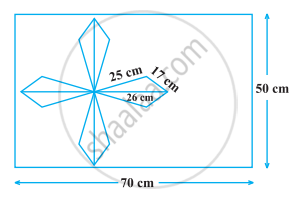
A design is made on a rectangular tile of dimensions 50 cm × 70 cm as shown in the following figure. The design shows 8 triangles, each of sides 26 cm, 17 cm and 25 cm. Find the total area of the design and the remaining area of the tile.