Talk to your partner about the following. Describe the changing relationship between the author and his grandmother. Did their feelings for each other change?
Advertisements
Advertisements
प्रश्न
Talk to your partner about the following.
Describe the changing relationship between the author and his grandmother. Did their feelings for each other change?
Advertisements
उत्तर
The story highlights the evolving relationship between the author and his grandmother. In his early childhood, they shared a close bond, but it weakened when they moved to the city. She stopped accompanying him to school, and the distance grew further when he went to university and later abroad for five years. Despite these changes, their affection for each other remained unchanged. Though she rarely showed emotions, she celebrated his homecoming wholeheartedly after his return.
APPEARS IN
संबंधित प्रश्न
Read the passage given below and answer the questions that follow:
1. Air pollution is an issue which concerns us all alike. One can willingly choose or reject a food, a drink or a life comfort, but unfortunately there is little choice for the air we breathe. All, what is there in the air is inhaled by one and all living in those surroundings.
2. Air pollutant is defined as a substance which is present while normally it is not there or present in an amount exceeding the normal concentrations. It could either be gaseous or a particulate matter. The important and harmful polluting gases are carbon monoxide, carbon dioxide, ozone and oxides of sulphur and nitrogen. The common particulate pollutants are the dusts of various inorganic or organic origins. Although we often talk of the outdoor air pollutions caused by industrial and vehicular exhausts, the indoor pollution may prove to be as or a more important cause of health problems.
3. Recognition of air pollution is relatively recent. It is not uncommon to experience a feeling of 'suffocation' in a closed environment. It is often ascribed to the lack of oxygen. Fortunately, however, the composition of air is remarkably constant all over the world. There is about 79 per cent nitrogen and 21 per cent oxygen in the air − the other gases forming a very small fraction. It is true that carbon dioxide exhaled out of lungs may accumulate in a closed and over-crowded place. But such an increase is usually small and temporary unless the room is really air-tight. Exposure to poisonous gases such as carbon monoxide may occur in a closed room, heated by burning coal inside. This may also prove to be fatal.
4. What is more common in a poorly ventilated home is a vague constellation of symptoms described as the sick-building syndrome. It is characterized by a general feeling of malaise, head-ache, dizziness and irritation of mucous membranes. It may also be accompanied by nausea, itching, aches, pains and depression. Sick building syndrome is getting commoner in big cities with the small houses, which are generally over-furnished. Some of the important pollutants whose indoor concentrations exceed those of the outdoors include gases such as carbon monoxide, carbon dioxide, oxides of nitrogen and organic substances like spores, formaldehydes, hydrocarbon aerosols and allergens. The sources are attributed to a variety of construction materials, insulations, furnishings, adhesives, cosmetics, house dusts, fungi and other indoor products.
5. By-products of fuel combustion are important in houses with indoor kitchens. It is not only the brining of dried dung and fuelwood which is responsible, but also kerosene and liquid petroleum gas. Oxides of both nitrogen and sulphur are released from their combustion.
6. Smoking of tobacco in the closed environment is an important source of indoor pollution. It may not be high quantitatively, but significantly hazardous for health. It is because of the fact that there are over 3000 chemical constituents in tobacco smoke, which have been identified. These are harmful for human health.
7. Micro-organisms and allergens are of special significance in the causation and spread of diseases. Most of the infective illnesses may involve more persons of a family living in common indoor environment. These include viral and bacterial diseases like tuberculosis.
8. Besides infections, allergic and hypersensitivity disorders are spreading fast. Although asthma is the most common form of respiratory allergic disorders, pneumonias are not uncommon, but more persistent and serious. These are attributed to exposures to allergens from various fungi, molds, hay and other organic materials. Indoor air ventilation systems, coolers, air-conditioners, dampness, decay, pet animals, production or handling of the causative items are responsible for these hypersensitivity − diseases.
9. Obviously, the spectrum of pollution is very wide and our options are limited. Indoor pollution may be handled relatively easily by an individual. Moreover, the good work must start from one’s own house
(Extracted from the Tribune)
(a) (i) What is an air pollutant? (1)
(ii) In what forms are the air pollutants present? (2)
(iii) Why do we feel suffocated in a closed environment? (1)
(iv) What is sick building syndrome? How is it increasing? (2)
(v) How is indoor smoking very hazardous? (1)
(vi) How can one overcome the dangers of indoor air pollution? (2)
(b) Find the words from the above passage which mean the same as the following: (3)
(i) giddiness (para 4)
(ii) constant (para 8)
(iii) humidity (para 8)
After the convocation, Mrs. Mini, Rahul’s mother and Rahul have a conversation. Write the conversation and present it to the class in groups of three.
Talk to your partner about the following.
Have you known someone like the author’s grandmother? Do you feel the same sense of loss with regard to someone whom you have loved and lost?
Describe the shifts in the narration of the events as indicated in the three sections of the text. Give a subtitle to each section.
Discuss the following in pairs or in small groups.
What were the voices that Paul heard? Did they lead him to success in the real sense?
Examine the communication channels in the story between Basset and Paul's uncle.
Identify the common characteristics shared by tribal communities all over the world.
The best punishment is ‘forgiveness’. Discuss the sentence in light of the text you have read. You can make use of the following points.
(a) Forgiveness provides an opportunity to change the behaviour.
(b) Forgiveness leads to repentance.
(c) A person may commit a mistake/crime impulsively or under the force of strong emotions.
(d) ________________________
(e) ________________________
Find evidence from the lesson and write in your own words.
We Indians are obsessed with foreign things.
Discuss in groups, reasons/ consequences/ effects:
The cherry blossomed.
Compare and contrast the two opposing human feelings as expressed by the poet.
Correct the following statement.
Sue and Johnsy were good neighbours.
Say where . . . . . . .
______ do squirrels store their food?
Go through the poem and state whether the following statement is true or false.
Planners plan to construct buildings wherever they find a place.
Join the sentence using appropriate Co-ordinators. (but, or, so, and)
He places his fingers into the master controls. He operates all four arms of the Da Vinci.
Ask your parents to show you TV programs on animals, wildlife and conservation on channels like the following:
DD National, National Geographic, Discovery, and Animal Planet.
Apart from the children, no other human beings are mentioned in the poem. However, many natural elements are shown to act like persons. Name them and also write what they do.
Read the given words and share with your friend what comes to your mind.

Form groups and hold debates on the following topics. Make bulleted lists of points in favour of the topic (pros) and those against it (cons). (3-6 points each)
You should admit your mistakes.
Complete the following using your own idea:
His head was too big to ______.
An activity:
Speak fast, think faster ! Form groups of 4-6. Discuss each of the following topics. Then each person in the group should choose a topic and speak about it for one minute. Try to say as many sentences as you can in that time.
What may happen...
I may study... A bird may fly into the classroom. The Principal may call me... It may rain... A dog may chase a cat... A king may lose his kingdom... My friend may give me a storybook to read... Mother may make idlis today...’ etc.
Complete the following sentence with reference to the passage:
Gautama, the Buddha, was born over two thousand five hundred years ago, as ______.
This story takes an unexpected turn when the lion decides to spare the camel’s life. Choose any fable, a story that you like, and rewrite it giving it an unexpected turn.
What changes do we see in the life of human beings when the season changes? Write with reference to their celebrations.
Find out how the following game is played.
Football
Look at the photographs on textbook pages 19-20 carefully and imagine the following:
- The colours, shape, size, actions, etc. of what you see in the picture.
- The sound/sounds you may hear at the scene of the photograph.
- How the different things, birds, animals, etc. in the picture feel to the touch.
- The smell / smells you may smell at the scene of the picture.
- The taste of what you see in the pictures.
In short, let your imagination include oil your five senses.
Now, write short descriptions of any 8-10 of your choice.
Remember to make use of your senses (one or more!) when you describe a photograph. You will find the following words and phrases useful. You may also use other words you know.
Have you ever seen or used a computer?
What is meant by browsing or surfing?
Give an instance that shows the pathetic condition of the young bird.
Look at the following expressions from the text. With the help of your teacher rewrite them in standard English. One has been done for you.
| 1. ‘Musta got away – whatt’d he like? | Must got away - what was he like?’ |
| 2. ‘Looky here, Joe | |
| 3. ‘No sign o’ nothing’ | |
| 4. ‘Back t’ the lines ye goodaam | |
| 5. ‘What was the idea of all them cops tarryhootin’ round the house last night. |
Read the incident again and answer the following question.
When did the writer remember the fact that he had to buy something for Mr. Gilson?
What did Aravind confess?
Why did Anne want to exchange the book ‘Camera Obscura’?
Read the data below and answer the following question.
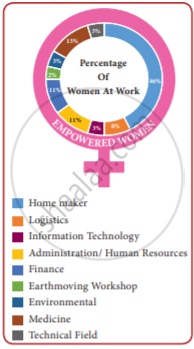
Choose the correct answer.
Percentage of women working in finance is the same as ______.
Hamid thought that his grandma would be pleased if he bought______
Identify the character/speaker.
Oh no, I'll never get back to the right size.
Can a courageous man be defeated? Why?
What are the characteristics of a courageous man?
Identify the speaker/character.
A man fell into the sea. Please save him.
A sea turtle camouflages its nest by tossing sand on it to ______.
What is the poem about?
Mother called ______.
Mithali’s mother tongue is Telugu.
Identify and write the sport's name respectively.
- ______
- ______
- ______
- ______
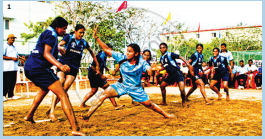


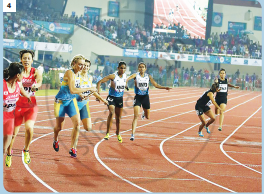
How should one react to adversity?
The wild boar settled down scraping the hole into a ______ to have a good sleep.
Read the lines and answer the questions given below.
Summer comes
in a blaze of heat with
sunny smiles
and dusty feet
- Does the poet welcome the summer? How do you know?
- Which line tells you that there is no rain in summer?
What should we do to save the Earth?
How did the cavalry officers look? What happened to them finally?
Were the girl and her brother friendly with each other?
Look at the picture and Choose the correct word.

Amir realised his mistakes.
Why should we close the tap after using it?
At the end of the festival , Kamali and Senthil saved______.
Whose word are these? Name the character.
“Utensils made of brass and tin for sale!”
Read the passage 3 times and colour the medal each time.
The school was decorated for the Annual Sports Day. The children came to the running track to cheer the runners. The next event was 800 meters running. Megala was in the race. She wanted to win the race, but the other runners were district and divisional winners. The race started. All had to finish two laps. At the end of the first lap, Megala was in the fifth place. Suddenly, she fell on the ground. Everyone ran to help her. But before that she got up and started to run. All children and teachers cheered her. She had come last, but the headmaster gave her a special prize.

The fir tree was not happy with the gold leaves ______.
What was the most important thing that Helen finally understood?
Choose the right word.
The tamarind tree grows over Tansen’s ______.
