Advertisements
Advertisements
प्रश्न
Read the following passage:
|
An organization conducted bike race under two different categories – Boys and Girls. There were 28 participants in all. Among all of them, finally three from category 1 and two from category 2 were selected for the final race. Ravi forms two sets B and G with these participants for his college project. |

Based on the above information, answer the following questions:
- How many relations are possible from B to G? (1)
- Among all the possible relations from B to G, how many functions can be formed from B to G? (1)
- Let R : B `rightarrow` B be defined by R = {(x, y) : x and y are students of the same sex}. Check if R is an equivalence relation. (2)
OR
A function f : B `rightarrow` G be defined by f = {(b1, g1), (b2, g2), (b3, g1)}. Check if f is bijective. Justify your answer. (2)
Advertisements
उत्तर
- Number of possible relations from B `rightarrow` G
= `2^(n(B) xx n(G))`
= 23 × 2
= 26
= 64. 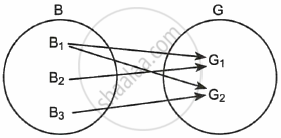
Every element of set B has two options to map in set G i.e., B1 can go to G1 and G2.
So, 2 ways (i.e., two functions).
∴ Total function = 2 × 2 × 2 = 8- R : B `rightarrow` B
R = {(x, y) : x and y are students of the same sex}
(b1, b1) ∈ R ...(Reflexive)
(b1, b2) ∈ R `\implies` (b2, b1) ∈ R ...(Symmetric)
If (b1, b2) ∈ R ∧ (b2, b3) ∈ R
`\implies` (b1, b3) ∈ R ...(Transitive)
`\implies` It is an equivalence relation.
OR
Given, B = {b1, b2, b3} and G = {g1, g2}
f = {(b1, g1), (b2, g2), (b3, g1)}
Since b1 and b3 both are related to same element g1.
So f is not bijective (one-one).
APPEARS IN
संबंधित प्रश्न
Determine whether the following relation is reflexive, symmetric and transitive:
Relation R in the set A = {1, 2, 3, ..., 13, 14} defined as R = {(x, y) : 3x – y = 0}.
Let A be the set of all human beings in a town at a particular time. Determine whether the following relation is reflexive, symmetric and transitive:
R = {(x, y) : x is exactly 7 cm taller than y}
Show that the relation R in the set {1, 2, 3} given by R = {(1, 2), (2, 1)} is symmetric but neither reflexive nor transitive.
Let A = {1, 2, 3}. Then number of equivalence relations containing (1, 2) is ______.
Given the relation R = {(1, 2), (2, 3)} on the set A = {1, 2, 3}, add a minimum number of ordered pairs so that the enlarged relation is symmeteric, transitive and reflexive.
Let Z be the set of integers. Show that the relation
R = {(a, b) : a, b ∈ Z and a + b is even}
is an equivalence relation on Z.
Let O be the origin. We define a relation between two points P and Q in a plane if OP = OQ. Show that the relation, so defined is an equivalence relation.
Let R be the relation defined on the set A = {1, 2, 3, 4, 5, 6, 7} by R = {(a, b) : both a and b are either odd or even}. Show that R is an equivalence relation. Further, show that all the elements of the subset {1, 3, 5, 7} are related to each other and all the elements of the subset {2, 4, 6} are related to each other, but no element of the subset {1, 3, 5, 7} is related to any element of the subset {2, 4, 6}.
Let Z be the set of all integers and Z0 be the set of all non-zero integers. Let a relation R on Z × Z0be defined as (a, b) R (c, d) ⇔ ad = bc for all (a, b), (c, d) ∈ Z × Z0,
Prove that R is an equivalence relation on Z × Z0.
Write the domain of the relation R defined on the set Z of integers as follows:-
(a, b) ∈ R ⇔ a2 + b2 = 25
If R = {(x, y) : x + 2y = 8} is a relation on N by, then write the range of R.
Define a reflexive relation ?
State the reason for the relation R on the set {1, 2, 3} given by R = {(1, 2), (2, 1)} to be transitive ?
The relation R defined on the set A = {1, 2, 3, 4, 5} by
R = {(a, b) : | a2 − b2 | < 16} is given by ______________ .
A relation R is defined from {2, 3, 4, 5} to {3, 6, 7, 10} by : x R y ⇔ x is relatively prime to y. Then, domain of R is ______________ .
A relation ϕ from C to R is defined by x ϕ y ⇔ | x | = y. Which one is correct?
Show that the relation S in the set A = [x ∈ Z : 0 ≤ x ≤ 12] given by S = [(a, b) : a, b ∈ Z, ∣a − b∣ is divisible by 3] is an equivalence relation.
If A = {a, b, c}, B = (x , y} find B × B.
Let A = {1, 2, 3, 4}, B = {4, 5, 6}, C = {5, 6}. Find (A × B) ∪ (A × C).
Consider the set A = {1, 2, 3} and the relation R = {(1, 2), (1, 3)}. R is a transitive relation.
Given A = {2, 3, 4}, B = {2, 5, 6, 7}. Construct an example of the following:
a mapping from A to B which is not injective
Give an example of a map which is neither one-one nor onto
If A is a finite set containing n distinct elements, then the number of relations on A is equal to ____________.
Let us define a relation R in R as aRb if a ≥ b. Then R is ____________.
The relation R is defined on the set of natural numbers as {(a, b) : a = 2b}. Then, R-1 is given by ____________.
A relation R in set A = {1, 2, 3} is defined as R = {(1, 1), (1, 2), (2, 2), (3, 3)}. Which of the following ordered pair in R shall be removed to make it an equivalence relation in A?
Sherlin and Danju are playing Ludo at home during Covid-19. While rolling the dice, Sherlin’s sister Raji observed and noted the possible outcomes of the throw every time belongs to set {1,2,3,4,5,6}. Let A be the set of players while B be the set of all possible outcomes.
A = {S, D}, B = {1,2,3,4,5,6}
- Let R: B → B be defined by R = {(1,1),(1,2), (2,2), (3,3), (4,4), (5,5), (6,6)}, then R is ____________.
Students of Grade 9, planned to plant saplings along straight lines, parallel to each other to one side of the playground ensuring that they had enough play area. Let us assume that they planted one of the rows of the saplings along the line y = x − 4. Let L be the set of all lines which are parallel on the ground and R be a relation on L.
Answer the following using the above information.
- Let R = `{ ("L"_1, "L"_2) ∶ "L"_1 bot "L"_2 "where" "L"_1, "L"_2 in "L" }` which of the following is true?
Let A = {1, 2, 3, 4} and let R = {(2, 2), (3, 3), (4, 4), (1, 2)} be a relation on A. Then R is ______.
