Advertisements
Advertisements
प्रश्न
Read the following passage:
|
An organization conducted bike race under two different categories – Boys and Girls. There were 28 participants in all. Among all of them, finally three from category 1 and two from category 2 were selected for the final race. Ravi forms two sets B and G with these participants for his college project. |

Based on the above information, answer the following questions:
- How many relations are possible from B to G? (1)
- Among all the possible relations from B to G, how many functions can be formed from B to G? (1)
- Let R : B `rightarrow` B be defined by R = {(x, y) : x and y are students of the same sex}. Check if R is an equivalence relation. (2)
OR
A function f : B `rightarrow` G be defined by f = {(b1, g1), (b2, g2), (b3, g1)}. Check if f is bijective. Justify your answer. (2)
Advertisements
उत्तर
- Number of possible relations from B `rightarrow` G
= `2^(n(B) xx n(G))`
= 23 × 2
= 26
= 64. 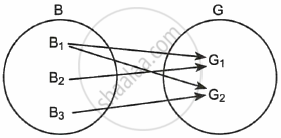
Every element of set B has two options to map in set G i.e., B1 can go to G1 and G2.
So, 2 ways (i.e., two functions).
∴ Total function = 2 × 2 × 2 = 8- R : B `rightarrow` B
R = {(x, y) : x and y are students of the same sex}
(b1, b1) ∈ R ...(Reflexive)
(b1, b2) ∈ R `\implies` (b2, b1) ∈ R ...(Symmetric)
If (b1, b2) ∈ R ∧ (b2, b3) ∈ R
`\implies` (b1, b3) ∈ R ...(Transitive)
`\implies` It is an equivalence relation.
OR
Given, B = {b1, b2, b3} and G = {g1, g2}
f = {(b1, g1), (b2, g2), (b3, g1)}
Since b1 and b3 both are related to same element g1.
So f is not bijective (one-one).
APPEARS IN
संबंधित प्रश्न
Show that the relation R in the set A = {x ∈ Z : 0 ≤ x ≤ 12} given by R = {(a, b) : a = b} is an equivalence relation. Find the set of all elements related to 1.
Given an example of a relation. Which is transitive but neither reflexive nor symmetric.
Show that the relation R in the set A of points in a plane given by R = {(P, Q) : distance of the point P from the origin is the same as the distance of the point Q from the origin} is an equivalence relation. Further, show that the set of all points related to a point P ≠ (0, 0) is the circle passing through P with the origin as its centre.
If R = {(x, y) : x2 + y2 ≤ 4; x, y ∈ Z} is a relation on Z, write the domain of R.
Write the identity relation on set A = {a, b, c}.
Define a reflexive relation ?
Define a transitive relation ?
Let R be the relation over the set of all straight lines in a plane such that l1 R l2 ⇔ l 1⊥ l2. Then, R is _____________ .
If R is the largest equivalence relation on a set A and S is any relation on A, then _____________ .
Show that the relation R on the set Z of all integers, given by R = {(a,b) : 2 divides (a-b)} is an equivalence relation.
For the matrix A = `[(2,3),(5,7)]`, find (A + A') and verify that it is a symmetric matrix.
Consider the set A = {1, 2, 3} and R be the smallest equivalence relation on A, then R = ______
Give an example of a map which is one-one but not onto
Give an example of a map which is neither one-one nor onto
The following defines a relation on N:
x y is square of an integer x, y ∈ N
Determine which of the above relations are reflexive, symmetric and transitive.
If a relation R on the set {1, 2, 3} be defined by R = {(1, 2)}, then R is ______.
Every relation which is symmetric and transitive is also reflexive.
Let A = {1, 2, 3} and R = {(1, 2), (2, 3), (1, 3)} be a relation on A. Then, R is ____________.
Let us define a relation R in R as aRb if a ≥ b. Then R is ____________.
Let S = {1, 2, 3, 4, 5} and let A = S x S. Define the relation R on A as follows:
(a, b) R (c, d) iff ad = cb. Then, R is ____________.
A relation S in the set of real numbers is defined as `"xSy" => "x" - "y" + sqrt3` is an irrational number, then relation S is ____________.
Sherlin and Danju are playing Ludo at home during Covid-19. While rolling the dice, Sherlin’s sister Raji observed and noted the possible outcomes of the throw every time belongs to set {1,2,3,4,5,6}. Let A be the set of players while B be the set of all possible outcomes.
A = {S, D}, B = {1,2,3,4,5,6}
- Let R ∶ B → B be defined by R = {(x, y): y is divisible by x} is ____________.
Sherlin and Danju are playing Ludo at home during Covid-19. While rolling the dice, Sherlin’s sister Raji observed and noted the possible outcomes of the throw every time belongs to set {1,2,3,4,5,6}. Let A be the set of players while B be the set of all possible outcomes.
A = {S, D}, B = {1,2,3,4,5,6}
- Let R: B → B be defined by R = {(1,1),(1,2), (2,2), (3,3), (4,4), (5,5), (6,6)}, then R is ____________.
If A is a finite set consisting of n elements, then the number of reflexive relations on A is
The relation > (greater than) on the set of real numbers is
On the set N of all natural numbers, define the relation R by a R b, if GCD of a and b is 2. Then, R is
In a group of 52 persons, 16 drink tea but not coffee, while 33 drink tea. How many persons drink coffee but not tea?
If f(x + 2a) = f(x – 2a), then f(x) is:
Let A = {3, 5}. Then number of reflexive relations on A is ______.
