Advertisements
Advertisements
प्रश्न
Name the male part of the flower.
What is the name of the male part of a flower?
Advertisements
उत्तर
The stamen is the male part of the flower.
APPEARS IN
संबंधित प्रश्न
How does fertilisation occur in flowers? Name the parts of the flower that develop into (i) seed, and (ii) fruit after fertilisation.

(i) Name the part marked 'A' in the diagram.
(ii) How dose 'A' reachese part 'B'?
(iii) State the importance of the part 'C'.
(iv) What happens to the part marked 'D' after fertilisation is over?
Name and differentiate between the two modes of pollination in flowering plants.
Name the parts labelled as A, B, C and D in the diagram given below:

Give one example of a unisexual flower.
State the name of the functional unit concerned with sexual reproduction.
Where are the pollen grains produced?
Where are a plant's sex organs located?
Where is the male gamete formed in flowering plants?
Fill in the following blank with suitable word :
The ovary of a flower becomes ....... after fertilisation.
Fill in the following blank with suitable word :
The female organ of reproduction in the flower is the...........
Fill in the following blank with suitable word :
The term used to refer to the transfer of pollen from the stamen of one flower to the carpel of another flower of the same species is...........
What type of plants reproduce by sexual reproduction method?
What is seed?
Name the part of a seed which grows into shoot.
In tobacco plant, the male gametes have 24 chromosomes.
What is the number of chromosomes in the female gamete?
The length of pollen tube depends on the distance between :
(a) pollen grain and upper surface of stigma
(b) pollen grain on upper surface of stigma and ovule
(c) pollen grain in anther and upper surface of stigma
(d) upper surface of stigma and lower part of style
One of the following occurs in the reproductive system of flowering plants as well as that of humans. This is :
(a) vas deferens
(b) anther
(c) ovary
(d) style
Which among the following statements are true for unisexual flowers?
(i) They possess both stamen and pistil
(ii) They possess either stamen or pistil
(iii) They exhibit cross pollination
(iv) Unisexual flower possessing only stamens cannot produce fruits
(a) (i) and (iv)
(b) (ii), (iii) and (iv)
(c) (ii) and (iii)
(d) (i), (iii) and (iv)
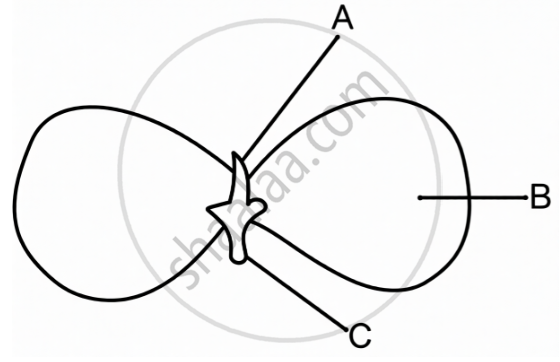
In the figure given alongside, the parts marked A, B and C are sequentially:
Fill in the blanks:
A stamen consists of ______ and ________.
Mention the function of Anther.
Explain the process of fertilisation in flowers.
Distinguish between unisexual and bisexual flowers giving one example of each. Draw a diagram showing process of germination of pollen grains on stigma and label the following parts:
(a) Female germ cell
(b) Male germ cell
(c) Ovary
Fill in the blanks and rewrite the completed statements:
Lymph flows in _______________ direction.
Differentiate between self-pollination and cross-pollination.
Answer the following question.
List two agents of pollination?
Accessory whorls : Calyx and corolla : : essential whorls : ______________
Pollen grains from anther are transferred to the stigma.
Define.
Inflorescence
Identify the parts A, B, C, and D?
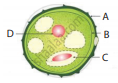
How many middle layers are generally present in the wall of the anther lobes?
Sperm and egg nuclei fuse due to ______.
Conidia are formed endogenously while zoospores are formed endogenously.
Double fertilization means ______.
What is the structural unit of sexual reproduction in plant?
Type of sexual reproduction is ______.
State the post-fertilisation changes that lead to fruit formation in plants.
