Advertisements
Advertisements
प्रश्न
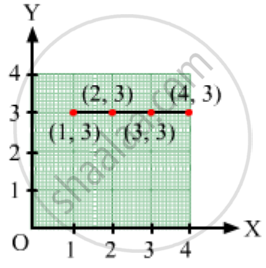
Locate the points:
(1, 3), (2, 3), (3, 3), (4, 3)
Advertisements
उत्तर
Follow the steps mentioned in point (i).
संबंधित प्रश्न
Decide which of the following statements is true and which is false. Give reasons for your answer.
A point whose y-coordinate is zero, will lie on x-axis.
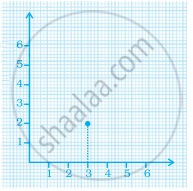
In the given graph the coordinates of point x are ______.
In the coordinates of a point, the second number denotes the ______.
The point where the two axes intersect is called the ______.
The distance of the point (3, 5) from the y-axis is 5.
Explain the situations represented by the following distance-time graph.

Extend the line segment on both sides to meet the coordinate axes. What are the coordinates of the points where this line meets the x-axis and the y-axis?
The table shows the data collected for Dhruv’s walking on a road.
| Time (in minutes) |
0 | 5 | 10 | 15 | 20 | 25 |
| Distance (in km) |
0 | 0.5 | 1 | 1.25 | 1.5 | 1.75 |
- Plot a line graph for the given data using a suitable scale.
- In what time periods did Dhruv make the most progress?
The graph given below compares the price (in Rs) and weight of 6 bags (in kg) of sugar of different brands A, B, C, D, E, F.
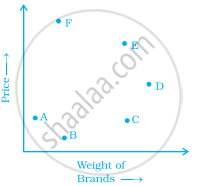
- Which brand(s) costs/cost more than Brand D?
- Bag of which brand of sugar is the heaviest?
- Which brands weigh the same?
- Which brands are heavier than brand B?
- Which bag is the lightest?
- Which bags are of the same price?
