Advertisements
Advertisements
प्रश्न
Imagine you are a tourist guide at Tadoba. Write two sentences each about the following points to help foreign tourists.
- About the place: History, languages spoken, special attractions
- Food: speciality, local delicacies, options (Indian, continental)
- Shopping: authenticity of local artefacts, price, variety
Advertisements
उत्तर
(a) About the Place:
- History: Tadoba, known for the Tadoba Andhari Tiger Reserve, is one of India's oldest and largest national parks, offering a rich tapestry of flora and fauna and a history intertwined with tribal culture.
- Languages Spoken: Predominantly Marathi, with Hindi and English also widely understood.
- Special Attractions: The park is famous for tiger sightings, and other wildlife includes leopards, sloth bears, and diverse bird species. The Tadoba Lake within the reserve is a haven for bird watchers.
(b) Food:
- Speciality: The local cuisine is heavily influenced by Maharashtrian flavours, with a focus on simple yet flavorful dishes.
- Local Delicacies: Must-try items include 'Zunka Bhakri' - a traditional chickpea flour dish, and 'Varadi cuisine' known for its spicy taste.
- Options: While the local cuisine is predominantly Indian, some resorts and nearby towns offer Continental or Chinese options for international tourists.
(c) Shopping:
- The authenticity of Local Artefacts: In and around Tadoba, tourists can find genuine tribal handicrafts, including hand-painted Gond art, bamboo crafts, and Warli paintings.
- Price: Items are generally affordable, offering good value for the quality and craftsmanship.
- Variety: There's a range of souvenirs to choose from, including ethnic jewellery, local textile products, and eco-friendly items.
APPEARS IN
संबंधित प्रश्न
If your friends get here before 7 o’clock we can take them out for dinner.
(Rewrite: Using ‘unless’)
What message is relevant to the present age in the poem?
How does a tree planter do civic good?
How does figurative language assist in conveying the theme and purpose of the poem?
Why were the children confused about their grandfather’s claims about the war?
What do ‘trade winds’ and ‘fat worms’ symbolise?
Discuss the conflict in the story, An Angel In Disguise.
Fill in each of the numbered blanks with the correct form of the word given in brackets. Do not copy the passage, but write in correct serial order the word or phrase appropriate to the blank space.
Example:
(0) beginning
Alice was (0)__________(begin) to get very tired of (1)__________(sit) by her sister on the bank and of having nothing to do: once or twice she had (2)__________(peep) into the book her sister was reading, but it (3)__________ (have) no pictures or conversations in it, "and what is the use of a book," (4)__________(think) Alice, "without pictures or conversations?" Alice wondered whether the pleasure of (5)__________(make) a daisy-chain would be worth the trouble of getting up and picking the daisies when suddenly a White Rabbit with pink eyes (6)__________(run) close by her. Alice did not think this was very remarkable, until the Rabbit actually (7)__________ (take) a watch out of its waistcoat-pocket, and (8) (look) at it, and then hurried on.
Don John:
Fie, fie, they are not to be nam'd my lord, not to speak of, There is not chastity enough in language Without offence to utter them. Thus, pretty lady, I am sorry for thy much misgovernment.
Claudio:
O, Hero! What a Hero hadst thou been If half thy outward graces had been plac'd About thy thoughts and counsels of thy heart! But fare thee well, most foul, most fair; farewell Thou pure impiety and impious purity For thee I'll lock up all the gates of love, And on my eyelids shall conjecture hang To turn all beauty into thoughts of harm, And never shall it more be gracious.
(i) Where are the speakers? What leads Claudio to speak in this manner?
(ii) What are the charges levelled against Hero by Don Pedro?
(iii) Explain the lines:
"What an I lero hadst thou been If half thy outward graces had been plac'd About thy thoughts and counsels of thy heart!"
(iv) What are the immediate reactions of Leonato and Hero to Claudio's words?
(v) What impressions do we form about Leonato in this scene?
(vi) Give the meanings of the following words as they are used in the context of the passage: misgovernment; impiety; conjecture
The best candidate should be appointed________the post.
Walter Scott appears sympathetic to Isaac's troubles. How does Scott highlight the treatment given to Jews through the character of Isaac?
Given below is an interesting combination of words. Explain why they have been used together.
stunning artefacts
Narrate in 100 words an incident, that illustrates the way a friend of yours ‘made you feel happy and accepted’, at some point in your life.
Find out from your grandparents or parents the names of vegetables and fruits they had eaten in their childhood and mention how the vegetables and fruits are different from the one's today.
| Name of the vegetable or fruit | Shape | Colour | Taste |
| 1. | |||
| 2. | |||
| 3. |
Discuss with your partner and match the following expressions given in column A with their interpretations in column 'B'.
| Sr.No. | A | B |
| 1. | While Chief Baron Ear sat to balance the laws. | (a) Eyes are refrained from using spectacles. |
| 2. | They are made with the straddle as wide as the ridge of the Nose is. | (b) The responsibility of giving a verdict rested on the shoulders of the hearing organ. |
| 3. | That whenever the Nose put his Spectacles on, by daylight or candlelight Eyes should be shut! | (c) Spectacles are meant for none other than the nose. |
| 4. | So his lordship decreed with a grave solemn tone, decisive and clear, without one if or but. | (d) The judge delivered a firm verdict without any doubt. |
Write about the daily routine of the 'Lord of Tartary' in 8-10 lines.
The story is written in an informal, colloquial style - the way it would be told orally. Find and write the expressions where the author addresses the audience directly in the story - for example, ‘but we, O Best Beloved, will...’, ‘Now attend and listen !’
Imagine Taffy comes to you for help to write a letter of apology, in the modern script we use. She wants to express her regret to the stranger-man for her mother’s action. Write that letter of apology (informal) on her behalf.
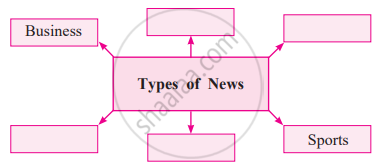
Complete the remaining blocks determining the types of news.
Work in pairs. Create three slogans on ‘Saving Trees’.
Read this example Save a Tree Get Oxygen for Free.
- Use catchy, meaningful phrases.
- Do not write complete sentences.
- Ensure that the words at the end rhyme.
Read the given slogans and match them appropriately with their theme.
| 1. | One for all and all for one | Junk food |
| 2. | Limit your fast food otherwise, it would be your last food | Save water |
| 3. | Restricting a woman restricts the growth of the family | Cleanliness |
| 4. | Clean and green makes perfect scene | Woman empowerment |
| 5. | It takes a lot of blue to stay green | Unity |
You are waiting for your exam results. ______
Who do you think has been more successful of the two? Give reasons.
The photographer had made changes ______.
Jill said that they owned the steering wheel of a car, one of the tyres, two of the cylinders and leg of the sofa. What does this convey?
Write a paragraph of about 150 word, on the following topic.
Need for Moral Education in schools
Write a composition in approximately 350 – 400 words on the following subjects:
(You are reminded that you will be rewarded for orderly and coherent presentation of material, use of appropriate style and general accuracy of spelling, punctuation, and grammar.)
You have recently shifted to a new city. Describe the area where you live, your next-door neighbours, the difficulties you faced while shifting and why you like/dislike the place.
Who is your favourite comedian?
What makes you angry?
