Advertisements
Advertisements
प्रश्न
Give one example of a pseudo first-order reaction.
Advertisements
उत्तर १
Hydrolysis of methyl acetate:
\[\ce{CH3COOCH_{3(aq)} + H2O_{(l)} -> CH3COOH_{(aq)} + CH3OH_{(aq)}}\]
उत्तर २
Acid-catalysed hydrolysis of ethyl acetate
\[\ce{\underset{Ethyl acetate}{CH3COOC2H5} + H2O ->[H+] \underset{Acetic acid}{CH3COOH} + \underset{Ethyl alcohol}{C2H5OH}}\]
In this reaction, the concentration of water is so large that it practically remains constant.
The rate law of the reactions is
Rate = k0[CH3COOC2H5]
Hence, it is a pseudo-first-order reaction.
संबंधित प्रश्न
Answer the following in brief.
How will you represent the zeroth-order reaction graphically?
Solve
A first-order reaction takes 40 minutes for 30% decomposition. Calculate its half-life.
Write a mathematical expression for integrated rate law for zero-order reaction.
Explain pseudo first order reaction with a suitable example.
For a first-order reaction \[\ce{A -> B}\] the rate constant is x min−1. If the initial concentration of A is 0.01 M, the concentration of A after one hour is given by the expression.
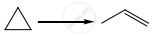
This reaction follows first-order kinetics. The rate constant at particular temperature is 2.303 × 10⁻² hour−1. The initial concentration of cyclopropane is 0.25 M. What will be the concentration of cyclopropane after 1806 minutes? (log 2 = 0.3010)
For a first-order reaction, the rate constant is 6.909 min−1 the time taken for 75% conversion in minutes is
Write the rate law for the following reaction.
A reaction that is second order in NO and first order in Br2.
A first order reaction has rate constant 1 × 10⁻² s−1. What time will, it take for 20 g or reactant to reduce to 5 g?
A first order reaction is 25% completed in 40 minutes. What is the rate constant k tor the reaction?
The time of completion of 90% of a first order reaction is approximately ____________.
What is the order of reaction if the unit of rate constant (k) is mol dm−3 s−1?
The integrated rate equation for first-order reaction, A → product, is ______.
Which of the following represents the expression for `(3/4)^"th"` life of 1st order reaction?
A first order reaction takes 40 minutes for 30% completion. Calculate the half-life of reaction.
For the first order reaction A → B, the rate constant is 0.25 s-1, if the concentration of A is reduced to half, the value of rate constant will be ________.
A first order reaction, A → B takes 100 minutes for it's 90% completion. What is the rate constant of reaction?
Half-life of first order reaction is 20 minutes. What is the time taken to reduce the initial concentration of the reactant to `1/10`th?
For zero order reaction, when [A]t is plotted against time (t), the slope of the straight line obtained is equal to ______.
The integrated rate equation is Rt = log C0 – log Ct, then the straight-line graph is obtained by plotting.
Obtain the expression for half-life and rate constant of the first-order reaction.
Define the half-life of a first-order reaction.
Which of the following is correct for a first-order reaction?
Calculate half-life of a first order reaction in minute if the rate constant is 1 × 10⁻³ s-1.
Consider the following reaction.
\[\ce{SO2(g) + 1/2 O2(g) <=>[K1] SO3(g)}\]
\[\ce{2SO3(g)<=>[K2] 2SO2(g) + O2(g)}\]
What is the relation between K1 and K2?
What are integrated rate laws?
The plot that represents the zero order reaction is:
