Advertisements
Advertisements
प्रश्न
Give one example of a pseudo first-order reaction.
Advertisements
उत्तर १
Hydrolysis of methyl acetate:
\[\ce{CH3COOCH_{3(aq)} + H2O_{(l)} -> CH3COOH_{(aq)} + CH3OH_{(aq)}}\]
उत्तर २
Acid-catalysed hydrolysis of ethyl acetate
\[\ce{\underset{Ethyl acetate}{CH3COOC2H5} + H2O ->[H+] \underset{Acetic acid}{CH3COOH} + \underset{Ethyl alcohol}{C2H5OH}}\]
In this reaction, the concentration of water is so large that it practically remains constant.
The rate law of the reactions is
Rate = k0[CH3COOC2H5]
Hence, it is a pseudo-first-order reaction.
संबंधित प्रश्न
Answer the following in brief.
What is a zeroth-order reaction?
In a first-order reaction, the concentration of the reactant decreases from 20 mmol dm−3 to 8 mmol dm−3 in 38 minutes. What is the half-life of reaction?
Solve
A first-order reaction takes 40 minutes for 30% decomposition. Calculate its half-life.
Rate constant of a reaction is 3.6 × 10⁻³ s–1. The order of reaction is ______.
Explain with the help of a potential energy diagram that the catalyst increases the rate of the reaction.
For a first-order reaction \[\ce{A -> B}\] the rate constant is x min−1. If the initial concentration of A is 0.01 M, the concentration of A after one hour is given by the expression.
For a first order reaction \[\ce{A ->Product}\] with initial concentration x mol L−1, has a half life period of 2.5 hours. For the same reaction with initial concentration `("x"/2)` mol L−1 the half life is
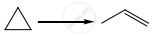
This reaction follows first-order kinetics. The rate constant at particular temperature is 2.303 × 10⁻² hour−1. The initial concentration of cyclopropane is 0.25 M. What will be the concentration of cyclopropane after 1806 minutes? (log 2 = 0.3010)
Write the rate law for the following reaction.
A reaction that is `3/2` order in x and zero order in y.
Give two examples for zero order reaction.
Identify the order for the following reaction.
Radioactive disintegration of 92U238
What is the value of rate constant of first order reaction, if it takes 15 minutes for consumption of 20% of reactants?
A first order reaction completes its 10% in 20 minutes, then the time required to complete its 19% is ____________.
In a first order reaction, the concentration of the reactant, decreases from 0.8 mol dm−3 to 0.4 mol dm−3 in 15 minutes. The time taken for the concentration to change from 0.1 mol dm−3 to 0.025 mol dm−3 is ____________.
In a first order reaction, the concentration of the reactant is reduced to 25% in one hour. The half-life period of the reaction is ____________.
What is the order of reaction if the unit of rate constant (k) is mol dm−3 s−1?
If time required to decrease concentration of reactant from 0.8 M to 0.2 M is 12 hours, the half life of this first order reaction is ____________.
The order of the reaction for which the unit of rate constant is s−1 is ____________.
In the reaction \[\ce{2SO2 + O2 -> 2SO3}\] the rate of appearance of SO3 is 4 × 10⁻⁴ M/s, the rate of disappearance of O2 is ____________.
The time taken for 80% of a first order reaction to be complete is approximately ____________.
Which among the following is an example of zero order reaction?
A first order reaction takes 40 minutes for 30% decomposition. What is the half-life of reaction?
For the first order reaction A → B, the rate constant is 0.25 s-1, if the concentration of A is reduced to half, the value of rate constant will be ________.
The integrated rate law is a direct relationship between time and ______
Define the half-life of a first-order reaction.
A radioactive isotope decayed to 17/32 of its original mass after 60 minutes. Find the half-life of this radioisotope.
The plot that represents the zero order reaction is:
Which of the following equations exhibits the integrated rate law equation for first order reaction?
If the half-life of a first-order reaction is 10 minutes, find the time required to decrease the concentration of the reactant from 0.08 M to 0.02 M.
