Advertisements
Advertisements
प्रश्न
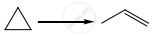
This reaction follows first-order kinetics. The rate constant at particular temperature is 2.303 × 10⁻² hour−1. The initial concentration of cyclopropane is 0.25 M. What will be the concentration of cyclopropane after 1806 minutes? (log 2 = 0.3010)
पर्याय
0.125 M
0.215 M
0.25 × 2.303 M
0.05 M
Advertisements
उत्तर
0.125 M
APPEARS IN
संबंधित प्रश्न
The rate constant of the first order reaction is 1.386 min–1. Calculate the time required for 80% reactant to decompose?
If 75% of a first order reaction was completed in 60 minutes, 50% of the same reaction under the same conditions would be completed in ____________.
Write the rate law for the following reaction.
A reaction that is second order in NO and first order in Br2.
A first order reaction is 40% complete in 50 minutes. Calculate the value of the rate constant. In what time will the reaction be 80% complete?
In a first order reaction, the concentration of the reactant, decreases from 0.8 mol dm−3 to 0.4 mol dm−3 in 15 minutes. The time taken for the concentration to change from 0.1 mol dm−3 to 0.025 mol dm−3 is ____________.
For the first order reaction, plot of log10 [A]t against time 't' is a straight line with a negative slope equal to ____________.
The order of the reaction for which the unit of rate constant is s−1 is ____________.
Half-life of first order reaction is 20 minutes. What is the time taken to reduce the initial concentration of the reactant to `1/10`th?
For zero order reaction, when [A]t is plotted against time (t), the slope of the straight line obtained is equal to ______.
Which of the following is correct for a first-order reaction?
