Advertisements
Advertisements
प्रश्न
For the decomposition of azoisopropane to hexane and nitrogen at 543 K, the following data are obtained.
| t (sec) | P(mm of Hg) |
| 0 | 35.0 |
| 360 | 54.0 |
| 720 | 63.0 |
Calculate the rate constant.
Advertisements
उत्तर
Azoisopropane decomposes according to the following equation:
\[\ce{(CH3)2CHN = NCH(CH3)2_{(g)} -> N2_{(g)} + C6H14_{(g)}}\]
This action is a first-order reaction.
Initial pressure (P0) = 35.0 mm Hg
Decrease in pressure of azoisopropane after time t is P.
Increase in N2 pressure = `P_(N_2)`
Increase in the pressure of hexane = `P_(C_6H_14)`
Total pressure of the mixture (Pt) = `P_A + P_(N_2) + P_(C_6H_14)`
Pt = (P0 – P) + P + P
Pt = P0 + P
P = Pt – P0
PA = P0 – (Pt – P0) = 2P0 – Pt
But PA ∝ a − x and P0 ∝ Pt
k = `2.303/t log P_0/(2P_0 - P_t)`
When t = 360 s,
k = `2.303/360 log 35/(2 xx 35 - 54)`
= `2.303/360 log 35/16`
= `2.303/360 log 2.1875`
= `2.303/360 xx 0.339`
k = 2.17 × 10⁻³ s–1
When, t = 720 s,
k = `2.303/720 log 35/(2 xx 35 - 63)`
= `2.303/720 log 35/7`
= `2.303/720 (log 35 - log 7)`
= `2.303/720 (1.544 - 0.845)`
= `2.303/720 xx 0.699`
k = 2.23 × 10⁻³ s–1
Rate constant = `((2.17 + 2.23))/2 xx 10^-3 s^-1`
= 2.20 × 10⁻³ s–1
संबंधित प्रश्न
A first order reaction has a rate constant 1.15 × 10⁻³ s−1. How long will 5 g of this reactant take to reduce to 3 g?
The rate constant for a first order reaction is 60 s−1. How much time will it take to reduce the initial concentration of the reactant to its `1/16`th value?
Show that the time required for 99.9% completion of a first-order reaction is three times the time required for 90% completion.
Which of the following graphs is correct for a first order reaction?


State a condition under which a bimolecular reaction is kinetically first order reaction.
With the help of an example explain what is meant by pseudo first order reaction.
First order reaction is 50% complete in 1.26 × 10¹⁴s. How much time could it take for 100% completion?
In the first order reaction, half of the reaction is complete in 100 seconds. The time for 99% of the reaction to occurs will be
The reaction X → product
Follow first order of kinetics. In 40 minutes the concentration of 'X' changes from 0.1 m to 0.025. M. The rate of reaction when concentration of X is 0.01 m is.
Observe the graph shown in figure and answer the following questions:
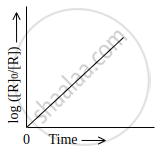
- What is the order of the reaction?
- What is the slope of the curve?
- Write the relationship between k and t1/2 (half life period).
Gaseous cyclobutene isomerizes to butadiene in a first order process which has a 'k' value of 3.3 × 10⁻⁴ s−1 at 153°C. The time in minutes it takes for the isomerization to proceed 40% to completion at this temperature is ______. (Rounded-off to the nearest integer)
The decomposition of formic acid on gold surface follows first-order kinetics. If the rate constant at 300 K is 1.0 × 10⁻³ s−1 and the activation energy Ea = 11.488 kJ mol−1, the rate constant at 200 K is ______ × 10−5 s−1. (Round off to the Nearest Integer)
(Given R = 8.314 J mol−1 K−1)
A definite volume of H2O2 undergoing spontaneous decomposition required 22.8 c.c. of standard permanganate solution for titration. After 10 and 20 minutes respectively the volumes of permanganate required were 13.8 and 8.25 c.c. The time required for the decomposition to be half completed is ______ min.
The slope in the plot of ln[R] vs. time for a first order reaction is ______.
The slope in the plot of `log ["R"]_0/(["R"])` Vs. time for a first-order reaction is ______.
Define first-order reaction.
Write the equation for integrated rate law for a first order reaction.
If the half-life (t1/2) for a first order reaction is 1 minute, then the time required for 99.9% completion of the reaction is closest to ______.
