Advertisements
Advertisements
प्रश्न
What is the rate constant?
What do you understand by rate constant?
What is meant by the rate constant of a reaction?
Advertisements
उत्तर १
When the concentration (active mass) of each reactant is at unity, the rate constant of a chemical reaction equals the rate of the reaction.
∵ Rate of reaction ∝ [Reactant]
If A → product, then
rate (R) = k[A]
If [A] = 1, then rate, R = k,
where k is the rate constant.
उत्तर २
- The rate constant of a reaction is equal to the rate of reaction when the concentration of each of the reactants is unity.
- At a specific temperature, a reaction's rate constant has a fixed value. As the temperature rises, so does its worth. It is independent of the reactant concentrations at the initiation.
APPEARS IN
संबंधित प्रश्न
Sucrose decomposes in acid solution into glucose and fructose according to the first order rate law with t1/2 = 3 hours. What fraction of the sample of sucrose remains after 8 hours?
The time required for 10% completion of a first order reaction at 298 K is equal to that required for its 25% completion at 308 K. If the value of A is 4 × 10¹⁰ s−1. Calculate k at 318 K and Ea.
Define order of reaction. How does order of a reaction differ from molecularity for a complex reaction?
Which of the following graphs is correct for a first order reaction?


Observe the graph shown in figure and answer the following questions:
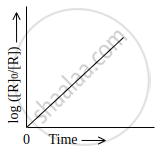
- What is the order of the reaction?
- What is the slope of the curve?
- Write the relationship between k and t1/2 (half life period).
The decomposition of formic acid on gold surface follows first-order kinetics. If the rate constant at 300 K is 1.0 × 10⁻³ s−1 and the activation energy Ea = 11.488 kJ mol−1, the rate constant at 200 K is ______ × 10−5 s−1. (Round off to the Nearest Integer)
(Given R = 8.314 J mol−1 K−1)
The rate constant for the reaction:
\[\ce{2N2O_{(s)} ->2N2O4_{(g)}}\] is 4.98 × 10⁻⁴ s-1.
The order of the reaction is ______.
Write the equation for integrated rate law for a first order reaction.
Show that `t_(1/2)= 0.693/k` for first reaction.
If the half-life (t1/2) for a first order reaction is 1 minute, then the time required for 99.9% completion of the reaction is closest to ______.
