Advertisements
Advertisements
प्रश्न
Find out the ‘ing’ forms from the story of 'An Encounter of a Special Kind' and classify them into the following table.
| Present Participle used as an Adjective | Present Participle used as a Verb in the Continuous Tense |
| twinkling eyes | was oozing |
| 1. | 1. |
| 2. | 2. |
| 3. | 3. |
| 4. | 4. |
| 5. | 5. |
Advertisements
उत्तर
| Present Participle used as an Adjective | Present Participle used as a Verb in the Continuous Tense |
| 1. twinkling eyes | 1. was oozing |
| 2. marauding langur | 2. she was pondering |
| 3. sloping roof | 3. barking became louder |
| 4. caring arms | 4. chirping of birds |
| 5. uncanny feeling | 5. holding a baby langur |
APPEARS IN
संबंधित प्रश्न
Let us begin by studying the relationship between the different verb forms and the time they denote.
Work individually
Indicate the tense and time of each of the highlighted verbs in the table below.
The first has been done as an example.
| Sentence | Tense | Time | |
| 1. | We are planning to go out for a picnic tomorrow. | Present | Future |
| 2. | India has made tremendous progress in the past few decades. |
||
| 3. | It has been raining since morning. | ||
| 4. | Could you please send your e-mail address as soon as possible? |
||
| 5. | The train must have reached Delhi by now. |
||
| 6. | It always rains in July here. | ||
| 7. | Cold wave intensifies further. (A news headline) |
||
| 8. | He was playing here a minute ago. | ||
| 9. | She won the Student of the Year award last year. |
||
| 10. | All incomplete forms will be rejected. |
Now compare your answers with those of your partner and discuss the
following questions and write your observations in the given space.
a. Is the time referred to in the sentences always the same as the tense of
the verb? What conclusion can you draw from your observation? Write
your observation below.
...............................................................................................................................................
..................................................................................................................................................
b. How have you found the tense of the verbs in the sentences above? Are
there any indicators or markers that reveal the tense of the verb? Write
your observation below.
...............................................................................................................................................
..................................................................................................................................................
c. Did you find any verb form that could be called 'future form'? (You will
learn more about the different ways of talking about future later in this
unit.)
...............................................................................................................................................
..................................................................................................................................................
d. Why do you think verb forms are often labelled as 'simple' or 'indefinite', 'progressive' or 'continuous', 'perfect' and 'perfect continuous'?
...............................................................................................................................................
..................................................................................................................................................
Form
• Have/has+ past participle
• Have/ has+ been + past participle
Work individually
Complete the following sentences by using the present perfect form (as
given in C.l)ofthe given verbs.
a) The kids (work) really hard for the show. Now, don't cancel it, please.
b) Yippyl I (select) for the interschool dance competition!
c) I ... (contest) five elections so far.
d) John? 0, he is a delightful boy. I (know) him since his childhood.
e) ... you ever (be) to the Taj Mahal?
• The box below shows different uses or meanings of the present perfect. Match the sentences above with the uses or meanings of the present perfect they illustrate.
i) Something that has happened several times up to the present.
ii) Announcement or news of a recent event.
iii) Finished event connected with the present.
iv) An action or situation that has continued up to the present.
v} Finished event at some/ any time up to now.
Answer: i - c; ii - b; iii - a; iv - d; v - e
Present Perfect vs. Simple Past
a. Explain the difference in the meaning of the following pairs of
sentences. You may like to use the given hints.
1. a. I have been a teacher for five years.
b. I was a teacher for five years.
(Hint: Is the speaker still a teacher?)
2. a. I always got good marks in English.
b. I have always got good marks in English.
(Hint: Is the speaker still studying?)
3. a. Geeta has never met her cousin.
b. Geeta never met her cousin.
(Hint: Is Geeta's cousin alive?)
4. a. I have never been to Timbuktu.
b. I never went to Timbuktu.
(Is the speaker talking about a particular journey or his travels so far?)
5. a. Jose has completed seven assignments today.
b. Jose completed seven assignments today.
(Hint: Is the day over? Has Jose more assignments to write?)
Present Perfect vs. Simple Past
b. What conclusion can you draw from these sentences about the use of present perfect and simple past forms of verbs?
-----------------------------------
-----------------------------------
-----------------------------------
Study the following picture carefully and then write a paragraph to describe what is happening.
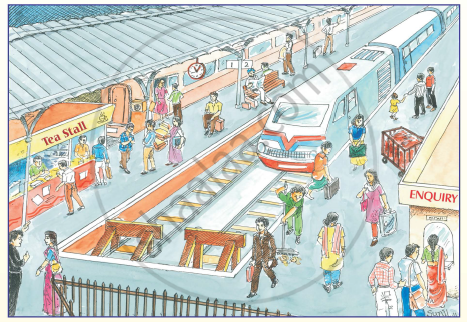
What has been the situation of your village/town/city five to ten years ago and how has it changed since then? Write a short paragraph describing the changes in its size, population, traftlc, buildings, lifestyle etc. Which verb forms would you mainly use to describe the changes? (Hint: Simple Past and Present Perfect forms.)
Study the following sentences.
1) I didn't know Jim had migrated to the United States.
2) When we arrived at the theatre, the show had already begun.
3) The patient had died before the ambulance reached the hospital.
4) He had got married by the time he started working.
5) I couldn't open the locker because I had mislaid the keys.
6) Byom Bakshi felt that he had seen the man somewhere before.
As you can see, each of the above sentences describes two different actions, events or situations. Work with a partner and list them as shown in the example.
| A. Occurred First | B. Occurred Later |
| 1. Example: Jim had migrated to the United States. | 1. I did not know it. The speaker came to know the fact later.) |
| 2. | 2. |
| 3. | 3. |
| 4. | 4. |
| 5. | 5. |
| 6. | 6. |
What verb forms have been used in (A) and (B) respectively?
A. ....................................................................
B ....................................................................
What conclusion can you draw from your analysis?
...................................................................
...................................................................
Carefully study each of the following events or situations described in a set of three sentences/phrases. Then, write a short paragraph to describe each event/situation as shown in the example. Your paragraph should begin with the description of the second event in each case. Use the verb form had+ past participle to describe the earliest of the past events.
|
• Somebody burgled the office on Sunday night. • Our arrival at work on Monday morning . • Police informed |
We arrived at work on Monday and found that somebody had burgled the office the previous night. So, we immediately informed the police. |
|
• (I) Mayank went out with his family. (ii) I tried to phone him this morning. (iii) His servant answered. |
I tried to phone Mayank this morning but the servant ........................................... ........................................... |
|
• (i) Rohit returned from holiday.(ii) Jayanti met Rohit. |
Jayanti met Rohit, who ........................................... ........................................... |
|
• (I) All the arrangements were finalised for the seminar. (ii) The seminar participants arrived in Gangtok. (iii) Met the professors from the UK the same evening. |
The participants arrived in Gangtok. They found ........................................... ........................................... |
Now write short paragraphs to describe the trends in the other groups of visitors featured in the graph.
• Overseas Visitors
....................................................
....................................................
• Domestic Visitors
....................................................
....................................................
• Total Number ofVisitors
....................................................
....................................................
Working with the same partner, use the information given below and
discuss the reasons for choosing a particular verb form in F .1. Then match
the information in the bubbles below with the sentences, and put the
sentence number in the space provided, as shown in the example.
| 1. e.g. Something is expected to happen before a particular time in the future. (Sentence No 2) |
2.Statement of a universal truth or fact. ( ) |
|
3.Something is expected to ( ) |
4.Simple statement of future ( ) |
|
5.Sure to happen at a particular time in the future, as arrangements for it ( ) |
6.Statement of a planned event expected. ( } |
Work with apartner
In the following sentences, choose and circle the verb form you think best fits the meaning of each sentence. You have been provided an example.
| 1. Tomorrow | is will be is going to be | Wednesday. |
| 2. The train | has left will have left is going to leave | by the time you reach the station. |
| 3. Hurry! The film | does will is about to | start. |
| 4. The Minister | opens is opening is about to open | the new Art Centrenext week. |
| 5. This time next year, he | will live is living will be living | in Mumbai. |
| 6. I | am going to be will be will have been | a nurse when I grow up |
The Dauphin will give me all I need.
(Rewrite the sentence using the present perfect tense)
Read this sentence.
M. Hamel had said that he would question us on participles.
In the sentence above, the verb form “had said” in the first part is used to indicate an “earlier past.” The whole story is narrated in the past. M. Hamel’s “saying” happened earlier than the events in this story. This form of the verb is called the past perfect.
Pick out five sentences from the story with this form of verb and say why this form has been used.
Use the correct tense form of the verb given in the bracket and rewrite the sentence.
She ________ that old fashion book of her mother a few months back.
Use the correct tense form of the verb given in the bracket and rewrite the sentence.
One human should _______ this for another always.
Name the Tense of the Verb underlined to include Time (Past/Present/Future) and Aspect (Simple/Continuous/Perfect/Perfect Continuous).
I slept on the floor.
Name the Tense of the Verb underlined to include Time (Past/Present/Future) and Aspect (Simple/Continuous/Perfect/Perfect Continuous).
You haven’t found it.
Name the Tense of the Verb underlined to include Time (Past/Present/Future) and Aspect (Simple/Continuous/Perfect/Perfect Continuous).
I am fine, now.
Change the Tense as instructed.
I got fired. (Future Perfect)
Observe the following underlined phrases. Here ‘have/has’ are followed by the past participle form of the verb. This construction indicates the present perfect tense. Find more such sentences from the text.
- We have made progress in the last couple of decades.
- We have prevented millions of child deaths.
- It has happened.
Spot the error and correct the following sentences.
- My grandparents laid down for an afternoon nap.
- A stranger were knocking at our door.
- My sister and I shares a study room.
- One of my friend, is leaving school.
- A flock of birds were flying overhead.
Rewrite the sentence as per the instruction given along with it.
The mother langur looked straight into my eyes.
(Rewrite the sentence in the Simple Present Tense)
Rewrite the sentence as per the instruction given along with it.
She simply sat there quietly.
(Rewrite the sentence in the Present Continuous Tense)
Underline the verb and choose the correct option from the options.
Preeti even wrote about it.
Underline the verb and choose the correct option from the options.
Preeti was scornful.
Read the following sentence carefully, underline the verb and find out the tense in the sentence.
Still they took no notice of him.
Read the following sentence carefully, underline the verb and find out the tense in the sentence.
She is standing on a little high hump on the plateau.
Read the following sentence carefully, underline the verb and find out the tense in the sentence.
He leaned out eagerly.
Read the following sentence carefully, underline the verb and find out the tense in the sentence.
He just felt dizzy.
Rewrite the sentences in present perfect tense:
I had been working for Anil for almost a month.
Rewrite the sentence in future tense:
I am doing it.
Fill in each of the numbered blanks with the correct form of the word given in brackets. Do not copy the passage but write in correct serial order the word or phrase appropriate to the blank space.
It was hot in the railway compartment and the fan ______ (1) (not work). The elderly lady ______ (2) (use) up all her water because she had cheerfully shared it with her fellow passengers. She knew that the train ______ (3) (halt) at the station for only three minutes. Calling a shoeshine boy she said, ‘Will you help me? I ______ (4) (need) a bottle of cold water and here is the money,' and she put a twenty rupee note in his hand. The boy snatched the money and ______ (5) (disappear) into the crowd on the platform. A fellow passenger ______ (6) (cannot believe) what he had witnessed. ‘What ______ (7) (you do)?’ He said, ‘You ______ (8) (never see) your money again.' Just then the whistle was heard and the train began to move. At that moment the child appeared at the window with the water. 'Your water,' he gasped, out of breath. ‘And the change.'
