Advertisements
Advertisements
प्रश्न
Let us begin by studying the relationship between the different verb forms and the time they denote.
Work individually
Indicate the tense and time of each of the highlighted verbs in the table below.
The first has been done as an example.
| Sentence | Tense | Time | |
| 1. | We are planning to go out for a picnic tomorrow. | Present | Future |
| 2. | India has made tremendous progress in the past few decades. |
||
| 3. | It has been raining since morning. | ||
| 4. | Could you please send your e-mail address as soon as possible? |
||
| 5. | The train must have reached Delhi by now. |
||
| 6. | It always rains in July here. | ||
| 7. | Cold wave intensifies further. (A news headline) |
||
| 8. | He was playing here a minute ago. | ||
| 9. | She won the Student of the Year award last year. |
||
| 10. | All incomplete forms will be rejected. |
Advertisements
उत्तर
| Sentence | Tense | Time | |
| 1. | We are planning to go out for a picnic tomorrow. | Present | Future |
| 2. | India has made tremendous progress in the past few decades. |
Present Perfect | Present |
| 3. | It has been raining since morning. | Present Perfect Continuous | Present |
| 4. | Could you please send your e-mail address as soon as possible? |
Present | Future |
| 5. | The train must have reached Delhi by now. |
Present | Present |
| 6. | It always rains in July here. | Present | Present |
| 7. | Cold wave intensifies further. (A news headline) |
Present | Present |
| 8. | He was playing here a minute ago. | Past | Past |
| 9. | She won the Student of the Year award last year. |
Past | Past |
| 10. | All incomplete forms will be rejected. |
Future | Future |
APPEARS IN
संबंधित प्रश्न
Change the following sentence into simple sentence.
Einstein smiled and put his arm across my shoulder.
Form
• Have/has+ past participle
• Have/ has+ been + past participle
Work individually
Complete the following sentences by using the present perfect form (as
given in C.l)ofthe given verbs.
a) The kids (work) really hard for the show. Now, don't cancel it, please.
b) Yippyl I (select) for the interschool dance competition!
c) I ... (contest) five elections so far.
d) John? 0, he is a delightful boy. I (know) him since his childhood.
e) ... you ever (be) to the Taj Mahal?
• The box below shows different uses or meanings of the present perfect. Match the sentences above with the uses or meanings of the present perfect they illustrate.
i) Something that has happened several times up to the present.
ii) Announcement or news of a recent event.
iii) Finished event connected with the present.
iv) An action or situation that has continued up to the present.
v} Finished event at some/ any time up to now.
Answer: i - c; ii - b; iii - a; iv - d; v - e
Study the following picture carefully and then write a paragraph to describe what is happening.
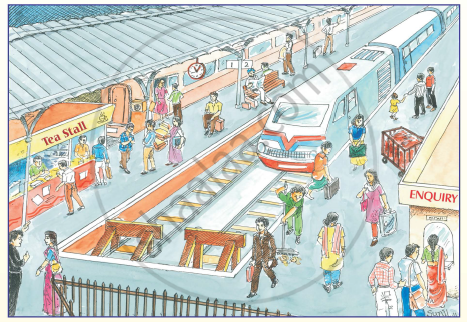
Look at the incomplete sentences below. Using the information provided, complete each sentence using a suitable tense. Follow the examples:
1947 until now India I has been (be) independent since 1947.
1947 India became (become) independent in 1947.
1. 1947 until now l There --------- (be) manywars.
2. 1991 There ------- (be) a war in the Persian Gulf.
3. 1953 -------- Edmund Hilary and Tensing first (climb) Everest.
4. 1953 until now Many people ________ (climb)Everest.
5. 1983 India --------- (win) the Prudential Cricket World Cup in England.
6. 1983 until now India -------- (win) many limited-overs cricket trophies.
Carefully study each of the following events or situations described in a set of three sentences/phrases. Then, write a short paragraph to describe each event/situation as shown in the example. Your paragraph should begin with the description of the second event in each case. Use the verb form had+ past participle to describe the earliest of the past events.
|
• Somebody burgled the office on Sunday night. • Our arrival at work on Monday morning . • Police informed |
We arrived at work on Monday and found that somebody had burgled the office the previous night. So, we immediately informed the police. |
|
• (I) Mayank went out with his family. (ii) I tried to phone him this morning. (iii) His servant answered. |
I tried to phone Mayank this morning but the servant ........................................... ........................................... |
|
• (i) Rohit returned from holiday.(ii) Jayanti met Rohit. |
Jayanti met Rohit, who ........................................... ........................................... |
|
• (I) All the arrangements were finalised for the seminar. (ii) The seminar participants arrived in Gangtok. (iii) Met the professors from the UK the same evening. |
The participants arrived in Gangtok. They found ........................................... ........................................... |
Now write short paragraphs to describe the trends in the other groups of visitors featured in the graph.
• Overseas Visitors
....................................................
....................................................
• Domestic Visitors
....................................................
....................................................
• Total Number ofVisitors
....................................................
....................................................
Use the correct tense form of the verb given in the bracket and rewrite the sentence.
She ______ like a dressmaker’s dummy standing there.
Name the Tense of the Verb underlined to include Time (Past/Present/Future) and Aspect (Simple/Continuous/Perfect/Perfect Continuous).
You haven’t found it.
Name the Tense of the Verb underlined to include Time (Past/Present/Future) and Aspect (Simple/Continuous/Perfect/Perfect Continuous).
We were designing the first Macintosh computer.
Change the Tense as instructed.
The dots will somehow connect. (Past Perfect)
Change the Tense as instructed.
My doctor advised me. (Past Perfect Continuous)
Rewrite the sentence as per the instruction given along with it.
The mother langur looked straight into my eyes.
(Rewrite the sentence in the Simple Present Tense)
Rewrite the sentence as per the instruction given along with it.
I took the baby langur to our backyard.
(Rewrite the sentence in the Past Perfect Tense)
Underline the verb and choose the correct option from the options.
Today Sanjay found a new book.
(present tense/past tense)
Underline the verb and choose the correct option from the options.
Rahul finds Maths easy.
(present tense/past tense)
Read the following sentence carefully, underline the verb and find out the tense in the sentence.
The sun was now ascending the sky.
Read the following sentence carefully, underline the verb and find out the tense in the sentence.
She is standing on a little high hump on the plateau.
Frame sentences using the homograph to show the difference in their meanings:
Train
Rewrite the sentence in future tense:
I am doing it.
