Advertisements
Advertisements
प्रश्न
Look at the incomplete sentences below. Using the information provided, complete each sentence using a suitable tense. Follow the examples:
1947 until now India I has been (be) independent since 1947.
1947 India became (become) independent in 1947.
1. 1947 until now l There --------- (be) manywars.
2. 1991 There ------- (be) a war in the Persian Gulf.
3. 1953 -------- Edmund Hilary and Tensing first (climb) Everest.
4. 1953 until now Many people ________ (climb)Everest.
5. 1983 India --------- (win) the Prudential Cricket World Cup in England.
6. 1983 until now India -------- (win) many limited-overs cricket trophies.
Advertisements
उत्तर
- have been
- was
- climbed
- have climbed
- won
- has won
APPEARS IN
संबंधित प्रश्न
Change the following sentence into simple sentence.
Einstein smiled and put his arm across my shoulder.
Complete the following sentences with the appropriate forms of the given verbs.
1. Every day I(go) to school in a bus but today I (go) by car because the bus operators are on strike.
2. "Baichung Bhutia (pass) the ball to Bannerjee; Bannerjee (take) a shot at the goal but it (be) way above the goal post. The Indians (attack) much more now ... "
3. I (think) you (make) a mistake by signing this contract.
4. The doctor (say) mother (respond) to the treatment well.
5. Farzana (be) not well. She (not come) to school today.
Study the following picture carefully and then write a paragraph to describe what is happening.
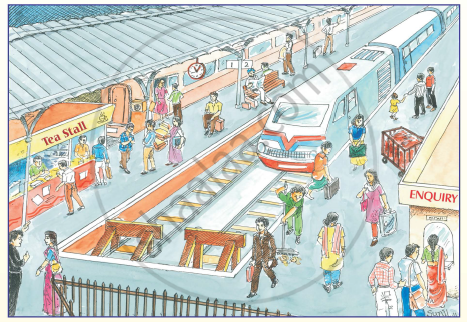
The present perfect is often used with the following time expressions:
until now for many years
so far over the last few years
lately in the past few months
not yet since20xx
recently
in recent years
Choose five of these time expressions and make sentences about interesting
items of news concerning yourself.
------------------------------------------
------------------------------------------
Now make groups of four, and tell (not read) each other your news.
Complete the following sentences correctly by using the simple past or
past perfect forms of the given verbs.
1) We ____ already (reach) home when Irlan __ (say) that he (forget) his books at school.
2) Wendy (wake up) late, then she ____ (miss) her school bus, so by the time she (reach) school, it already (start).
3) I ___ (visit) my town again ten years after I _____ (leave) it and ___ (find) thatit completely (change).
4) When Feroze and Mehr (meet) for the first time, they ___ _ (not like) each other but now they are married.
Now write short paragraphs to describe the trends in the other groups of visitors featured in the graph.
• Overseas Visitors
....................................................
....................................................
• Domestic Visitors
....................................................
....................................................
• Total Number ofVisitors
....................................................
....................................................
Tenses -Summary
Read the biodata of Sangeeta Rani Puri, India's swimming sensation. Then, complete the interview in the spaces provided. Do NOT add any extra information. Use appropriate tenses.
|
Natne : Sangeeta Rani Puri Status : Non-resident Indian Place of Birth : Trinidad Place of Residence : USA Parents : Raj Krishna Puri (Father) -fatnous immigration lawyer Moyna Margaret Puri (mother) - (from Trinidad) Achievements records : i) six new national records in five day (Junior National Swimming Meet, Vijaywada) |
Interviewer: Sangeeta, since you were in India for only a short while before
you flew to Atlanta, would you tell us a little about yourself?
Sangeeta : Well, I'm an Indian and I'm proud to be one.
I: Please tell us about your parents.
S: My father ____________________
_______________________ from Trinidad.
I: Have you taken part in any of the National Championships?
S: (Very excited) Yes,_________at Vijaywada.
I: How ______________________________________________ Senior Nationals?
S: I won seven events and __________
I: How do you rate your performance in the Altanta Olympics in 1996?
S: I ___________________________ in the 50 metres freestyle. It's true that I _____________in Atlanta. But _____________________
I: Haveyou ___________________ forthefuture?
S: I in the USA. And of course I ____________for as long as possible. Also I _______________________ in the olympics.
I: Thank you, Sangeeta. I wish you all the best.
S: Thankyouverymuch.
Work with apartner
In the following sentences, choose and circle the verb form you think best fits the meaning of each sentence. You have been provided an example.
| 1. Tomorrow | is will be is going to be | Wednesday. |
| 2. The train | has left will have left is going to leave | by the time you reach the station. |
| 3. Hurry! The film | does will is about to | start. |
| 4. The Minister | opens is opening is about to open | the new Art Centrenext week. |
| 5. This time next year, he | will live is living will be living | in Mumbai. |
| 6. I | am going to be will be will have been | a nurse when I grow up |
Use the correct tense form of the verb given in the bracket and rewrite the sentence.
She ________ that old fashion book of her mother a few months back.
Use the correct tense form of the verb given in the bracket and rewrite the sentence.
All this ________ destroyed in a few years.
Name the Tense of the Verb underlined to include Time (Past/Present/Future) and Aspect (Simple/Continuous/Perfect/Perfect Continuous).
It had made all the difference.
Spot the error and correct the following sentence.
My grandparents laid down for an afternoon nap.
Underline the verb and choose the correct option from the options.
Preeti even wrote about it.
(present tense/past tense)
Underline the verb and choose the correct option from the options.
Today Sanjay found a new book.
(present tense/past tense)
Underline the verb and choose the correct option from the options.
Preeti was scornful.
(singular/plural)
Rewrite the sentences in present perfect tense:
I had been working for Anil for almost a month.
Rewrite the sentence in future tense:
I am doing it.
